

In today’s highly competitive bag manufacturing industry, speed alone is no longer enough. You are expected to deliver large volumes, maintain consistent quality, control costs, and still respond quickly to changing market demands. However, many manufacturers discover that one specific process repeatedly becomes a bottleneck: eyelet and snap installation.
This case study shows how a typical bag manufacturer transformed its production line by upgrading to QC Machinery’s automatic Eyelet Machines. By replacing manual and semi-automatic processes with a fully automated solution, you’ll see how measurable improvements in efficiency, quality, and cost control were achieved—and how similar results may be possible for your own factory.
The Hidden Efficiency Challenge in Bag Production
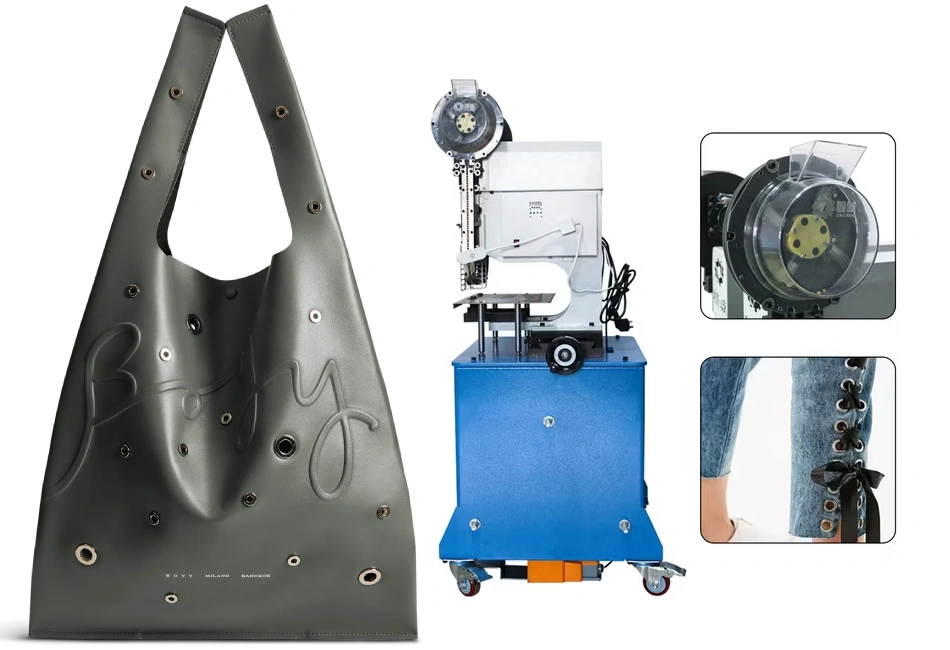
If you operate a bag manufacturing facility, you are likely familiar with the challenges of eyelet and snap installation. Whether you produce backpacks, handbags, luggage, or outdoor gear, this process plays a critical role in both product function and appearance.
In this case, you are a mid-sized bag manufacturer supplying international brands. Your factory handles leather, canvas, and synthetic fabrics, producing several bag models that all require eyelets or snaps. Despite having modern cutting and sewing equipment, you still rely heavily on manual or semi-automatic eyelet machines.
Over time, several problems become impossible to ignore:
- Production speed cannot keep up with increasing order volumes
- Quality inconsistencies appear between operators and shifts
- Skilled labor is difficult and expensive to retain
- Machine downtime increases during peak seasons
- Delivery deadlines become harder to meet
You face a critical question:
How can you increase output without sacrificing quality or driving labor costs even higher?
The answer, as this case study demonstrates, lies in upgrading to a fully automated Eyelet Machine from QC Machinery.
Understanding the Role of Eyelet Machines in Bag Manufacturing
Before examining the solution, it is important to clearly understand what an Eyelet Machine does within your production process.
In the QC Machinery context, an Eyelet Machine is a specialized automated device designed to install eyelets, snaps, rivets, or similar fasteners into materials such as leather, fabric, canvas, or synthetic composites. These machines are widely used in:
- Bag and luggage manufacturing
- Footwear production
- Outdoor and sports equipment
- Fashion accessories
The machine’s core value lies in its ability to perform high-speed, precise, and repeatable riveting, which manual processes simply cannot match at scale.
The Initial Situation: Bottlenecks, Labor Pressure, and Inconsistent Quality
At the start of this case study, your bag production line relies on a mix of manual placement and semi-automatic riveting machines. While these machines function adequately at low volumes, problems become severe during peak demand.
Key Challenges You Face
1. Low Throughput at the Eyelet Station
Manual feeding limits how fast operators can work. Even experienced workers struggle to maintain consistent speed throughout long shifts.
2. Quality Variations
Eyelets may be misaligned, under-pressed, or damaged, leading to rejected products and rework.
3. High Labor Dependency
The process depends heavily on skilled operators. Training new workers takes time, and staff turnover disrupts production.
4. Frequent Downtime
Jams, misfeeds, and inconsistent material handling cause repeated machine stoppages.
5. Rising Costs
Labor costs per unit increase, and missed delivery deadlines risk damaging customer relationships.
At this stage, incremental adjustments no longer solve the problem. You need a structural upgrade, not a temporary fix.
The Turning Point: Introducing QC Machinery’s Eyelet Machine
To address these challenges, you decide to integrate QC Machinery’s automatic Eyelet Machine into your production line.
This decision is not based solely on machine specifications, but on how well the equipment aligns with your real production needs.
QC Machinery’s Eyelet Machines are designed with several defining characteristics that directly target your pain points:
- Fast and stable riveting speed
- Automatic feeding with orderly material arrangement
- Easy operation with minimal training requirements
- Wide application across different bag materials
Rather than treating the eyelet process as a minor step, the machine transforms it into a high-efficiency, controlled operation.
Solution Breakdown: How the Eyelet Machine Solves Your Production Problems
Full Automation of Feeding and Riveting
One of the most significant improvements comes from automatic feeding.
The Eyelet Machine features:
- A material tray with uniform rotation speed
- A raceway where eyelets are arranged in an orderly manner
This design ensures that eyelets are delivered to the riveting position continuously and correctly oriented.
What this means for you:
- No more manual placement
- No more hesitation or rhythm breaks
- No more feeding-related jams
As a result, your production line achieves a smooth, uninterrupted workflow.
Fast and Stable Riveting for High-Volume Orders
The machine’s fast and stable riveting speed allows you to dramatically increase throughput without sacrificing precision.
Unlike manual processes, the machine delivers:
- Consistent pressure
- Uniform installation depth
- Repeatable results across thousands of cycles
For you, this means every bag—whether it is the first or the ten-thousandth—meets the same quality standard.
Easy Operation Reduces Training and Labor Costs
One major concern when upgrading equipment is operator training. QC Machinery addresses this directly by designing machines that are easy to operate.
You find that:
- New operators can be trained quickly
- The machine interface is intuitive
- Fewer adjustments are required during operation
This reduces your dependency on highly skilled labor and allows you to reassign experienced workers to higher-value tasks.
Stability and Durability Under Continuous Operation
Bag manufacturing often involves long production runs, especially during peak seasons. QC Machinery’s Eyelet Machines are built to handle continuous, high-load operation.
Thanks to strict quality control and complete machine assembly testing:
- Machine stability improves
- Unplanned downtime decreases
- Maintenance becomes more predictable
For you, this translates into greater confidence when committing to large orders and tight delivery schedules.
Measurable Results: What Changed After Implementation
After integrating QC Machinery’s Eyelet Machine into your production line, the improvements are both immediate and measurable.
Production Efficiency
Your daily output increases by approximately 40%, simply because the eyelet process no longer slows down the entire line.
Quality Performance
Defect rates related to eyelet installation drop significantly. Misaligned or damaged eyelets become rare, reducing rework and scrap.
Labor Cost Reduction
With automation in place:
- Fewer operators are required at the eyelet station
- Training time decreases
- Labor cost per unit drops noticeably
Improved Delivery Reliability
With stable, predictable output, you can confidently meet delivery deadlines—even during seasonal demand spikes.
Operational Flexibility: Handling Different Bag Styles with Ease
Another key advantage you experience is production flexibility.
QC Machinery’s Eyelet Machines are suitable for:
- Paper bags
- Leather bags
- Luggage
- Canvas and synthetic materials
This versatility allows you to switch between different bag styles and materials without major reconfiguration. As product lines change, your equipment adapts instead of holding you back.
A Partner, Not Just a Machine Supplier
One reason this upgrade succeeds is that QC Machinery does not position itself as a simple equipment vendor.
With over 15 years of industry experience, the company offers:
- Engineering-driven solutions
- In-house development capabilities
- Comprehensive quality control processes
- Customization options based on your materials and production goals
For you, this means ongoing support rather than a one-time transaction.
Customer Perspective: A Production Manager’s Reflection
“Before upgrading, the eyelet process was always our weakest link. Now it’s one of our most stable stations. Output increased, quality improved, and our operators feel less pressure. The Eyelet Machine completely changed how we manage production.”
This type of feedback reflects a broader truth: automation does not just improve numbers—it improves daily operations.
Why Eyelet Machines Are a Strategic Investment
From your experience, one conclusion becomes clear: upgrading to an automatic Eyelet Machine is not merely an equipment purchase. It is a strategic decision.
It helps you:
- Increase competitiveness
- Control costs
- Protect product quality
- Scale production with confidence
In an industry where margins are tight and customer expectations are high, these advantages are critical.
FAQ
Why are Eyelet Machines so important in modern bag production?
Eyelet Machines play a critical role in ensuring both functional strength and visual consistency in bags. By automating eyelet and snap installation, these machines eliminate manual variability, increase production speed, and ensure every eyelet is installed with uniform pressure, which is essential for high-volume, quality-focused bag manufacturing.
How does an automatic Eyelet Machine improve production efficiency?
An automatic Eyelet Machine combines continuous feeding with fast, stable riveting. This allows you to install eyelets without stopping for manual placement, significantly increasing output. As shown in this case study, automation can boost overall production efficiency by up to 40 percent in real manufacturing conditions.
Can Eyelet Machines handle different bag materials and designs?
Yes, Eyelet Machines are designed to work with a wide range of materials, including leather, canvas, synthetic fabrics, and paper-based materials. With proper configuration, the same machine can support different bag designs, eyelet sizes, and thicknesses, offering excellent flexibility for multi-product manufacturing lines.
How do Eyelet Machines help reduce labor costs and operator dependency?
By automating both feeding and riveting, Eyelet Machines significantly reduce reliance on highly skilled operators. Training time is shorter, fewer workers are needed per shift, and production quality remains consistent regardless of operator experience, leading to lower labor costs and more stable workforce management.
What impact do Eyelet Machines have on product quality and defect rates?
Eyelet Machines deliver precise, repeatable installation with consistent pressure and alignment. This greatly reduces common defects such as loose, tilted, or damaged eyelets. As a result, manufacturers experience fewer rejected products, less rework, and improved overall product appearance and durability.
Conclusion
This case study shows that when you address bottlenecks with the right technology, the impact extends far beyond one workstation.
By implementing QC Machinery’s Eyelet Machine, you transform:
- A labor-intensive process into an automated one
- An inconsistent operation into a stable system
- A production limitation into a growth opportunity
If you are facing similar challenges in bag production, now may be the right time to evaluate your eyelet and snap installation process.