

When you look at a finished shoe, your eyes are naturally drawn to the silhouette, the upper material, or the sole design. Yet one of the smallest components—the shoe eyelet—plays a disproportionately large role in durability, performance, and perceived quality.
As a footwear manufacturer, product developer, or factory manager, you already know this truth: failure around the lace holes often leads to early product returns, customer complaints, and brand damage. Shoe eyelets are not decorative afterthoughts. They are structural reinforcement systems engineered to protect the upper, distribute stress, and maintain consistent lacing tension throughout the shoe’s life cycle.
In today’s highly automated footwear industry, expectations have changed. You are no longer competing only on design or price. You are competing on precision, repeatability, production speed, and long-term reliability. That is why understanding shoe eyelets industrial production methods—from raw material processing to fully automatic installation—is essential for your factory’s success.
This article walks you through the entire industrial journey of shoe eyelets, explaining how they are manufactured, how they are installed using automatic eyelets machines, and how modern trends are reshaping this critical process.
The Core Value of Shoe Eyelets and Their Functional Diversity
Before you focus on machines or production lines, you need to clearly understand what shoe eyelets actually do and why their design directly impacts your manufacturing outcomes.
1.1 Function Beyond Decoration
At an industrial level, shoe eyelets serve three primary mechanical purposes:
- Structural reinforcement
You use shoe eyelets to reinforce lace holes by clamping the upper material between a front flange and a rolled or riveted barrel. This prevents tearing, elongation, and deformation under repeated tension. - Stress distribution
Instead of allowing lace forces to concentrate on a small cut edge, the eyelet spreads load across a wider surface area. This significantly increases upper longevity, especially in leather, synthetic, and textile materials. - Wear resistance
Shoe laces constantly rub against the inner surface of the lace hole. Eyelets act as a sacrificial, wear-resistant interface that protects the upper material from abrasion.
From a production perspective, this means one thing: inconsistent or poorly installed eyelets will fail long before the shoe reaches its designed lifespan.
1.2 Main Types of Shoe Eyelets and Material Selection
You typically select shoe eyelets based on application, cost targets, and performance requirements. The table below summarizes the most common industrial categories:
| Type | Common Materials | Key Characteristics | Typical Applications |
|---|---|---|---|
| Metal Eyelets | Brass, Stainless Steel, Aluminum Alloy, Zinc Alloy | High strength, excellent durability, corrosion resistance | Work boots, outdoor shoes, premium sports shoes, leather dress shoes |
| Plastic Eyelets | Nylon, Polyester | Lightweight, low cost, wide color options | Children’s shoes, casual footwear, fast-fashion products |
| Decorative Eyelets | Metal base with surface treatments | Visual appeal, premium finishes (PVD, antique) | Fashion footwear, luxury shoes |
Material selection directly affects your automation compatibility.
For example, brass remains the industry’s gold standard because it combines corrosion resistance, ductility, and dimensional stability—ideal traits for automatic eyelets machines.
From Metal Coil to Precision Eyelet – Industrial Stamping Processes
Once you define material and design, industrial production begins. Shoe eyelets are not machined one by one; they are produced in massive volumes using high-speed precision stamping technology.
2.1 Deep Drawn Stamping: The Core Manufacturing Method
Most metal shoe eyelets are produced using deep drawn stamping, a process perfectly suited for cylindrical and cup-shaped components.
Here is how you typically manufacture them:
- Material feeding
You start with metal coils—usually brass or stainless steel—mounted on a decoiler. The strip is straightened and fed into the press with extreme precision. - Progressive forming
Inside the stamping press, a progressive die performs multiple operations in sequence:- Blanking
- Deep drawing
- Flange forming
- Barrel trimming
- Final cutoff
- Finished separation
With each press stroke, one or more finished eyelets are produced and separated from the strip.
This process allows you to achieve micron-level consistency, which is absolutely critical for automated installation later.
2.2 Automated Production Line Configuration
A modern shoe eyelet stamping line typically includes:
- Decoiler and straightener
- High-precision servo feeder
- High-speed punch press (25–60 tons common range)
- Progressive stamping die
- Automatic collection system
When properly configured, such a line can produce tens of thousands of identical eyelets per hour, ensuring stable supply for fully automated shoe assembly lines.
For you as a manufacturer, this consistency is not optional—it is what keeps your automatic eyelets machine running without jams or misfeeds.
Automatic Eyelets Machine – The Heart of Modern Installation
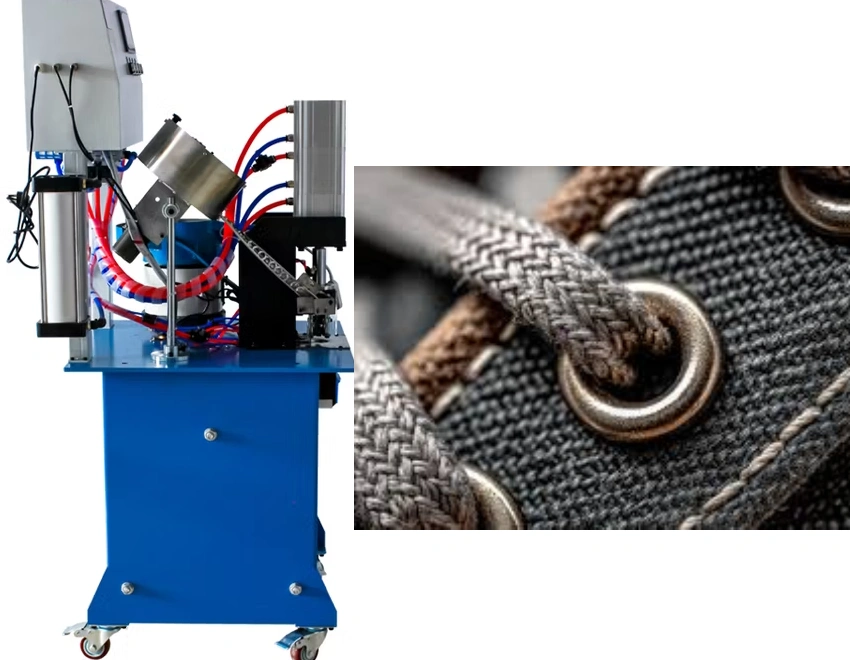
Producing eyelets is only half the story. Installing them efficiently, accurately, and repeatably is where modern footwear factories gain a real competitive advantage.
3.1 How an Automatic Eyelets Machine Works
An industrial automatic eyelets machine integrates mechanics, pneumatics, and control systems into a single workflow:
- Upper positioning and clamping
You load the shoe upper or component onto the worktable. Pneumatic or mechanical fixtures hold it in the correct position. - Automatic feeding
Eyelets are loaded in bulk into a hopper. A vibratory bowl or mechanical feeder orients and delivers individual eyelets to the setting station. - Punching and setting in one stroke
The machine simultaneously:- Punches a clean hole in the upper
- Inserts the eyelet barrel
- Rolls or rivets the barrel from the backside
- Quality-consistent output
Each cycle produces uniform flange pressure, consistent barrel expansion, and clean material edges.
Compared to manual tools, this process eliminates operator variability and dramatically increases throughput.
3.2 Evolution Toward Fully Automated and Intelligent Systems
Modern factories no longer rely on semi-automatic machines. Advanced automatic eyelets machines now offer:
- Vision positioning systems
Cameras identify lace hole locations and compensate for material stretch or deformation. - Multi-station rotary tables
You can install different eyelet sizes on the same shoe without manual tool changes. - IoT and data monitoring
Production counts, downtime, and alarms are tracked in real time for predictive maintenance.
However, you must remember one critical rule:
Even a 0.1 mm deviation in eyelet dimensions can cause feeding failures.
This is why machine builders and eyelet suppliers must work closely together—a principle emphasized in professional automation solutions like those provided by https://qcmachinery.com/.
Industry Trends, Challenges, and Future Direction
The footwear industry continues to evolve, and shoe eyelet production is evolving with it.
4.1 Material Innovation and Surface Treatments
You are seeing increasing demand for:
- Lightweight aluminum alloys
- High-performance engineering plastics
- Eco-friendly electroplating
- PVD coatings with high wear resistance
These innovations help you meet regulatory requirements such as REACH while delivering premium aesthetics.
4.2 Integration with Knit and Smart Uppers
With knit uppers becoming mainstream, traditional punching methods are challenged. New approaches include:
- Reinforced knit zones woven directly into lace areas
- Ultrasonic bonding for special eyelet designs
- Hybrid reinforcement structures
These methods reduce weight and increase comfort while maintaining durability.
4.3 Flexibility for Small-Batch Production
Fast fashion and customization require machines that adapt quickly. Future-ready automatic eyelets machines focus on:
- Rapid tool change systems
- CAD-driven programming
- Reduced setup time from hours to minutes
This flexibility allows you to remain competitive even with smaller, high-mix orders.
Conclusion
From raw metal coil to precision-installed reinforcement, the journey of a shoe eyelet reflects the best of modern manufacturing: materials science, precision engineering, and automation working together.
When you understand this process deeply, you gain more than technical knowledge. You gain the ability to:
- Reduce defects and returns
- Increase production efficiency
- Protect brand reputation
- Scale automation confidently
By choosing reliable, automation-ready solutions—such as the **automatic eyelets machines and industrial systems offered by https://qcmachinery.com/**—you position your factory for long-term success in an increasingly competitive footwear market.
Small components matter. When you engineer them correctly, they become silent contributors to quality, efficiency, and trust.