
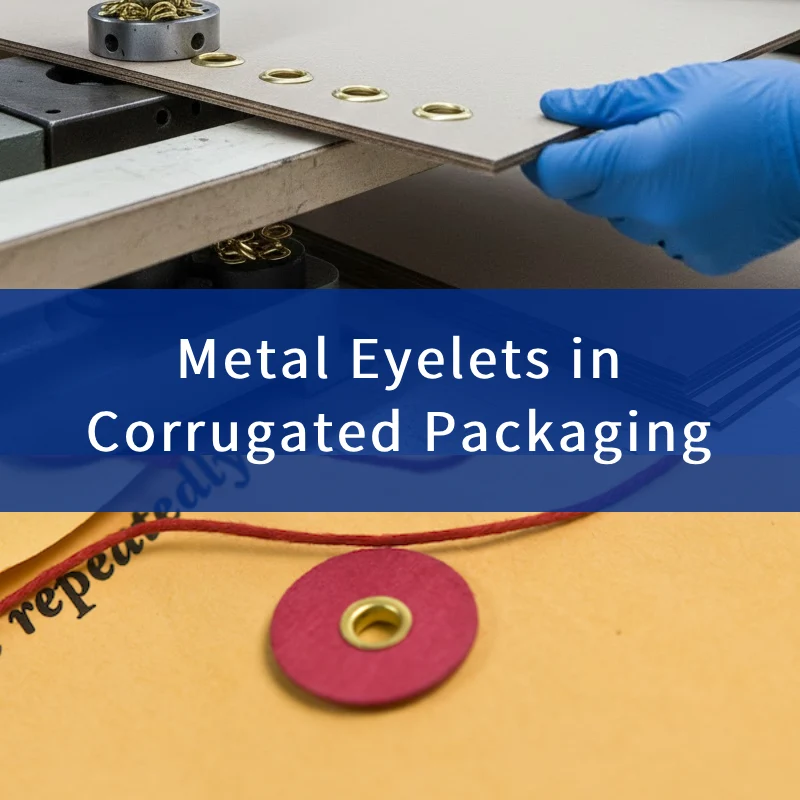
Everyone is switching to recycled paperboard and corrugated packaging. The marketing departments love it. It photographs well. It checks the sustainability box. It tells the customer that your brand cares about the planet.
But on the factory floor, it is causing a quiet crisis.
Recycled fibers are shorter than virgin pulp. They have been through the process once already. They have less spring, less integrity, less ability to recover from impact. When a standard eyelet machine—designed for virgin board, fabric, or leather—slams a metal barrel through recycled corrugated, the material does not cooperate. It collapses. The middle layer, the fluting, compresses like a stepped-on cardboard box. The eyelet sits in a depression instead of flush against the surface. The washer spins freely. The closure fails.
I have stood in packaging facilities and watched operators slow down their machines manually, feathering the pedals, trying to find the exact pressure that crushes the board just a little less. I have seen QC inspectors reject ten, fifteen, twenty percent of finished pieces because the eyelets are recessed or the liners are torn. I have heard production managers say, “It’s just the material,” as if that ends the conversation.
It does not end the conversation. The material is not going back to virgin fiber. The trend is only moving one direction: more recycled content, lighter weight boards, lower costs. The problem is not the paper. The problem is the machine.
At Qingdao QC Machinery, we have spent fifteen years building equipment that solves problems like this. Not selling machines—building them. We have a five-thousand-square-meter factory, fifty mechanics, seven senior engineers. We do not buy components from a catalog and bolt them together. We design our own vibrating plates, our own raceways, our own voltage stabilization systems. We hold the patents. We write the code. When a customer brings us a material that crushes, tears, or rejects, we do not quote them a generic machine and hope for the best. We engineer a solution.
This article is about that engineering. It is about why recycled paperboard crushes, what actually happens inside the material during eyelet insertion, and how the right machinery transforms a chronic defect into a non-issue.
Understanding the Anatomy of the Crush
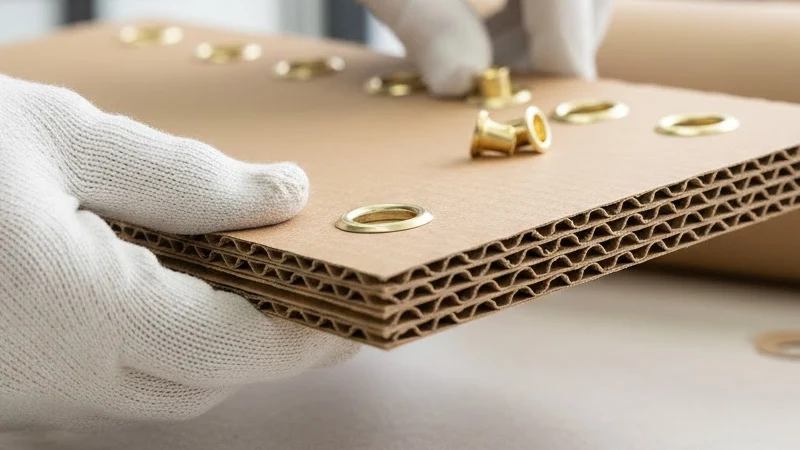
Corrugated board is not solid. This is the first thing you have to understand. It is a sandwich: two flat liners with a fluted medium in between. The strength comes from the arch structure of those flutes. When you apply downward force to insert an eyelet, you are compressing those arches. Virgin board, with its long, strong fibers, springs back. The flutes recover most of their original shape.
Recycled board does not.
The fibers are shorter. They have been broken down, reformed, and dried once already. The arches are weaker. When you apply the same force, they do not spring back. They stay compressed. The result is a visible depression around the eyelet. The eyelet sits below the surface of the board. The back washer, instead of gripping a flat plane, is trying to clamp onto a concave dish. It cannot get purchase. It spins. The closure is useless.
Standard semi-automatic eyelet machines make this worse because they were designed for different materials. Fabric stretches. Leather deforms and recovers. Thin paper has no middle layer to crush. These machines use a single, hard impact—a quick strike that flares the barrel in one fast motion. That works when the material can absorb the shock. It does not work when the material collapses.
The failure modes are distinct. You can walk a production floor and identify them immediately:
Flute collapse is the depression. You run your finger over the eyelet and feel a dip. The board around the fastener is thinner than the surrounding area.
Liner tear happens at the punch stage. Recycled fibers are brittle. Instead of cutting cleanly, they sometimes tear, leaving a ragged edge. The eyelet covers it, mostly, but the tear can propagate under tension.
Washer spin is the functional failure. The eyelet is set, but the back washer rotates freely. The customer picks up the product, twists the cord, and the whole assembly pulls loose.
Delayed failure is the worst because it passes inspection. The eyelet looks fine on the line. But after shipping, after handling, after the box has been moved from warehouse to truck to retail floor, the compressed fibers relax further. The washer loosens. The closure fails in the customer’s hand.
None of these are material defects. They are machinery mismatches.
The QC Machinery Approach: Engineering, Not Guesswork
There is a difference between a machine builder and a machine seller. We are the former.
When you buy from an import-export company, you are buying whatever the supplier in Zhejiang or Guangdong shipped that month. If it works on your material, good. If it crushes your material, you adjust your process to accommodate the machine.
We operate the other way. We adjust the machine to accommodate your material.
This is only possible because we control the entire manufacturing process. We handle sheet metal fabrication, pressure mechanisms, circuit board design, microcontroller programming, and complete assembly. When a customer says, “The board is crushing,” we do not call a supplier and ask if they have a different die. We go to our engineering team and modify the die geometry ourselves.
Our voltage stabilizing performance is a good example of why this matters. Voltage fluctuations cause pressure fluctuations. If your machine surges, your pressing force varies from cycle to cycle. Some eyelets get full force, some get less. On virgin board, the variation is within tolerance. On recycled board, variation means some pieces crush and some do not. You cannot find the sweet spot because the machine keeps moving the target.
We designed our stabilization system specifically to eliminate this variable. The feeding speed stays consistent. The riveting force stays consistent. Not most of the time. Every cycle.
The vibrating plate is another component we refuse to outsource. We design our own. This is not a vanity project. It is because feeding consistency determines alignment consistency. If the eyelet arrives at the die at a slightly different angle on cycle 5,000 than it did on cycle 50, the force distribution changes. Force concentrates on one edge of the barrel. That edge punches through the liner instead of flaring cleanly. The board tears. The piece rejects.
Our raceways are engineered for fluent transfer. The eyelets do not tumble, jam, or hesitate. They arrive at the exact same orientation, at the exact same speed, ten thousand times per shift.
And when that is still not enough—when the customer’s material is unusual in thickness, density, or composition—we customize. Our FAQ states this clearly: we provide customized machines per client requests. For paperboard applications, that usually means three specific modifications.
First, reduced impact force with extended dwell time. Instead of one hard strike, the die applies gentler pressure over a longer period. The barrel rolls gradually rather than flares abruptly. The board compresses slowly and has time to redistribute stress.
Second, modified die angles. The geometry of the die determines how the barrel folds. A sharper angle flares fast, which works for thin materials. A shallower angle rolls the barrel more gradually, which is kinder to fragile substrates. We grind our own dies. We can change the angle in increments of one degree.
Third, dual-head configurations. Some packaging requires eyelets on opposite sides of a box or bag. If you insert them sequentially, the first eyelet is already set when you apply pressure to the second. That unbalanced force can distort the panel. Dual-head machines insert both eyelets simultaneously, with identical pressure. The stresses cancel. The board stays flat.
Machine Specifications That Matter for Paperboard
Every eyelet machine spec sheet lists voltage and net weight. Those numbers are table stakes. They tell you almost nothing about whether the machine will crush your material.
Here is what actually matters.
Working speed versus controlled speed. Our QC54222 semi-automatic eyelet machine is rated at 80 to 120 cycles per minute. That is the maximum mechanical speed. But we do not sell maximum speed. We sell controlled speed. The machine is capable of high volume when the material can handle it. It is equally capable of running at sixty cycles with reduced pressure when the material is fragile. The same machine that punches through five-layer corrugated can also set eyelets in thin paperboard without crushing. That versatility is the result of in-house engineering, not off-the-shelf components.
Throat depth. Our QC54222 has a throat depth of 180 millimeters. In practical terms, this determines how far into a box panel you can reach. Many packaging applications require eyelets set away from the edge—six inches, eight inches, more. Standard machines with shallow throats force you to fold or crush the box to access the insertion point. You are damaging the package before you even set the fastener. Adequate throat depth means you insert the eyelet where it belongs, not where the machine forces you to put it.
Net weight and structural rigidity. Our machine weighs 42 kilograms. This is not a lightweight desktop unit. It is heavy enough to absorb vibration and maintain die alignment through tens of thousands of cycles. Vibration causes die drift. Die drift causes off-center punching. Off-center punching causes one side of the eyelet to flare unevenly. Uneven flare tears recycled liners. Weight is not just shipping cost. It is precision.
Dual-head configurations. Our double-head clamping machines are referenced on our main product page. They are not simply two machines bolted together. The head spacing is adjustable. The pressure synchronization is electronic, not mechanical. Both heads fire at exactly the same millisecond, with exactly the same force. For paper bag and corrugated applications requiring symmetrical eyelet placement, this is the difference between a balanced panel and a warped one.
Material Considerations: Brass Eyelets for Paperboard
Brass is not the cheapest metal. It is not the hardest. But for paperboard packaging, it is often the correct choice.
Brass is corrosion-resistant. This matters if the packaged goods are stored in humid warehouses, transported through varying climates, or displayed in retail environments with high foot traffic and open doors. A rusted eyelet ruins the presentation and compromises the closure.
More importantly, brass is malleable. It rolls rather than cracks. When the die flares the barrel, brass bends smoothly. Steel, especially cheaper grades, can split along the barrel seam. That split creates a sharp edge that abrades cords and cuts fingers. Brass yields cleanly.
Our brass eyelets are manufactured to consistent dimensional tolerances. This sounds obvious, but in practice, it is not universal. We have examined eyelets from other suppliers where the barrel diameter varies by two-tenths of a millimeter within a single batch. That variation changes the die interaction completely. An undersized barrel does not flare enough to grip the washer. An oversized barrel requires excessive force to flare, crushing the surrounding board. The eyelet itself becomes a variable in the process.
We eliminate that variable. Our eyelets are dimensionally consistent. When we set up a machine for a customer, we know exactly how much force will be required to flare that specific barrel diameter. We can dial in the pressure once and run for weeks without adjustment.
The finish matters too. Our brass eyelets have a smooth, polished surface. For paperboard applications, smooth finish reduces friction during insertion. Lower friction means lower required force. Lower force means less compression of the corrugated flutes. It is a small detail with measurable consequences.
We also offer robust plastic grommets for applications where metal is overkill—lightweight signage, disposable packaging, low-cost retail goods. But for structural packaging, for boxes that will be handled, stacked, and shipped through industrial supply chains, brass remains the standard. It provides the pull-out resistance that plastic cannot match.
Quality Assurance: How We Prevent Field Failures
Every machine we ship has passed through our quality management system. We are ISO 9001 certified. Most of our products carry CE approval. These are not decorative seals. They represent documented procedures, defined acceptance criteria, and third-party verification.
But certification is not the same as testing.
We test each machine before shipment. For standard applications, this is functional testing—does it feed, punch, flare, eject. For paperboard applications, we go further. We keep samples of customer materials in our factory. When a packaging manufacturer orders a machine configured for recycled corrugated, we run their actual board through our actual dies. We verify that the pressure curve is correct, that the flare geometry is clean, that the washer grips without crushing. We send video documentation.
This is possible because we build to order. Most of our machines do not sit in inventory. When you order, we produce. The lead time is fifteen to thirty days. That is not a limitation; it is a feature. It means your machine is built for your material, not for a generic catalog specification.
Our warranty is twelve months after shipment. We do not view this as a liability limitation. We view it as a statement of confidence. We do not expect our equipment to fail within the first year, even under two-shift operation. If it does, we address it.
And when the warranty period expires, we continue to support. Our after-sales team solves problems with pictures, videos, and detailed instructions. When necessary, our engineers travel overseas for on-site service. We have customers in more than fifty countries. We have visited most of them.
For paperboard applications, this support often takes the form of die adjustment consultations. A customer receives their machine, runs production for a week, and notices that the eyelets are sitting slightly proud or slightly recessed. The board is different from the sample they sent. The humidity has changed. The paper mill changed their formulation. Something has shifted.
We do not say, “That is your problem.” We say, “Show us the flare cross-section. Let us see the board compression. We will grind you a new die and have it on the next flight.” The die is two centimeters of shaped steel. It costs us almost nothing to produce. But it keeps your production line running, and that is the only metric that matters.
Applications: Where This Actually Matters
Paper bags. High-end retail packaging requires eyelets for rope handles. The material is often recycled kraft. The aesthetic expectation is high. A crushed eyelet with a spinning washer ruins the brand presentation. The customer associates the loose handle with cheap quality. Our semi-automatic machines are widely used in this sector because they produce consistent flare without board deformation. The eyelet sits flush. The handle holds. The bag hangs straight on the retail hook.
Corrugated mailers. E-commerce packaging increasingly uses eyelets for tamper-evident closures or hanging displays. The material is typically single-wall corrugated with high recycled content. The failure mode is pull-through—the eyelet tears out of the board during shipping. Prevention requires precise flare geometry. The barrel must roll outward enough to create a mechanical lock, but not so aggressively that it fractures the surrounding fibers. This is a narrow window. Our machines hold it consistently.
Point-of-purchase displays. Retail signage often hangs from pegboards via eyelets. The board is frequently recycled content. The eyelet must sit perfectly flush; a raised edge catches on other products, tilts the sign, and looks unprofessional. Flush seating requires precisely controlled pressure. Too little, and the eyelet sits proud. Too much, and the board crushes, creating a recess. Our voltage stabilization and consistent feeding eliminate the guesswork.
Industrial packaging. Heavy-duty corrugated used for automotive parts, machinery components, and industrial supplies often requires reinforced attachment points. These are not decorative. A handle that pulls loose during transit means a fifty-kilogram part shifts, collides with other parts, and arrives damaged. The repair cost exceeds the packaging cost by orders of magnitude. Structural eyeletting demands repeatable, verifiable insertion strength. Our machines deliver it.
ROI: The Math Behind the Upgrade
The crush problem has a cost. It is not just the rejected piece.
It is the labor already spent on insertion. It is the material cost of the eyelet and washer. It is the value of the package or bag that must be scrapped or reworked. It is the line downtime while the operator clears the jam, adjusts the pressure, or calls the supervisor to inspect another questionable piece.
In facilities running manual or poorly automated equipment on recycled board, the hidden cost is speed reduction. Operators learn that running at full cycle rate increases the rejection percentage. They slow down. They feather the pedal. They position each piece with extra care. Production slows by twenty, twenty-five, sometimes thirty percent below rated capacity.
Our machines maintain rated speed across the entire shift. The voltage regulation ensures consistent pressure. The feeding system ensures consistent alignment. The operator does not need to compensate for machine variability because there is none. They load material and cycle. That is the entire job description.
Tooling life is another factor. Dies that are forced through misaligned or over-compressed materials wear faster. The cutting edges dull. The flare contours erode. Replacement dies from third-party suppliers are expensive and often do not match the original geometry.
We manufacture our own tooling. Replacement dies are available immediately and priced reasonably. More importantly, correct machine setup extends die life by three to five times. When the material is fed consistently and the pressure is calibrated correctly, the die contacts the eyelet at the same angle every time. Wear is uniform and predictable.
The payback period for a QC54222 or dual-head configuration, in a facility running two shifts on paper bag or corrugated packaging, is typically under eight months. That calculation includes waste reduction, throughput recovery, and tooling savings. It does not include the softer benefits—reduced operator fatigue, fewer customer complaints, smoother audit trails—but those exist as well.
The Difference Between a Machine and a Solution
A machine is a collection of components bolted to a frame. It has a motor, a die set, and a pedal. It has a spec sheet and a price. You can buy one from any number of suppliers, and it will arrive in a wooden crate, and you will plug it in, and it will run, more or less, until something breaks.
A solution is different.
A solution begins with someone who understands why your current process is failing. It continues with engineering adjustments—a modified die angle, a recalibrated pressure curve, a custom feed raceway. It includes sample testing, remote support, and the willingness to say, “That is not working, let us try something else.”
This is what we have built at Qingdao QC Machinery over the past fifteen years. We are not the largest manufacturer in China. We are not the cheapest. But we are the manufacturer that treats your material problem as our engineering problem.
If you are processing recycled paperboard or corrugated, and you are fighting the crush problem, you already know that standard solutions do not work. The machine that runs virgin board perfectly will crush your material. The machine that runs fabric beautifully will tear your liners. The machine that your competitor recommended, the one they have been using for years, was not designed for your specific board weight, flute profile, or eyelet diameter.
The solution is not a different catalog. It is a different conversation.
FAQ
Can your semi-automatic eyelet machine handle recycled corrugated board without crushing the flutes?
Yes, but the machine must be configured for the specific board. Our QC54222 and dual-head machines allow pressure adjustment and die customization. We routinely run sample tests with customer materials to verify settings before shipment.
What is the difference between your machine and the inexpensive units on Alibaba?
The difference is in-house engineering and quality control. We design our own vibrating plates, voltage stabilization systems, and raceways. We hold ISO 9001 and CE certifications. We manufacture in our own 5,000-square-meter facility with fifty mechanics. Many low-cost units are traded goods assembled from third-party components with no engineering support.
Do you sell brass eyelets specifically for paperboard applications?
Yes. We supply brass eyelets with consistent dimensional tolerances and smooth finish. Proper die matching is essential; we can recommend the correct eyelet and die combination for your specific board thickness.
Can you customize a machine for my specific package size or eyelet pattern?
Yes. We provide OEM and customized machines per client requests. This includes dual-head spacing adjustments, specialized die profiles, and modified throat depths.
What is your lead time?
Typical production time is fifteen to thirty days, depending on machine size and customization requirements. Most machines are built to order rather than stocked.
Do you offer training and technical support?
Yes. We provide support via pictures, videos, and instructions. Our engineers are available for overseas service visits if required. We also offer on-site installation and operator training with each machine.
What is your warranty?
Twelve months after shipment, covering defects in materials and workmanship.
How do I get started with a sample test?
Contact us via WhatsApp or the inquiry form on our website. We can coordinate material shipping and conduct machine testing at our factory, providing video documentation of the results.