
Marine covers are not indoor curtains. They sit on boats. In the sun. In the salt spray. In the wind.
A cover that fails is not just annoying. It is expensive. The boat owner paid hundreds or thousands for that cover. When the eyelet pulls out, the cover is useless.
Marine covers need different eyelets and different machines. Here is what changes.
What Makes Marine Covers Different
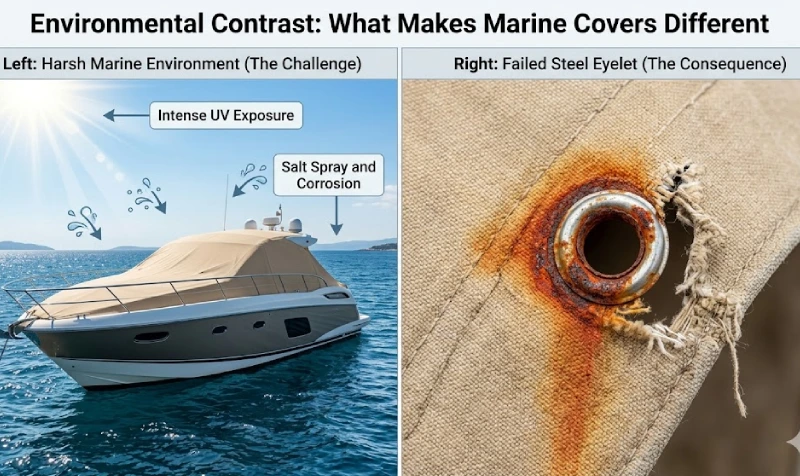
Salt. Salt water corrodes metal. A standard steel eyelet will rust in weeks. The rust stains the cover. The eyelet weakens.
UV. Sunlight breaks down materials. The cover fabric degrades. The eyelet’s plating fades and cracks. Water gets in. Rust starts.
Wind. Marine covers get pulled constantly. Flapping in the wind. Tied down to trailers. The eyelet has to hold.
Heavy fabric. Marine covers use thick, coated materials. Vinyl. Polyester with PVC coating. Acrylic. Standard eyelet barrels may be too short.
Wet installation. Covers are sometimes installed damp. The material swells. The eyelet has to fit correctly on wet and dry material.
A standard eyelet machine setup will fail on marine covers. Quickly.
Eyelet Material: Stainless or Brass Only
For marine covers, do not use steel eyelets. Not even zinc-plated steel. The plating wears off. Rust starts.
Stainless steel (316 grade) is the best choice. Resists salt. Resists UV. Strong. Expensive.
Brass is also good. Resists corrosion. Softer than stainless, so easier to set. Less expensive than stainless.
Aluminum is not strong enough for marine applications. It stretches. It corrodes in salt.
Do not use plain steel. Do not use zinc-plated steel. Do not use nickel-plated steel unless the base metal is brass.
Ask your eyelet supplier: “Is this rated for saltwater exposure?” If they do not know, find another supplier.
Eyelet Barrel Length for Thick Marine Fabric
Marine cover fabric is thick. Vinyl-coated polyester. Acrylic. Heavy PVC.
Standard eyelet barrels are too short. The barrel does not reach through the material. The flare happens in the material, not past it. The eyelet is loose.
Measure your fabric thickness with a caliper. Add 20% for compression. Add the washer thickness. That is the minimum barrel length you need.
Example: Fabric is 2mm thick. Washer is 1mm. Total 3mm. Barrel length should be 4mm minimum.
Test before buying bulk. Run 20 eyelets. Leave them overnight. Check for looseness in the morning.
Machine Requirements for Marine Covers
Marine covers are large and heavy. The machine needs specific features.
Deep throat. Covers are wide. You need to reach far from the edge. 300mm throat depth minimum. 500mm is better.
High force. Thick fabric needs pressure. 3 to 5 tons. A lightweight machine will struggle.
Rigid frame. Marine fabric fights back. The frame must not flex. Cast iron or heavy steel.
Adjustable stroke. Fabric thickness varies. Hemmed edges are thicker than the main panel. Adjustable stroke lets you adapt.
Corrosion-resistant components. The machine itself may be used in marine environments. Look for stainless steel or plated parts. QC Machinery builds for durability, but ask about marine-specific options.
Die Selection for Marine Covers
The die flare profile for marine covers is different than for indoor fabrics.
Gentler flare. Marine cover eyelets are often stainless steel. Stainless is harder than brass. A sharp flare can crack it. Use a gentler, longer flare profile.
Larger washer. Marine covers need bigger washers to distribute load. The die must match the washer size exactly.
Polished die cavity. The eyelet barrel must slide smoothly. Rough cavities cause friction. Friction can damage the barrel coating.
Ask your die maker: “Is this die profiled for stainless eyelets on thick vinyl?” If they are confused, find another die maker.
Preventing Corrosion on the Machine
The machine itself can corrode in marine environments. Salt air gets everywhere.
For pneumatic machines:
- Use an air filter with good water separation. Salt air is humid. Water in the air lines will corrode the cylinder from the inside.
- Cover the machine when not in use. Salt dust settles on everything.
- Wipe down the machine with a dry cloth at the end of each day.
For all machines:
- Keep the die and punch oiled. A light coat of oil prevents rust.
- Do not let moisture sit on the machine. Dry it off.
- Consider a stainless steel die holder if available.
QC Machinery’s machines have painted and plated surfaces. But no machine is fully corrosion-proof. Operator care matters.
Common Marine Cover Eyelet Problems
Problem: Eyelet rusts after a few months
Cause: Steel eyelet used instead of stainless or brass.
Fix: Switch to 316 stainless or marine-grade brass. Pay the extra cost. It is worth it.
Problem: Eyelet pulls out under wind load
Cause: Barrel too short for fabric thickness. Or die cavity too deep.
Fix: Longer barrel eyelets. Shallower die cavity. Test with pull tester.
Problem: Fabric tears around eyelet
Cause: Dull punch tore the fabric. Or die flare too aggressive for the coated material.
Fix: Sharper punch. Gentler flare profile. Test on scrap first.
Problem: Eyelet barrel cracks during setting
Cause: Stainless steel is hard. The die flare profile is too sharp.
Fix: Use a gentler flare die. Reduce pressure slightly.
Problem: Washer corrodes
Cause: Washer is steel. Or plated steel with thin plating.
Fix: Use stainless or brass washers. Match washer material to eyelet material.
Testing Marine Cover Eyelets
Do not skip testing. Marine covers are expensive to replace. A failed eyelet means a failed cover.
Test protocol for marine covers:
- Run 10 eyelets into your actual cover material.
- Pull test each one. Use a pull tester or spring scale. Record the force.
- Soak the test pieces in salt water for 24 hours. Lay them in the sun for a day. Repeat 3 times.
- Pull test again. Compare to the original numbers.
If the pull force drops by more than 20% after salt and UV exposure, your setup is not good enough.
If the eyelet shows any rust, reject the batch.
What QC Machinery Recommends for Marine Covers
QC Machinery serves customers in many industries. Marine covers are a common application.
When a marine cover customer calls, QC Machinery asks:
- What fabric are you using? (vinyl, acrylic, polyester)
- What thickness? (measured with calipers)
- What eyelet material? (stainless, brass, other)
- What is the cover size? (determines throat depth)
They recommend:
- A heavy-duty pneumatic machine with 300mm+ throat depth
- Custom die set for your specific eyelet and fabric
- Carbide punch for longer life on abrasive coated fabrics
- 12 months warranty, with support for overseas customers
They also remind customers: Use marine-grade eyelets. The machine cannot fix a cheap eyelet.
Conclusion
Marine covers are hard on eyelets and hard on machines.
Use stainless or brass eyelets. Steel will rust. Rust stains the cover. The cover fails.
Match barrel length to fabric thickness. Marine fabric is thick. Standard barrels are too short.
Use a gentle flare die. Hard stainless eyelets crack under sharp flares.
Test with salt and UV. Simulate real conditions before shipping covers.
Keep the machine clean. Salt air corrodes. Wipe down daily.
Marine covers cost the customer money. A failed eyelet makes the cover worthless. Do it right the first time. The right eyelets, the right die, the right machine.
FAQ
Q1: Can I use standard steel eyelets for temporary marine covers?
Temporary means weeks, not months. Even then, steel will start to rust. Use stainless or brass.
Q2: What is the best eyelet material for saltwater?
316 stainless steel. It is expensive. It is worth it. Brass is second best.
Q3: Do I need a special machine for marine covers?
A heavy-duty pneumatic machine with deep throat. Same machine as for tarpaulins. With the right dies.
Q4: How do I stop the machine from corroding in a marine shop?
Cover it when not in use. Wipe it down daily. Use an air filter with water separation. Keep it oiled.
Q5: Does QC Machinery make machines for marine applications?
Yes. Their heavy-duty machines are used for tarpaulins and outdoor products. Ask about marine-specific die options.
Q6: How often should I replace dies for marine cover eyelets?
Stainless steel eyelets wear dies faster than brass. Inspect weekly. Replace at first sign of wear.