
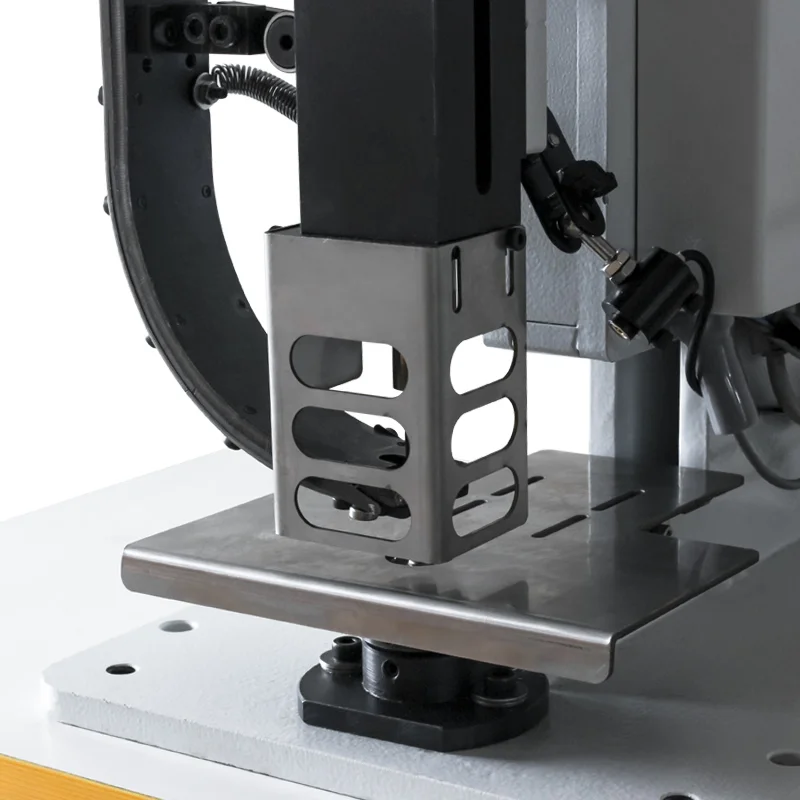
Throat depth looks like a small line on an eyelet machine specification sheet. In production, it can decide whether the machine reaches your eyelet position at all. If the throat is too shallow, you will fold the material, fight the machine frame, or discover that an otherwise suitable machine cannot set the job.
If it is much deeper than you need, you may pay for a larger, heavier frame without gaining useful capacity. That is why understanding how throat depth affects eyelet machine selection should come before you compare speed, feeding systems or price.
The right number comes from your finished product and the way you will present it to the dies. You need to measure the deepest eyelet center from an edge that can actually enter the machine, then allow room for seams, folds, guides, clamps and normal positioning variation. A catalogue number on its own does not tell you whether the material will sit flat or whether your operator can work comfortably.
Quick answer
Throat depth controls reach. Choose a machine whose throat is greater than the farthest eyelet center you must reach from a usable edge, plus real operating clearance. Do not choose from the overall sheet width alone, and do not confuse throat depth with stroke or working height.
What Throat Depth Actually Measures?
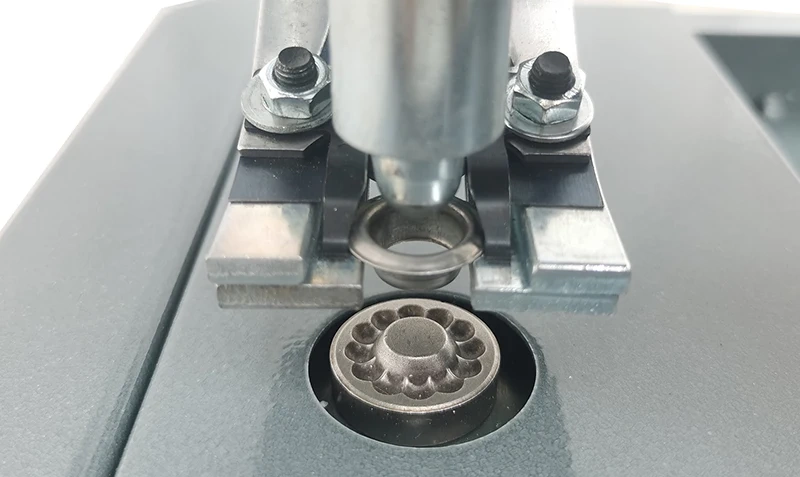
On an eyelet machine, throat depth is the horizontal distance from the centerline of the punch, ram or die station to the nearest rear part of the machine frame that blocks the workpiece. Put simply, it tells you how far you can slide material under the tooling before the material hits the frame.
The measurement should be taken to the eyelet center, not to the outside edge of the eyelet. That distinction matters when you work close to the machine’s limit. A specification of 130 mm means the center of the setting position can be about 130 mm from the accessible material edge; it does not mean a 130 mm-wide flap will automatically fit once you add a raised seam or folded hem.
Throat depth is also different from three other specifications that buyers often mix together:
- Stroke is the vertical travel of the moving tool.
- Working height or daylight is the vertical space available for the material, dies and finished assembly.
- Pressing force is the load available to pierce and set the eyelet correctly.
A machine can have enough stroke and force but still be unable to reach the eyelet position. It can also have a deep throat but too little vertical clearance for a thick, folded or three-dimensional product. You have to check these dimensions together.
How Throat Depth Affects Eyelet Machine Selection?
1. It decides which eyelet positions are physically reachable
Your first question is not how large the product is. It is how far the most difficult eyelet center sits from an edge you can feed into the machine. A 3 m tarpaulin may only need eyelets 30 mm from the perimeter, so its reach requirement is modest. A 600 mm panel with one eyelet in the middle may need roughly 300 mm of reach if you can approach from either side. The smaller product can demand the deeper throat.
This is the mistake behind many poor selections: overall size is used as a shortcut for reach. It works only when the eyelet pattern and feed direction are known. You need the drawing, not a guess based on the product name.
2. Product shape changes the usable depth
A flat rectangular sheet is easy to measure. A finished shoe upper, bag, box panel or multi-layer strap is not. Side walls can touch the machine head before the marked eyelet center reaches the dies. Handles, zips, reinforcements and existing hardware can prevent you from rotating the workpiece into the best position.
When you process bags or footwear, look at the product in the same state in which it will be set. The practical checks in QC Machinery’s shoe and bag eyelet machine guide help you separate simple flat parts from shaped work that needs more open access.
3. It changes material handling and operator control
A dimension can fit on paper and still feel wrong at the machine. If you use nearly all of the available throat, the material may rub the rear frame, bunch around the head or hide the locating stop. Your operator then spends time pulling, refolding and checking the mark. That slows output and increases variation even when the press cycle itself is fast.
You should leave enough room for the material to lie naturally. Large flexible sheets also need support before and after the setting point. In many tarpaulin and banner jobs, a support table, roller surface or movable setting head improves handling more than an unnecessarily deep fixed C-frame. For application-specific advice, see the tarpaulin and PVC sheet machine guide.
4. A deeper frame has to remain rigid
Throat depth controls access; it does not create setting force. But the two are connected through the frame. As the distance from the ram to the rear of a C-frame grows, the structure has a longer lever arm. The frame must be designed to resist opening and twisting under load. If it deflects, the upper and lower dies can lose alignment, especially at full reach.
This is why the deepest available machine is not automatically the safest choice. You should ask how die alignment is maintained at the stated working load, whether the reach is standard or custom, and whether your sample has been tested at the farthest setting position. A rigid 160 mm machine can be a better production tool than a lightly built deep-throat machine with an impressive brochure number.
5. It influences layout, fixtures and automation
More reach usually means a larger frame and a larger working envelope. That affects bench depth, guarding, support tables and the distance your operator reaches to load the part. It can also complicate automatic stops or guides because the workpiece has more freedom to move.
If your eyelet line is always close to one edge, a compact machine with a positive edge stop can be faster and easier to repeat. If positions vary across a panel, you may need an adjustable guide, an XY support method, or a custom deep-throat solution. Your selection should follow the process you want to run, not just the maximum dimension you can buy.
How to Calculate the Throat Depth You Really Need?
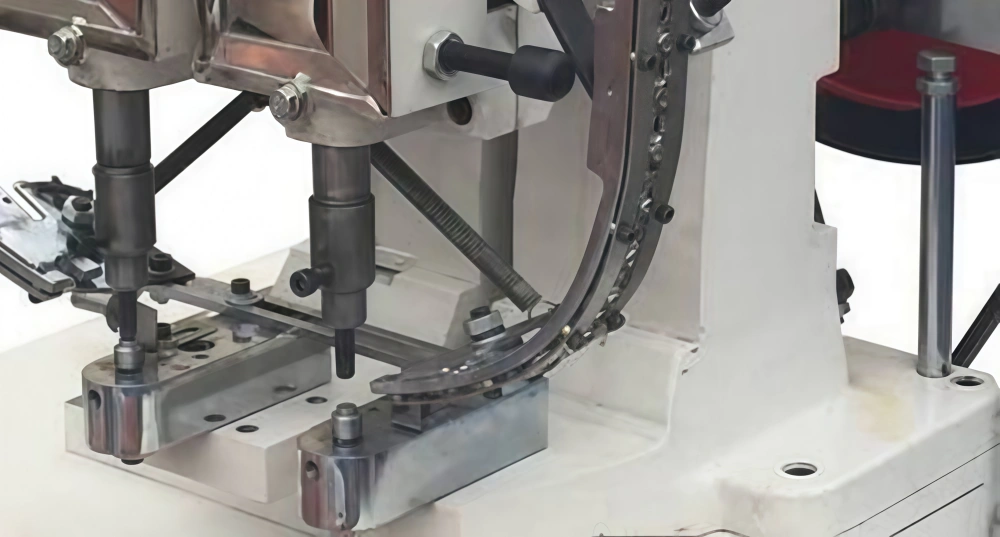
Use a simple reach calculation, then prove it with a physical sample. The useful rule is:
Required throat depth ≥ deepest eyelet-center offset from an accessible edge + operating clearance
Operating clearance covers hems, folded material, guides, clamps, product variation and the small amount of free movement your operator needs. Base it on the actual part; do not add an arbitrary allowance to every job.
Step 1: Draw the product in its processing condition
Use the cut part if you set eyelets before assembly, and use the assembled shape if you set them afterward. Mark seams, stiffeners, pockets, handles and anything else that can hit the machine. A clean flat drawing of a bag panel will give you the wrong answer if the setting operation happens after the side walls are sewn.
Step 2: Mark every eyelet center
Measure to the center of each setting position. For each one, identify the nearest edge that can physically enter the throat. Do not assume you can feed from all four sides. A sewn tube, closed corner or decorative face may limit the approach direction.
Step 3: Find the worst reachable offset
Take the largest center-to-edge distance from all practical feed directions. If a 600 mm-wide flat panel has a centered eyelet and you can insert it from either long edge, the geometric reach is about 300 mm. If the same panel cannot be turned because of a frame or attachment, the required reach may be greater.
Step 4: Add clearance you can defend
Add space for the thickest seam, folded bulk, edge stop and normal placement tolerance. Ten millimetres may be enough for a thin flat strap with a firm guide. A soft multi-layer panel may need considerably more. The point is not to use one universal number; it is to make the allowance visible before you order the machine.
Step 5: Test the worst-case part
Send your largest and most awkward sample, the eyelet and washer, and a dimensioned placement drawing to the supplier. Ask for a setting trial at the deepest position. If a finished sample is unavailable, use a full-size cardboard or foam-board template that includes raised seams and blocked feed directions. A short video of the test can reveal handling problems that a dimensioned drawing misses.
Five Selection Examples
The examples below show why product width and throat depth are not the same thing. The figures are selection examples, not substitutes for a sample trial.
| Workpiece and placement | Geometric reach | Practical selection note |
| Curtain edge eyelets | About 25–40 mm | A compact throat can be suitable when the hem stays flat and the eyelets remain near the edge. |
| Large banner, perimeter only | About 30–50 mm | The sheet is large, but reach is shallow. Prioritize material support and easy repositioning. |
| Bag panel; eyelet 120 mm from usable edge | 120 mm + clearance | A nominal 130 mm throat may be tight after seams and guides. A 160 mm class machine is safer to evaluate. |
| Box or folder panel; eyelet 150 mm in | 150 mm + clearance | A 160 mm throat leaves little margin. Check the folded shape and rear-frame interference. |
| 600 mm flat panel; centered eyelet | About 300 mm + clearance | Standard 65–160 mm machines cannot reach it. Review a custom deep-throat or movable-head process. |
Matching Throat Depth to QC Machinery Models
QC Machinery’s standard models cover several common reach ranges. You should treat the product-page figures as a shortlist, then confirm your exact eyelet, material and workpiece drawing before purchase.
| Machine / solution | Published throat | Good starting fit | What you still need to check |
| QC1805A automatic curtain eyelet machine | 65 mm | Curtain eyelets placed close to a flat edge | Check the 40 mm inner-diameter eyelet format, hem thickness and edge guide. |
| QC16002 automatic eyelet punching machine | 45–130 mm | Repetitive flat parts that benefit from automatic eyelet and washer feeding | Select the reach configuration and verify that the product clears the rear frame. |
| QC54222 semi-automatic eyelet machine | 160 mm | Mixed work where eyelets feed automatically and washers are placed by hand | The current product page lists 160 mm; confirm the final production drawing before ordering. |
| Custom or alternative handling solution | Beyond standard range | Centered positions, wide panels or shapes that cannot be rotated | Send a sample and drawing so frame rigidity, access, supports and cycle method can be reviewed together. |
You can review the detailed specifications on the QC16002 automatic eyelet punching machine, the QC54222 semi-automatic eyelet machine and the QC1805A automatic curtain eyelet machine. Published dimensions can change with tooling and configuration, so use the approved order drawing as the final reference.
Why the Deepest Throat Is Not Always the Best Choice?
Extra capacity sounds useful, but unused reach can carry costs. A deeper frame may require more steel and floor or bench space. The loading point may sit farther from the operator. A long unsupported sheet can be harder to keep square, and a custom frame needs careful stiffness and alignment control.
You should buy enough reach for the current product range and credible future work, with a sensible margin. You should not double the requirement simply because the larger number feels safer. If most eyelets sit 30 mm from an edge, a compact rigid machine with a stable stop will usually be easier to operate than a deep frame designed for positions you never use.
There is also a point where changing the handling method makes more sense than extending the throat. Very large tarpaulins, covers and assembled structures may be easier to process with a movable head, portable setter or a dedicated support system. The right question is not ‘How deep can the frame be?’ It is ‘What is the cleanest way to bring every setting position under the dies?’
Check These Specifications at the Same Time
Throat depth only answers the reach question. Before you select a machine, confirm the rest of the process.
- Working height and stroke. Make sure thick hems, folded assemblies and the selected die set fit vertically.
- Eyelet and washer compatibility. Confirm inner diameter, flange size, barrel length, material and washer style. The die selection guide explains why the hardware and tooling have to be treated as one system.
- Required setting force. Thicker material and larger eyelets need enough controlled force, but excessive force can crack, split or flatten the eyelet.
- Feeding method. Decide whether eyelets and washers will be fed automatically, placed by hand, or changed frequently between products.
- Stops and fixtures. A deep throat is wasted if you cannot locate the part consistently at that depth.
- Material support. Plan tables, rollers or an assistant for large flexible sheets so their weight does not pull the eyelet off position.
- Changeover and maintenance. Check die access, adjustment time, spare tooling and how easily you can clear a misfeed.
If you are still deciding between manual, semi-automatic and fully automatic equipment, read the eyelet machine type comparison. Throat depth should eliminate machines that cannot reach the part; production volume and feeding requirements should decide the automation level among the machines that remain.
Common Throat-Depth Mistakes
- Measuring to the eyelet edge instead of its center. The machine specification is normally based on the tool centerline.
- Using half the product width as a universal rule. That only works for a centered position on a flat part that you can approach from either side.
- Ignoring the finished shape. A bag wall, shoe upper or folded box can hit the head or frame before the marked center reaches the die.
- Selecting exactly at the limit. A 130 mm target on a 130 mm throat leaves no room for hems, guides or normal production variation.
- Assuming a large sheet needs a deep throat. Perimeter eyelets may sit close to the edge even when the sheet is several metres wide.
- Treating reach as proof of quality. You still need stable force, rigid alignment, suitable dies and repeatable positioning.
- Skipping a full-depth test. A sample set near the edge does not prove that the machine stays aligned or feels workable at maximum reach.
What to Send With Your Machine Enquiry
A useful quotation starts with application data. Send the following information so the supplier can check reach and tooling instead of recommending from a product name alone:
- A dimensioned drawing showing every eyelet center and all accessible feed edges.
- The product in the condition in which you will set it: flat part, folded part or finished assembly.
- Your minimum and maximum center-to-edge distance.
- Material type, number of layers and total thickness at the setting point.
- Actual eyelet and washer samples, including barrel length and material.
- Photos or a short video showing seams, walls, handles and other possible obstructions.
- Required output per hour or per shift, plus the number of product changes.
- Your preferred locating method and acceptable position tolerance.
QC Machinery can use this information to review a standard model or discuss a custom approach. Send the worst-case sample through the contact page and ask for the proposed throat depth to be marked on the approval drawing.
FAQ
What is a good throat depth for an eyelet machine?
There is no single best depth. A good throat is one that reaches your deepest eyelet center from a usable edge with enough clearance for the real product, guides and handling. For edge work, 65 mm may be sufficient. Other applications may need 130 mm, 160 mm or a custom solution.
Is throat depth measured to the center of the eyelet?
Yes. It is normally measured from the punch or die centerline to the rear frame obstruction. Measure your product to the center of the setting position so the two numbers are comparable.
Does a wider product always need a deeper throat?
No. A wide tarpaulin with eyelets close to the perimeter can have a shallow reach requirement. A much smaller panel with a centered eyelet can need a deeper throat.
How much clearance should you add?
Add enough for the thickest seam or fold, the positioning stop, normal product variation and free movement. Do not rely on one fixed allowance for every material. A sample test is the safest way to confirm the margin.
Can you fold a large sheet to make it fit?
Sometimes, but the fold must not damage the material, hide the mark, create excessive bulk or pull the setting point out of square. If folding becomes part of every cycle, check the real production time and defect risk before you approve the method.
Does a deeper throat reduce setting force?
Throat depth does not directly set the press force, but a deeper C-frame needs sufficient stiffness to resist deflection. Ask for full-reach sample testing and confirm die alignment under the required load.
What if your required reach is greater than 160 mm?
Send a drawing and physical sample for review. A custom deep-throat frame may be possible, but a movable head, portable setter or different assembly sequence can be a better answer for very large or awkward products.
Should you choose throat depth before automation level?
Yes. First remove any machine that cannot physically reach the work. Then compare manual, semi-automatic and automatic feeding based on output, labor, changeover and consistency.
Choose Reach From the Product, Not the Brochure
When you understand how throat depth affects eyelet machine selection, the decision becomes practical. Measure the farthest eyelet center from an edge you can truly use. Add clearance for the actual material and locating method. Then test the worst-case part at full reach.
That process prevents two expensive outcomes: buying a machine that cannot reach the job, and paying for a large custom frame that adds no value to production. Once reach is confirmed, you can compare feeding, speed, force, tooling and operator safety with confidence.
If you send QC Machinery your product drawing, eyelet samples and required output, you can receive a model recommendation based on the work you will actually run—not a generic throat-depth number. Before production starts, also keep the common eyelet setting defects guide available for die setup and first-article checks.