
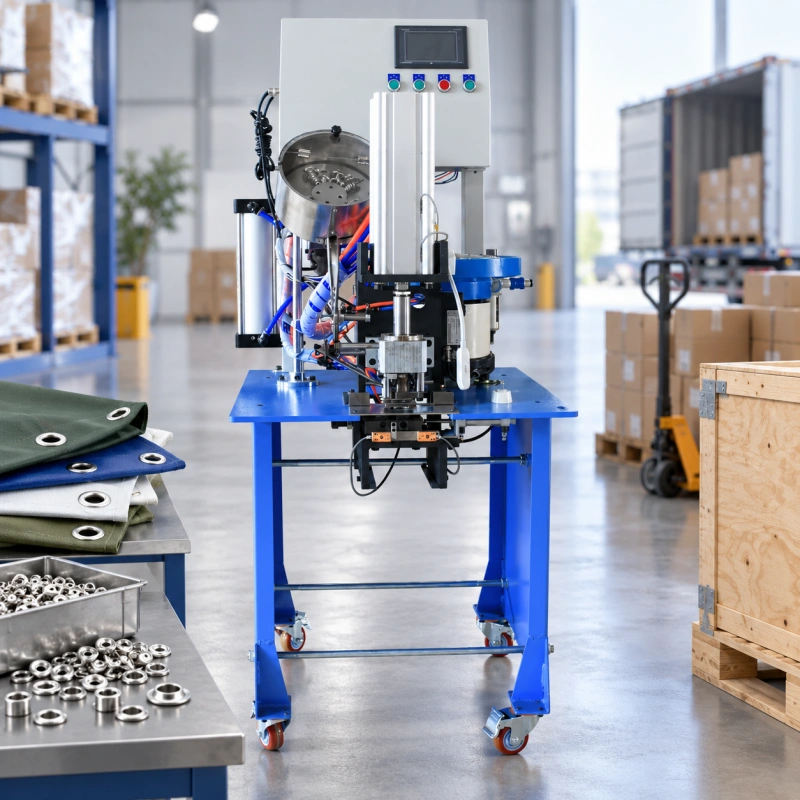
The price printed on an eyelet machine quotation is rarely the amount you will actually spend before the machine can produce acceptable parts at your factory. Freight, import charges, dies, feeders, electrical work, commissioning, trial materials, spare parts, and payment costs can all fall outside the headline figure.
For a useful comparison, bring every offer to the same point: a machine installed at your site, configured for your specific eyelet and washer, tested using your material, and ready for normal production. That figure is your total ready-to-run cost.
This guide gives you a cost model, not a model-selection guide. If you still need to decide between manual, pneumatic, semi-automatic, and automatic equipment, use our automatic eyelet machine buying guide first. Then return here to compare quotations on the same financial basis.
Quick Answer: How Much Does an Eyelet Machine Cost?
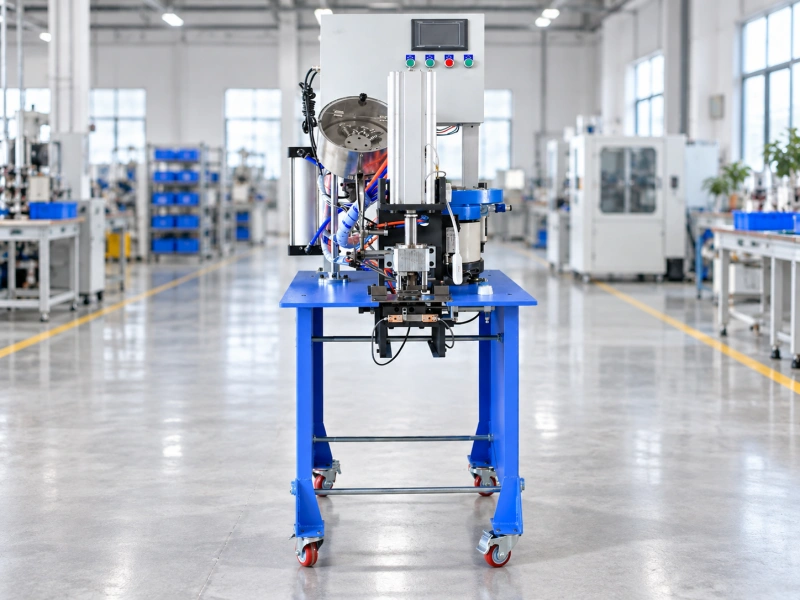
There is no reliable universal price list for industrial eyelet machines. Your price depends on the press, automation level, number of heads, punching arrangement, eyelet and washer feeding system, tooling, controls, guards, application engineering, destination voltage, documentation, and delivery term. A quote that looks cheaper may simply leave more of those items for you to arrange and pay for separately.
Use this formula:
Ready-to-run cost = quoted equipment + tooling and options + export packing + origin charges + international freight + insurance + destination charges + duty and non-recoverable tax + inland delivery + installation and utilities + training and validation + startup spares and consumables + financing and currency costs – recoverable tax or credits
Keep operating costs and production risk in a separate calculation. They affect the investment decision, but mixing five years’ worth of labor and maintenance costs into the import invoice makes quote comparisons harder to audit.
The Four Numbers You Should Keep Separate
| Cost measure | What it includes | What it helps you decide |
|---|---|---|
| Quoted equipment price | The machine and only the items expressly listed in the offer | Whether two suppliers have quoted the same scope |
| Landed cost | Equipment plus logistics, insurance, customs, duty, tax treatment, and delivery to your site | The cash required to receive the shipment |
| Ready-to-run cost | Landed cost plus tooling, utilities, installation, training, trials, spares, and validation | The budget needed to release the machine to production |
| Total cost of ownership | Ready-to-run cost plus labor, energy, maintenance, scrap, downtime, financing, and residual value over a defined period | Whether the investment is economical over its working life |
State which number you mean whenever you use the phrase eyelet machine price. Otherwise, your purchasing team may compare an EXW machine-only offer with a delivered package that includes tooling and support.
Start by Normalizing the Supplier Quote
Ask each supplier to complete the same quotation schedule. The schedule should identify the machine model and configuration, quantity, Incoterm and named place, currency, validity period, production lead time, packing dimensions and gross weight, payment terms, and every included or excluded item.
For an eyelet machine, confirm these scope items separately:
- upper and lower dies for each approved eyelet and washer combination;
- punching tools or a separate pre-punching station;
- eyelet feeder, washer feeder, tracks, bowls, escapements, sensors, and change parts;
- worktable, guides, gauges, positioning fixtures, stands, guards, and foot controls;
- electrical specifications, plugs, transformer, air-treatment equipment, compressor, or dryer;
- manuals, electrical and pneumatic drawings, spare-parts list, and required conformity documents;
- factory acceptance testing using your production material and fasteners;
- installation, remote or on-site training, warranty, and travel expenses; and
- recommended startup and two-year spare-parts packages.
Jopevi’s application overview makes the underlying point: metal, plastic, and decorative eyelets can require different equipment characteristics, and production scale affects the practical choice of machine. For cost comparison, this means the machine and tooling must be matched to the exact fastener and application. A bare press price is not enough.
Check the Incoterm and Named Place
An Incoterms rule allocates transport tasks, costs, and risk between the seller and buyer. It does not tell you whether the machine includes the correct dies, whether customs will accept the declared classification, or whether tax is recoverable. Write the rule, version, and named place into the quote, such as FCA Seller’s Facility, Incoterms 2020, or DAP Your Factory, Incoterms 2020.
| Term | What the quoted price commonly reaches | Costs you still need to verify |
|---|---|---|
| EXW | Seller’s facility before most export-related handling | Pickup, loading responsibility, export clearance, origin fees, main freight, insurance, import, and delivery |
| FCA | Named handover point after the seller completes the agreed export delivery | Main freight, insurance if required, destination charges, import, and inland delivery |
| FOB | Named port with goods delivered on board for sea shipment | Ocean freight, insurance, destination port charges, import, and inland delivery |
| CIF | Named destination port with seller-arranged freight and minimum contractual insurance | Unloading or local port charges as applicable, import charges, inland delivery, and the adequacy of insurance coverage |
| DAP | Named destination with the seller arranging carriage | Import clearance, duty, tax, unloading, and any excluded local work |
| DDP | Named destination with the seller taking the broadest delivery obligation | Unloading and site work; also verify whether the seller can legally handle import and tax obligations in your country |
Do not compare the term alone. Compare the named place and the written inclusions. FOB Qingdao and FOB at another port can involve different origin transport costs. DAP port and DAP factory also represent different cost positions.
Build the Total Landed Cost Line by Line
Quoted equipment and production options
Begin with the machine, feeders, tooling, controls, safety equipment, fixtures, and services listed in the commercial offer. Deduct optional items only after you confirm that they are genuinely unnecessary. Removing a washer feeder, guard, transformer, or second die set may lower the quotation while shifting the cost and integration work to your factory.
Export packing and origin charges
Include export crating or pallet preparation, moisture protection, collection, loading, export documentation, terminal handling, customs brokerage, and any inspection required before shipment. Ask for packed dimensions and gross weight before requesting freight rates. Carriers charge based on the shipment they actually move, not the footprint of the uncrated machine.
International freight and cargo insurance
Price the correct transport mode and route. Air freight may shorten delivery time but can be uneconomical for a heavy press. Sea freight may have a lower line-haul rate while adding port handling, longer transit times, and greater working-capital requirements. Confirm whether the quote is for a full container, a shared container, or another service, and list any surcharges that remain variable.
Insurance should match the actual shipment value and risk profile. Check the deductible, covered events, valuation basis, exclusions, claim documentation, and who is responsible for filing a claim. The word insured in an offer does not tell you whether the coverage is adequate.
Customs value, duty, and import tax
Your broker should confirm the tariff classification, customs value method, country of origin, duty rate, import VAT or GST, and any local fees. These items depend on the destination and the transaction. A supplier can provide product information, but your importer or customs professional should verify the appropriate filing position.
Separate recoverable tax from permanent cost. Import VAT or GST may create a large cash payment without becoming a long-term expense if your business can reclaim it. Show it in the cash requirement, then remove the recoverable portion from the economic landed cost. If recovery is delayed, include the financing effect of that delay.
Destination handling and inland delivery
Add terminal or airport handling, documentation, customs brokerage, storage charges, potential demurrage or detention, inspection, local transport, appointment fees, tail-lift or crane service, and unloading. Confirm whether the carrier will deliver to the door, loading dock, or curbside and whether your site can receive the crate safely.
Add the Costs Between Delivery and Production
Tooling and change parts
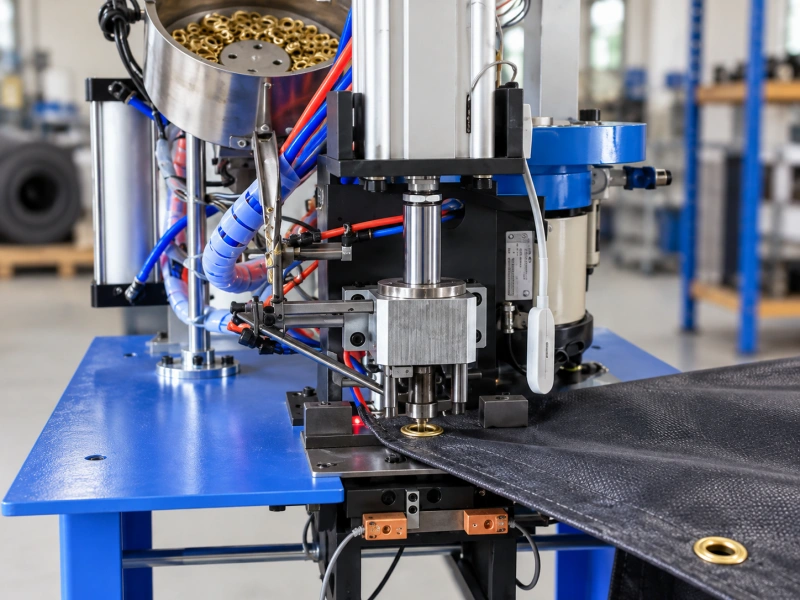
Price a complete working tooling set for every fastener you plan to approve. The press frame cannot compensate for an incorrect or worn die. Include punches, lower dies, washer tools, holders, feeder tracks, escapements, sensors, guides, and setup samples. If you need several eyelet sizes, list each conversion kit and the labor required to change over and validate it.
Utilities and site preparation
Check voltage, frequency, phase, rated load, grounding, disconnects, plug type, compressed-air pressure and flow, air quality, extraction, lighting, floor loading, access routes, and working clearance. Budget for transformers, wiring, breakers, air lines, filters, dryers, regulators, worktables, anchoring, or guarding changes before the machine arrives.
Installation, training, and validation
Include technician labor, travel, visas, accommodation, local transport, interpretation, remote support arrangements, lifting equipment, and your own employees’ time. Define the acceptance criteria: approved samples, stable consecutive cycles, agreed output conditions, safety checks, and operator handover. A cycle video recorded at the supplier’s facility is not the same as a machine released for production at your site.
Startup materials, spares, and contingency
Allow for eyelets, washers, production material, sample blanks, gauges, lubricants, filters, wear parts, sensors, seals, belts, and other recommended spares used during setup and early production. Keep a contingency line visible rather than hiding it in freight or installation costs. Apply it only to uncertain lines and record what it is intended to cover.
Worked Eyelet Machine Landed Cost Example
The following figures are illustrative. They are not a QC Machinery price list or a market benchmark. Replace them with current written quotations, broker estimates, tax advice, and site costs for your destination.
| Cost line | Illustrative calculation | Amount USD |
|---|---|---|
| Machine package | Machine, one feed setup, one die set, standard guards | 18,000 |
| Additional tooling and startup spares | Two change kits plus wear parts | 2,400 |
| Export packing and origin charges | Quoted fixed amount | 850 |
| International freight | Current forwarder estimate | 1,900 |
| Cargo insurance | Estimated shipment coverage | 180 |
| Customs duty | Illustrative 4% × assumed $22,000 customs value | 880 |
| Broker and destination charges | Brokerage, handling, and documentation | 760 |
| Inland delivery and unloading | Carrier plus forklift | 640 |
| Electrical and air preparation | Local contractor estimate | 1,350 |
| Installation, training, and validation | Remote support plus internal labor and trials | 1,600 |
| Contingency | Selected uncertain lines | 940 |
| Ready-to-run cost | Total before recoverable tax | 29,500 |
In this example, the $18,000 headline machine price becomes $29,500 before recoverable tax. The difference is $11,500, or about 64% of the machine price. That percentage is not a rule. It changes with shipment size, destination, duty, tooling, site work, and service scope.
If import VAT or GST is payable, show it below the total as a separate cash requirement. Mark the recoverable amount and the expected recovery date. This keeps your procurement budget, cash forecast, and economic cost consistent.
Calculate Cost per Good Eyelet
A lower ready-to-run cost does not automatically mean a lower production cost. Compare each technically acceptable option over the same evaluation period and production volume.
Annual ownership cost = annualized ready-to-run investment + direct labor + energy and compressed air + planned maintenance + wear tooling and spares + quality losses + downtime costs + financing – residual value credit
Cost per good eyelet = annual ownership cost/number of accepted eyelets produced
Use accepted output, not rated strokes. Feed interruptions, changeovers, cleaning, setup trials, inspection, rework, and rejected parts all reduce saleable production. If one option requires more labor but has a lower purchase price, calculate the break-even volume rather than guessing.
Break-even annual volume = additional annual fixed cost of the higher-investment option / variable-cost saving per good eyelet
Keep quality-loss calculations in the production model, not the landed-cost table. Our eyelet-setting scrap cost guide explains how to separate scrap, rework, downtime, and customer failures without double-counting them.
Price Risks That Commonly Distort a Comparison
| Risk | Why the quote looks cheaper | How you control it |
|---|---|---|
| Machine-only scope | Dies, feeders, guards, or services are excluded | Use a mandatory inclusion schedule and assign a cost to every exclusion |
| Different Incoterms | The seller’s responsibility ends earlier in the transport chain | Convert offers to the same named destination and scope |
| Unverified packed data | Freight is estimated from net weight or machine size | Obtain crate count, dimensions, gross weight, and handling limits |
| Wrong fastener assumption | Standard tooling does not fit your eyelet or washer | Send drawings and traceable samples; approve trial results |
| Destination utility mismatch | Transformer, compressor, wiring, or air treatment is omitted | Issue a site utility sheet before order confirmation |
| Tax treated as permanent cost | Recoverable VAT or GST inflates the economic comparison | Show cash tax and recoverable tax on separate lines |
| Rated speed used as output | Stops, rejects, and changeovers disappear from the model | Use accepted output from a defined test and realistic utilization |
| Vague service promise | Travel, response time, parts, and warranty exclusions remain unknown | Put service scope, support channels, and chargeable items in writing |
| Currency exposure | The home-currency amount changes before payment | Model deposit and balance payments using a stated exchange-rate policy |
How to Request a Comparable Eyelet Machine Quote
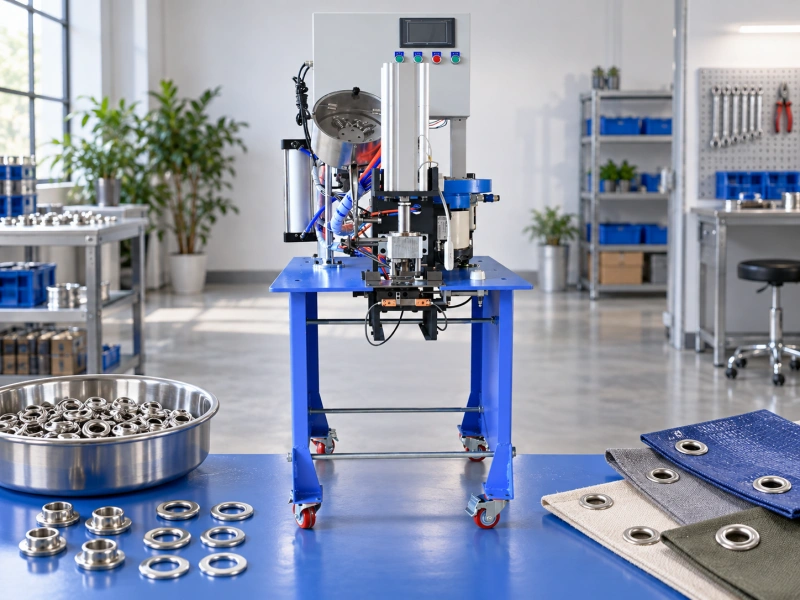
Send one data pack to every shortlisted supplier. Include enough detail for each supplier to price the same job:
- Describe the product and application. State the material, coating, thickness range, layer stack, reinforcement, and finished-part dimensions.
- Identify each eyelet and washer. Provide drawings, dimensions, materials, finishes, samples, and expected lot-to-lot variation.
- State the process. Confirm whether the machine must punch and set in one cycle or work with pre-punched holes.
- Define output. Give daily or per-shift demand, batch size, product mix, changeover frequency, and the accepted-output target.
- Provide layout and utility constraints. Include throat reach, product clearance, floor space, voltage, frequency, phase, and compressed-air requirements.
- Define the test. Specify sample quantities, consecutive-run length, acceptance criteria for defects, strength checks, output measurement, and required evidence.
- Request commercial details. Ask for the Incoterms 2020 rule and named place, currency, payment schedule, validity period, packed data, lead time, warranty, and exclusions.
- Request separate prices. Ask for the base machine, each tool set, feeder change parts, spares, packing, freight options, installation, and training to be shown as individual line items.
If a supplier cannot price a line yet, mark it as pending and assign a responsible person and due date. Do not enter zero. A blank cost is an unresolved assumption, not a saving.
Your Final Comparison Sheet
Use one column for each supplier and one column for the evidence behind each number. Record the quotation date and currency. Convert all offers using the same exchange-rate date, and keep the original currency beside the converted amount.
| Section | Required lines |
|---|---|
| Equipment scope | Machine, heads, punching, feeders, tooling, controls, guards, fixtures, documentation |
| Trade and logistics | Incoterm, named place, packing, origin, freight, insurance, destination, broker, delivery, unloading |
| Import | Classification assumption, customs value, duty, fees, tax paid, tax recoverable, recovery timing |
| Site readiness | Electrical, air, foundations, access, lifting, guarding, work support |
| Production release | Installation, training, trials, gauges, validation, startup materials, spares, contingency |
| Commercial exposure | Payment timing, exchange rate, bank fees, financing, quote validity, delay risk |
| Decision measures | Landed cost, ready-to-run cost, cash requirement, annual ownership cost, cost per good eyelet |
Questions to Ask Before You Approve the Price
- Which exact eyelet and washer combination does each included die set support?
- Does the machine punch and set, or does it require a separate hole-making step?
- Are all feeder change parts included for every approved fastener?
- What is the Incoterms 2020 rule and exact named place?
- What are the final crate dimensions, gross weight, center of gravity, and lifting points?
- Which destination charges remain payable by you?
- Which safety devices and conformity documents are included in the ordered configuration?
- What must your factory provide for power, air, unloading, installation, and guarding?
- What test will prove the accepted output and setting quality before shipment?
- Which travel, training, remote support, warranty labor, and freight costs are excluded?
- Which parts should you stock at startup, and what are their current lead times?
- What changes if your fastener, material, destination, shipping date, or exchange rate changes?
Frequently Asked Questions
Why do eyelet machine prices vary so much?
Offers may cover different press sizes, levels of automation, numbers of heads, feeders, tooling, guards, controls, services, and delivery points. Normalize the technical scope and Incoterm before treating the price gap as a supplier difference.
Is an automatic eyelet machine always more expensive overall?
It typically requires a higher initial investment than a simpler press, but the total ownership cost depends on accepted output, labor, changeovers, quality losses, maintenance, and downtime. Calculate the cost per good eyelet at your expected production volume.
Should import duty be calculated on the machine price?
Not necessarily. The classification, customs value basis, dutiable additions, duty rate, and fees depend on the destination and transaction. Ask a qualified broker or customs adviser to confirm the method before approving the budget.
Is import VAT or GST part of landed cost?
It is part of the cash required at import. However, it may not be a permanent economic cost if your business can recover it. Show tax paid, recoverable tax, non-recoverable tax, and expected recovery timing separately.
What should be included in an eyelet machine quotation?
At minimum, the quotation should specify the exact machine configuration, dies and feed parts, guards, controls, electrical and air specifications, documentation, test scope, packing data, Incoterm and named place, lead time, payment terms, warranty, training, spares, and exclusions.
How much contingency should you add?
There is no universal percentage. Build the base estimate from written evidence, then apply contingency to unresolved or variable lines such as freight surcharges, destination handling, utility modifications, and travel. Replace contingency with firm amounts as quotations become available.
Get a Price You Can Actually Approve
Send us your material samples, eyelet and washer details, required output, destination, utilities, and preferred delivery term. We can prepare a scope-based eyelet machine quotation that separates the machine, tooling, optional equipment, packing, and service items. You can then add your destination-side import and site costs without having to guess what the factory price includes.