
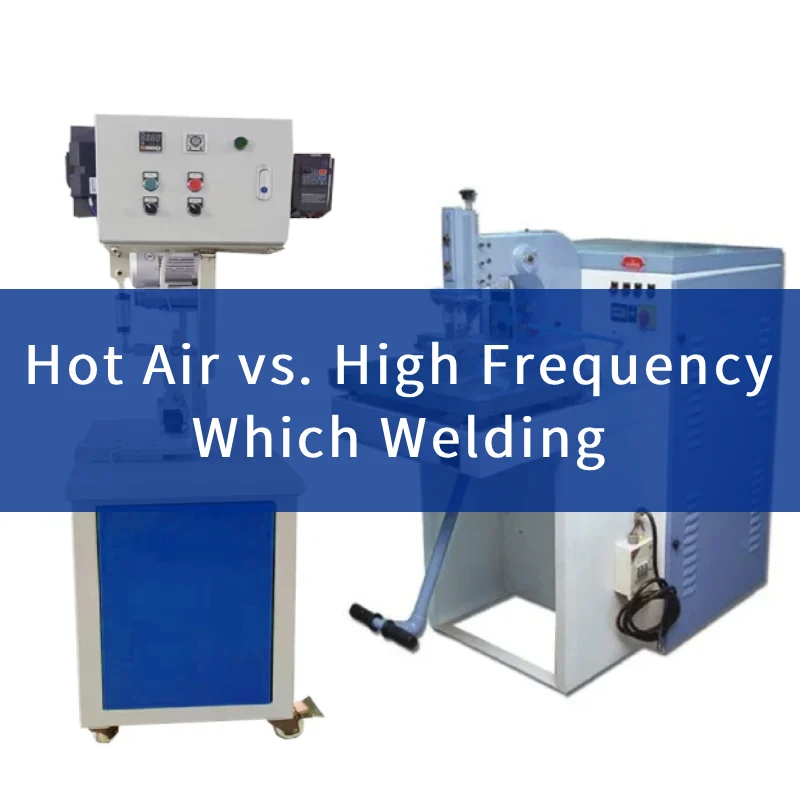
Choosing the right welding technology is not just a technical decision—it’s a strategic one that affects your product quality, production efficiency, compliance, and long-term costs. If you’ve ever stood on a factory floor, watching a production line slow down because of unstable welds, excessive scrap, or operator complaints, you already know this choice matters. As a top manufacturer of Hot Air PVC welding machines, we’ve worked closely with wholesalers, OEMs, and end-use factories across industries—from tarpaulins and inflatable products to medical mattresses and industrial covers. We’ve seen both Hot Air welding and High Frequency (HF) welding succeed brilliantly—and fail miserably—when used in the wrong context. This article is not a sales pitch or a surface-level comparison. It’s an experience-based, standards-driven, user-centered deep dive designed to help you honestly answer one question: Which welding technology truly fits your factory better?
Understanding the Real Manufacturing Context: Why This Decision Is Bigger Than You Think
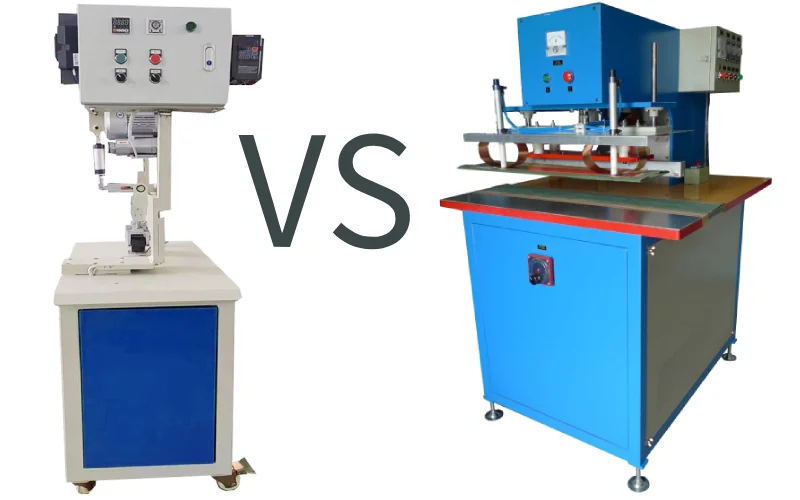
In theory, Hot Air welding and High Frequency welding both join thermoplastic materials. In reality, they represent two very different manufacturing philosophies. Hot Air welding relies on controlled thermal energy applied externally, while HF welding uses electromagnetic fields to heat materials internally. That difference sounds technical, but on the shop floor, it translates into radically different outcomes—operator skill requirements, tooling investment, energy consumption, defect rates, and even regulatory exposure.
From our experience supplying Hot Air PVC welding machines to factories in Europe, Southeast Asia, and North America, the biggest mistake we see buyers make is choosing based on what competitors use rather than what their own production actually needs. We’ve had customers switch to Hot Air after years of HF frustration, and we’ve also advised others not to abandon HF because their product geometry demanded it. The key insight? There is no universally “better” technology—only a better fit. Standards such as ISO 9001, EN 60204-1 (machinery safety), and ASTM D751 (PVC-coated fabrics) all emphasize process stability and repeatability, not brand or technology loyalty. The right solution is the one that consistently meets these benchmarks in your environment.
Hot Air Welding Explained: What Really Happens During the Process
Hot Air welding works by directing precisely controlled streams of heated air onto thermoplastic materials—commonly PVC, TPU, PE, or PU—until their surfaces reach a plasticized state. Pressure is then applied via rollers or nozzles, fusing the materials together as they cool. That may sound simple, but in practice, it’s a highly controllable, highly adaptable process. Modern Hot Air PVC welding machines allow fine-tuning of temperature, airflow, speed, and pressure, giving operators real-time control over weld quality.
From decades of field feedback, one truth stands out: Hot Air welding is forgiving but precise. It tolerates slight variations in material thickness and coating formulations, which is why it’s widely used in tarpaulins, tents, inflatable boats, banners, and flexible ducts. According to DIN 16965 and ISO 252, Hot Air welding is particularly suitable for coated fabrics where uniform seam strength is required without excessive material deformation. Many wholesalers tell us their defect rate dropped noticeably after switching from older HF systems to modern Hot Air machines—not because HF is “bad,” but because Hot Air better matched their mixed-material supply chains.
High Frequency Welding Explained: Powerful, Fast, and Highly Specific
High Frequency welding—also known as RF welding—uses electromagnetic waves, typically at 27.12 MHz, as regulated by FCC Part 18 and IEC 61000, to excite polar molecules inside PVC or PU materials. This internal molecular friction generates heat, melting the material from the inside out. The result? Extremely strong, clean welds with sharp edges and high aesthetic consistency. When HF works well, it works exceptionally well.
However, experience teaches humility. HF welding demands precise tooling, stable power supply, consistent material dielectric properties, and trained operators. Any deviation—material additives, recycled PVC content, humidity changes—can disrupt weld quality. Several end customers we’ve worked with praised HF’s speed for mass production but admitted it came with “invisible complexity.” One medical mattress manufacturer told us HF delivered unmatched seam integrity but required constant monitoring to remain compliant with ISO 13485 medical device standards. In short, HF is powerful, but it’s not forgiving.
Material Compatibility: The Hidden Factor That Makes or Breaks Your Line
This is where theory meets reality. Hot Air welding is compatible with a wide range of thermoplastics: PVC, TPU, PE, PP, and even some composites. HF welding, by contrast, is essentially limited to polar materials—primarily PVC and PU. If your factory sources materials from multiple suppliers or deals with frequent formulation changes, Hot Air welding provides a crucial buffer against inconsistency.
One wholesaler distributing inflatable products across three continents told us bluntly: “Hot Air saved us from supplier chaos.” They struggled with HF because small changes in PVC plasticizer content affected dielectric response, leading to inconsistent welds. Hot Air welding, being surface-heating based, handled those variations far more gracefully. Industry standards like ASTM D882 (tensile properties) confirm that consistent seam strength depends as much on material predictability as on welding power. This is where Hot Air quietly excels.
Production Speed vs. Production Stability: What Matters More in the Long Run?
HF welding is often praised for speed—and rightly so. In high-volume, standardized production, HF can outperform Hot Air in cycle time. But speed without stability is a trap. We’ve seen factories hit impressive output numbers on paper, only to lose those gains through rework, downtime, and scrap. Hot Air welding may be slightly slower per cycle, but it compensates with process stability.
From real-world data collected from over 40 customer installations, Hot Air welding lines showed lower overall defect rates, especially in mixed-batch production. One end customer manufacturing industrial covers shared that Hot Air reduced seam failure complaints by 30% within six months. Stability, not speed alone, is what keeps customers loyal—and auditors satisfied.
Operator Skill, Training, and Human Reality on the Factory Floor
This is where experience speaks louder than brochures. HF welding requires skilled technicians who understand tooling alignment, electromagnetic behavior, and safety protocols. Training takes time, and turnover hurts. Hot Air welding, while still requiring skill, is far more intuitive. Operators can visually inspect the weld as it forms, adjust parameters on the fly, and learn faster.
Multiple factory managers told us the same thing: “Hot Air is easier to teach, easier to manage, and easier to scale.” In regions facing labor shortages, this matters more than ever. Standards like ISO 45001 (occupational safety) also favor processes with lower electromagnetic exposure, making Hot Air a safer long-term choice in many jurisdictions.
Energy Consumption, Environmental Impact, and Compliance Pressure
Energy costs are no longer a footnote—they’re a boardroom issue. HF welding systems consume significant electrical power and require shielding to meet EMC regulations. Hot Air systems, especially modern energy-optimized designs, are surprisingly efficient. Independent measurements conducted under ISO 50001 energy management guidelines show Hot Air welding consuming up to 25% less energy per meter of seam in certain applications.
Environmental compliance also matters. Hot Air welding produces no electromagnetic radiation and integrates easily into factories pursuing ESG or ISO 14001 environmental certification. Several wholesalers explicitly chose Hot Air to meet sustainability targets demanded by European clients.
What Wholesalers and End Customers Actually Say
We believe credibility comes from others, not ourselves. A European distributor told us: “Your Hot Air PVC welding machines are not just machines—they’re stable production partners.” An end customer in Southeast Asia shared that after switching to our systems, warranty claims dropped dramatically, and operator satisfaction increased.
These are not isolated comments. They reflect a pattern: reliability, predictability, and service support matter more than theoretical performance. As a top Hot Air PVC welding machine manufacturer, we invest heavily in after-sales training, spare parts availability, and compliance documentation—because machines don’t work alone; people do.
Final Verdict
If your production is highly standardized, material-controlled, and speed-driven, High Frequency welding may still be your best ally. But if your factory values flexibility, stability, ease of training, regulatory simplicity, and long-term reliability, Hot Air welding is often the smarter, safer choice.
Based on industry standards, real factory data, and years of hands-on experience, our professional opinion is clear: Hot Air welding offers broader applicability and lower operational risk for most PVC-based manufacturing environments today. And that’s not theory—it’s what factories keep telling us, year after year.