
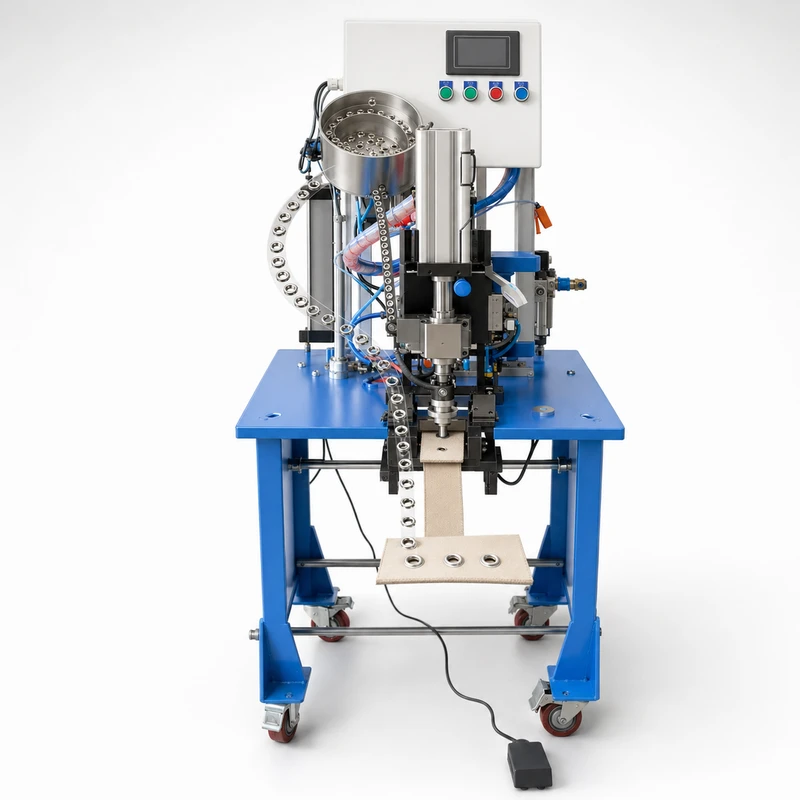
You see how automatic eyelet machines transform production with advanced automation by understanding how an automatic eyelet machine works. The machine inserts eyelets into materials quickly and accurately, enhancing efficiency. Automation boosts speed and consistency while reducing errors and labor costs.
QC Machinery delivers reliable solutions for industries seeking quality and efficiency.
| Aspect | Automation | Manual Methods |
|---|---|---|
| Production Speed | Significantly increased | Slower, limited by manual labor |
| Quality Consistency | Enhanced precision and uniformity | Variable, prone to human error |
| Defect Rate | Reduced likelihood of defects | Higher due to inconsistencies |
| Labor Costs | Lower due to reduced manual handling | Higher due to more operators needed |
| Workplace Safety | Improved by minimizing manual tasks | Riskier due to manual handling |
Key Takeaways
- Automatic eyelet machines enhance production speed and quality, reducing labor costs and errors.
- Understanding the machine’s components, like the eyelet feeding system and punching mechanism, boosts efficiency and consistency.
- Regular maintenance, such as cleaning and lubrication, is crucial for optimal machine performance and longevity.
- Automation allows one operator to manage multiple machines, significantly increasing productivity in manufacturing.
- QC Machinery’s eyelet machines are versatile, accommodating various materials and eyelet sizes for diverse applications.
Main Parts of Automatic Eyelet Machine
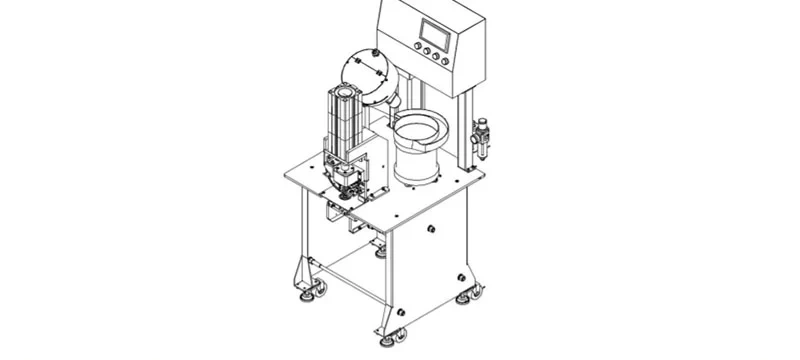
You gain a clear advantage in production when you understand the main parts of an automatic eyelet machine. QC Machinery designs each component to maximize efficiency, precision, and durability. The following table summarizes the essential features that set these machines apart:
| Component | Description |
|---|---|
| Material Compatibility | Handles a wide range of materials, from soft cotton to tough leather. |
| Automation Levels | Available in fully automatic and semi-automatic models. |
| Safety Features | Includes safety features to protect operators. |
| Efficiency | Streamlines the eyelet insertion process for large orders. |
| Durability | Built with robust materials for heavy factory use, lasting 8 to 15 years. |
| User-Friendly Controls | Designed for easy operation with quick adjustments for settings. |
Eyelet Feeding System
You rely on the eyelet feeding system to automate the supply of eyelets and washers. The hopper holds loose eyelets, and a rotating finger pushes them into position. This system ensures accurate placement for every insertion. You benefit from increased productivity because the feeding process operates automatically.
The system maintains quality by positioning each eyelet precisely, which is crucial for consistent results.
Punching Mechanism
You use the punching mechanism to create holes in the material before inserting the eyelet. Layering techniques allow you to punch through multiple fabric layers at once. Template-based punching ensures that holes align perfectly, giving you repeatable results.
Consistent spacing between eyelets enhances the professional appearance of your products. The mechanism delivers reliable performance for high-volume production.
Setting Unit
You depend on the setting unit to press the eyelet securely into the material. The unit applies adjustable force, accommodating different eyelet sizes and material thicknesses. You achieve uniform results because the setting unit operates with precision.
The robust design ensures durability, making it suitable for heavy factory use.
Inspection Module
You trust the inspection module to verify the quality of each eyelet installation. Electronic sensors check for proper placement and detect any defects. The module enhances safety and allows for rapid prototyping. You maintain high standards by using this module to ensure every eyelet meets your specifications.
Tip: You can optimize your workflow by adjusting the settings for each component, ensuring the machine matches your production needs.
How an Automatic Eyelet Machine Works: Step-by-Step Process
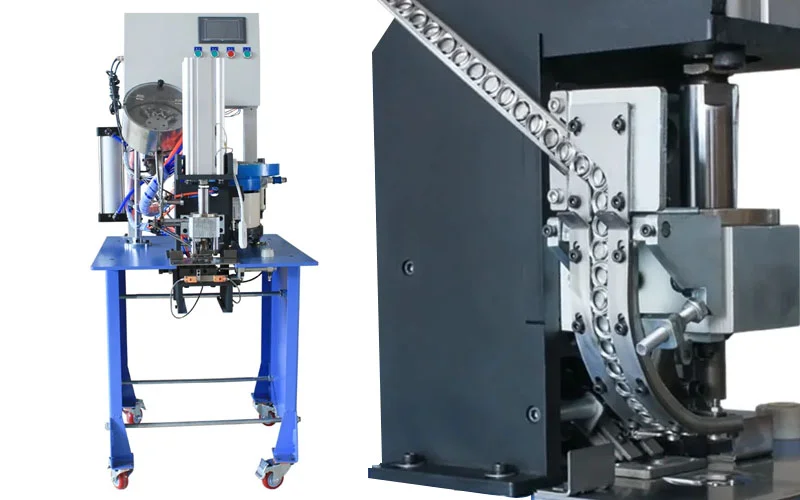
Understanding how an automatic eyelet machine works helps you achieve consistent, high-quality results in your production line. QC Machinery’s eyelet machines follow a precise cycle that includes feeding, punching, setting, and inspection.
Each step plays a vital role in ensuring your products meet industry standards.
Feeding Eyelets and Washers
You begin by preparing the machine for operation. Place the eyelets and washers into the automatic feeder bowl. The machine uses a specialized feeding system to sort and deliver each eyelet and washer to the correct position. This process reduces manual handling and speeds up production.
You can switch between different eyelet sizes by adjusting the feeding tracks and die sets. Regular cleaning and maintenance of the feeder bowl prevent jams and ensure smooth operation.
| Step/Task | Description |
|---|---|
| Setup | Place the machine on a level, rigid floor to minimize vibration. |
| Feeding Tracks Changeover | Adjust feeding tracks and die sets when switching between different eyelet sizes. |
| Daily Maintenance | Clear dust and material debris to prevent blockages in the feeding tracks. |
| Weekly Lubrication | Lubricate the main ram and clutch mechanism to prevent wear. |
| Feeder Bowl Cleaning | Clean residue from eyelet coatings to ensure smooth feeding without jams. |
| Die Inspection | Inspect dies for burrs or rounding to avoid damaging finished eyelets. |
Tip: Regular maintenance of the feeding system keeps your eyelet machines running efficiently and extends their lifespan.
Punching the Material
Once the eyelet and washer are in place, the machine prepares the material for installation. You mark the exact spot where you want the eyelet. The punching mechanism then creates a clean hole in the fabric, leather, or other material.
You select the correct die size and adjust the pressure settings based on the thickness of your material. This step ensures that the hole is the right size for the eyelet, preventing tearing or deformation.
- Mark the position for the eyelet on your material.
- Select the correct die size and load eyelets and washers into the feeder.
- Adjust pressure settings for the material thickness.
- The machine punches a clean hole at the marked spot.
- The eyelet and washer move into position for the next step.
Note: Proper alignment and pressure settings are crucial for clean holes and accurate eyelet placement.
Setting the Eyelet
After punching the hole, the machine inserts the eyelet from the top and the washer from the bottom. The setting unit applies controlled force to press both parts together. You achieve a secure and uniform finish every time.
The robust design of QC Machinery’s eyelet machines allows you to work with different materials and eyelet sizes. You can adjust the settings to match your specific requirements, ensuring the eyelet grips the material tightly without causing damage.
- Insert the eyelet into the punched hole from the front side.
- Place the washer on the back side automatically.
- The setting unit presses both parts together with high pressure.
- The eyelet locks firmly with the washer, securing it in place.
- Check the stability by gently pulling on the material.
Tip: Adjust the pressing force to match the thickness and type of your material for the best results.
Inspection and Quality Control
The final step in how an automatic eyelet machine works involves inspection and quality control. QC Machinery’s eyelet machines use advanced sensors and digital controls to check each installation.
The inspection module verifies the placement, tightness, and appearance of every eyelet. Automated vision systems can detect defects such as rough hole edges, fabric tearing, or loose eyelets. You benefit from consistent quality and reduced waste.
| Inspection Method | Purpose |
|---|---|
| Programmable CMM | Dimensional verification and repeatability |
| Optical comparators | Profile and feature inspection |
| Surface metrology | Verify finishes and contact surfaces |
| Leak and burst testing | Functional validation for performance |
| Custom attribute gauges and fixtures | Ensures consistent inspection at production speeds |
- Finished eyelets are inspected for defects or irregularities.
- Automated vision systems sort eyelets by size and type before packaging.
QC Machinery addresses common quality control issues with advanced automation and digital controls. You experience fewer errors, improved productivity, and long-lasting machine performance.
By following these steps, you see how an automatic eyelet machine works to deliver fast, precise, and reliable results. Eyelet machines from QC Machinery help you maintain high standards and meet the demands of modern manufacturing.
Key Features and Advantages of QC Machinery Eyelet Machine

Automation and Efficiency
You experience a dramatic boost in productivity when you use QC Machinery’s automatic eyelet machine. The machine operates with high automation, allowing one operator to manage multiple units. You save labor costs and reduce manual errors.
The machine performs punching and setting tasks at the same time, increasing production speed. You achieve consistent quality in high-volume manufacturing because automation stabilizes every step.
Tip: Automation minimizes downtime and ensures repeatable results, making your workflow more reliable.
| Factor | Manual Press | Automatic Machine |
|---|---|---|
| Peak speed | 10–15 pcs/min | 25–40 pcs/min |
| Sustained speed | 6–8 pcs/min | 20–30 pcs/min |
| Misalignment/jam rate | 1–2% | 0.5–1% |
| Operator requirement | 1 per station | 1 per 2–3 machines |
Versatility and Customization
You gain flexibility with QC Machinery’s customizable options. The machine adapts to different eyelet sizes, materials, and production needs. You can select punch sizes from 3mm to 30mm, making it suitable for apparel, outdoor products, and industrial applications.
Custom tooling ensures a perfect fit for your specific requirements.
| Customization Option | Description |
|---|---|
| Customizable Punch Sizes | Supports diverse needs across industries, including waterproof fabrics. |
| Eyelet Size Range | Accommodates eyelets from 3mm to 30mm in diameter. |
| Specialized Tooling | Custom tooling for non-standard sizes and materials. |
Note: You can request OEM and ODM services for custom branding and manufacturing support.
Durability and Safety
You rely on QC Machinery’s robust design for long-term performance. The machine uses durable components that withstand heavy use and require minimal maintenance. You operate with confidence because the machine meets ISO 9001 and CE certification standards.
Intuitive controls and built-in safety features protect you and your team.
| Certification Type | Description |
|---|---|
| ISO 9001 | Quality management standards compliance |
| CE Certification | International shipping and regulatory acceptance |
Safety features and professional technical support help you maintain a secure and efficient production environment.
You benefit from reduced labor, consistent quality, and fast return on investment. QC Machinery’s automatic eyelet machine delivers reliable results for every project.
Applications in Modern Manufacturing
Apparel and Footwear
You rely on automatic eyelet machines to streamline production in the apparel and footwear industry. These machines punch precise holes and crimp eyelets in a single operation, optimizing workflow and reducing labor costs. You enhance the durability and appearance of shoes by adding eyelets for laces.
Clothing manufacturers use eyelets for both functional and decorative purposes, such as jackets, hoodies, and corsets. You achieve consistent results across multiple layers of fabric, which is essential for maintaining quality in high-volume manufacturing.
Automatic eyelet machines help you maintain profit margins by minimizing downtime and ensuring uniformity in every product.
| Industry | Application |
|---|---|
| Shoe | Eyeleting for laces and durability |
| Clothing | Adding eyelets for laces or decorative purposes |
| Curtain | Eyeleting for design and functionality |
| Toy | Incorporating eyelets for design and safety |
Bags and Outdoor Products
You gain efficiency and versatility when you use automatic eyelet machines for bags and outdoor products. Manufacturers of backpacks, tents, tarpaulins, and banners depend on these machines to attach eyelets quickly and securely. You ensure a professional finish and consistent strength in every product.
The machine handles various eyelet sizes and materials, allowing you to adapt to different applications.
| Benefit | Description |
|---|---|
| Increased Efficiency | Automates the eyelet attachment process for faster production |
| Consistent Results | Ensures uniform and secure attachment of eyelets |
| Reduced Labor Costs | Lowers the need for manual labor |
| Versatility | Handles various eyelet sizes and materials |
You can process materials like canvas, synthetic textiles, and thin plastic sheets, making the machine suitable for diverse outdoor and bag products.
Industrial and Home Uses
You support a wide range of industrial and home applications with QC Machinery’s automatic eyelet machine. Industrial users apply eyelets to tents, sails, seat covers, and heavy-duty materials.
Home-based businesses and workshops use hand or pneumatic eyelet machines for smaller projects, such as paper bags, folders, and bookbinding. You benefit from cost-effective solutions and professional finishes, whether you operate in a factory or a home workshop.
- Textile and fashion: Shoes, clothing, bags
- Signage & banners: Advertising displays, PVC banners
- Automotive and leather goods: Seat covers, upholstery
- Packaging and printing: Paper bags, folders, bookbinding
- Industrial applications: Tents, sails, heavy-duty materials
QC Machinery’s automatic eyelet machine is compatible with fabric, leather, canvas, denim, synthetic textiles, and thin plastic sheets. You can select eyelet sizes from 3 mm to 10 mm, ensuring strong and reliable attachment for every material.
Conclusion
You see how QC Machinery’s Automatic Eyelet Machine streamlines your workflow with automation, precision, and versatility. The machine delivers high productivity and reliable results for modern manufacturing. You benefit from features that set QC Machinery apart:
| Feature | Description |
|---|---|
| High Productivity | Fast, consistent output |
| Customization | Minor adjustments for your needs |
| Delivery Assurance | Compensation for late delivery |
| Money-back Protection | Secure shipping guarantee |
Explore more about QC Machinery’s solutions at qcmachinery.com.
FAQ
What materials can you process with an automatic eyelet machine?
You can process cotton, polyester, leather, canvas, denim, and synthetic fabrics. The machine also works with thin plastic sheets. You select the right settings for each material to achieve the best results.
Can you use both metal and plastic eyelets?
Yes, you can use both metal and plastic eyelets. The machine supports a wide range of eyelet sizes and types. You only need to adjust the feeding system and die set for your chosen eyelet.
How do you maintain the automatic eyelet machine?
Tip: Clean the feeder bowl and tracks daily. Lubricate moving parts weekly. Inspect dies for wear. Regular maintenance keeps your machine running smoothly and extends its lifespan.
Is the machine easy to operate?
You find the controls user-friendly. You can adjust settings quickly for different projects. The machine includes safety features and clear instructions, so you can operate it with confidence.