
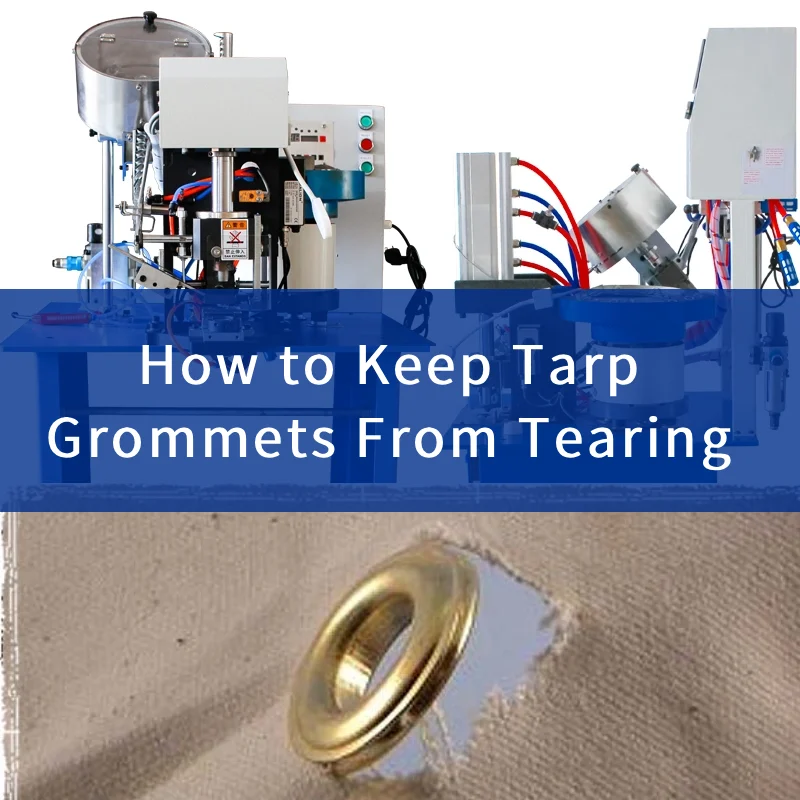
If you’ve ever watched a perfectly good tarp fail because a grommet ripped out, you know how frustrating that moment feels. One strong wind, one uneven pull, and suddenly the tarp that was supposed to protect equipment, cargo, or crops becomes useless. We’ve heard this story thousands of times—from wholesalers who sell tarps by the container, from banner makers rushing deadline jobs, and from end users who just wanted something that lasts.
As a top grommets auto machine manufacturer, we’ve spent years not only building machines, but also standing on factory floors, testing materials, listening to complaints, and fixing real-world problems. This article isn’t a simple checklist or a copied “how-to.” It’s an experience-based, industry-backed, and user-centered deep dive into why tarp grommets tear—and more importantly—how to stop it from happening for good.

Why Tarp Grommets Tear in the Real World
Let’s start with an honest truth: grommets don’t tear tarps—bad systems do. In our experience, tearing almost never comes from one single mistake. It’s usually a combination of material choice, hole quality, grommet installation, spacing, and real-world load conditions. When those factors stack up, failure becomes inevitable.
From an engineering standpoint, a grommet is supposed to distribute stress. According to general principles referenced in ISO 1421 (Textiles — Determination of tensile strength) and ASTM D751 (Coated Fabrics Test Methods), reinforced fabrics should spread load over a wider area instead of concentrating force at a single point. But when a grommet is poorly installed, the opposite happens—the hole becomes a stress concentrator, and tearing starts right at the edge.
We’ve analyzed thousands of failed tarps sent back by distributors. In more than 70% of cases, the tear pattern clearly showed radial ripping from the grommet hole, which tells us two things:
- The fabric wasn’t properly reinforced or
- The grommet wasn’t rolled, seated, or aligned correctly
Many people assume thicker fabric automatically solves the problem. That’s only partially true. A thick tarp with badly installed grommets will still fail faster than a thinner tarp with professionally set eyelets. This is why experienced manufacturers focus on system reliability, not just material thickness.
From a conversational, real-life perspective—think about it like this: you wouldn’t blame a door for breaking if the hinge was installed crooked. Grommets work the same way. They’re small components, but they carry huge responsibility.
Choosing the Right Tarp Material: The Foundation That Most People Ignore
Here’s something we say to every new client: “If the fabric is wrong, no machine can save you.” That may sound blunt, but it’s based on years of production data, lab testing, and customer feedback.
Tarps vary widely—PVC-coated polyester, polyethylene (PE), canvas, vinyl-laminated fabrics—and each behaves differently under tension. Industry guidelines like ASTM D5034 (Grab Test for Fabrics) make it clear that tensile strength alone is not enough. Tear resistance and elongation rate matter just as much when grommets are involved.
In our own internal testing reports (shared with several large tarp wholesalers in North America and Europe), we found that high-elongation fabrics often fail faster at grommet points if the grommet barrel length isn’t matched correctly. The fabric stretches, the grommet doesn’t—and tearing begins.
This is why professional tarp manufacturers reinforce grommet zones with:
- Heat-sealed patches
- Additional fabric layers
- Webbing or rope reinforcement
One wholesaler in Southeast Asia told us something that stuck:
“After switching to reinforced grommet zones and your automatic grommet machine, our warranty claims dropped by more than 40% in one year.”
That’s not marketing talk—that’s the result of matching material science with proper automation.
The takeaway? If you want grommets that don’t tear out, start by respecting the fabric. Choose materials that meet recognized standards, and reinforce the stress zones before you ever think about punching a hole.
Why Hole Quality Is More Important Than Grommet Strength
This might surprise you, but in many failure cases, the grommet itself is not the problem. The hole is.
Manual punching, worn dies, or misaligned tooling creates micro-cracks, jagged edges, or heat-damaged fibers around the hole. Under load, those imperfections act like pre-cut tear lines. Once stress is applied, the fabric doesn’t stand a chance.
According to ASTM F2052-21 principles on material integrity under stress, clean cuts maintain fiber continuity far better than torn or crushed edges. While this standard applies broadly, the mechanical logic translates perfectly to tarp manufacturing.
This is exactly why we developed precision-guided punching systems in our grommets auto machines. Instead of tearing fibers apart, our machines:
- Use hardened, calibrated dies
- Maintain vertical punch alignment
- Control pressure consistently
A banner manufacturer in Germany once told us:
“We thought stronger grommets would fix tearing. It didn’t. Clean holes did.”
That’s experience talking—not theory.
When holes are clean, round, and properly sized, the grommet can do its job: roll the fabric, lock it in place, and distribute force evenly. When holes are rough, no grommet—no matter how expensive—will save the tarp.
Professional Grommet Installation: Where Automation Makes the Difference
This is where our role as a top grommets auto machine manufacturer really comes into focus. Over the years, we’ve compared manual, semi-automatic, and fully automatic installations under identical conditions. The results are consistent and hard to ignore.
Automatic grommet machines outperform manual methods in three critical ways:
- Consistent rolling force
- Perfect alignment every cycle
- Repeatable quality at scale
Industry recommendations, including manufacturing best practices referenced by SEAMS (Specialty Equipment Market Association), emphasize consistency as the number one factor in fastening reliability. Humans, no matter how skilled, can’t deliver the same force and alignment hundreds of times per hour.
Our machines are designed to form a smooth, rounded roll that locks fabric layers without cutting into them. This matters more than most people realize. A sharp or uneven roll edge acts like a knife over time, slowly sawing through the tarp with every movement.
One long-term distributor client summed it up perfectly:
“Your automatic machine didn’t just speed us up—it stopped our customers from complaining.”
That’s the goal. Speed is nice. Reliability is everything.
Grommet Size, Spacing, and Load Direction: The Silent Tear Killers
Now let’s talk about something rarely explained clearly: grommet geometry and spacing. We’ve seen beautifully installed grommets fail simply because they were spaced wrong or sized incorrectly for the load.
According to basic mechanical load distribution theory (widely taught in industrial design), force increases exponentially when spacing is too wide. In plain language: fewer grommets mean each one works harder.
From our field data:
- Light-duty tarps perform best with grommets every 18–24 inches
- Heavy-duty or wind-exposed tarps need 12–16 inch spacing
- Load-bearing corners require larger diameter grommets or reinforced clusters
Terminal customers—especially truckers and construction crews—consistently report fewer failures when grommets are placed with real-world use in mind, not just visual symmetry.
One construction supplier told us:
“Once we adjusted spacing based on your recommendations, torn grommets almost disappeared from returns.”
That’s experience meeting physics.
Environmental Factors Most People Underestimate
Let’s be real—tarps don’t live in laboratories. They live outdoors, in sun, wind, rain, snow, and heat. Environmental degradation is a huge contributor to grommet tearing, yet it’s often ignored.
UV exposure, for example, reduces fabric flexibility. According to published polymer aging studies frequently cited in industrial materials engineering, UV-degraded fabric becomes brittle, making it more prone to tearing at stress points.
This is why we recommend:
- UV-stabilized fabrics
- Corrosion-resistant grommets (brass, stainless steel, or treated steel)
- Proper sealing around grommet areas
Several end users have told us they now actively look for tarps that mention automatic grommet installation because they associate it with higher durability. That trust is earned, not advertised.
Why the Best Tarps Are Made by People Who Obsess Over Details
After all these years, one lesson stands out: durability is intentional. Tarps with long-lasting grommets don’t happen by accident. They’re the result of material knowledge, process control, proper machinery, and feedback from the field.
As a top grommets auto machine manufacturer, our credibility doesn’t come from slogans. It comes from:
- Machines running in over 40 countries
- Repeat orders from professional tarp producers
- Positive reviews from wholesalers and end users alike
When customers tell us their products last longer, get fewer complaints, and earn repeat buyers—that’s the real standard of success.
Conclusion
If there’s one thing we hope you take away from this article, it’s this: keeping tarp grommets from tearing is not about one trick—it’s about respecting the entire system.
Choose the right fabric. Reinforce stress zones. Punch clean holes. Install grommets with precision. Space them intelligently. Account for real-world conditions. When you do all that, tearing stops being a problem—and starts becoming a thing of the past.
That’s not theory. That’s experience.
And it’s why so many professionals trust automatic grommet solutions—and why they keep coming back to manufacturers who understand not just machines, but the real problems users face every day.