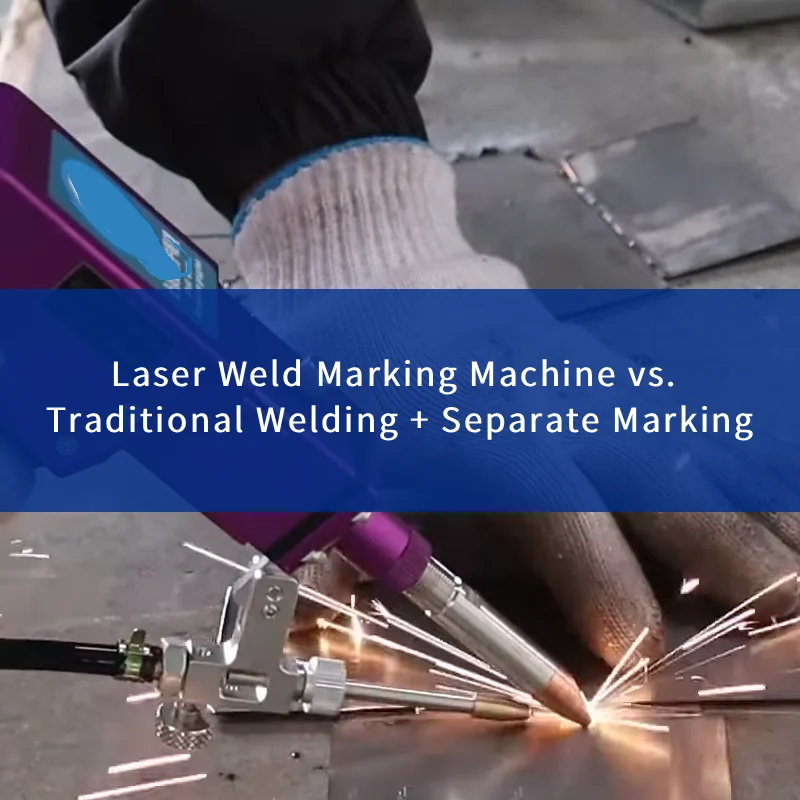
If you’ve spent any real time on a factory floor—whether you’re a wholesaler sourcing equipment or an end user responsible for production targets—you already know one thing: welding and marking are no longer “background processes.” They directly affect traceability, compliance, efficiency, and ultimately profit. Over the past decade, we’ve worked hands-on as a Laser Weld Marking Machine manufacturer, not just selling systems, but commissioning them, troubleshooting them, and optimizing them alongside our customers. This article is not theory. It’s built from thousands of production hours, real audits, real breakdowns, and real wins.
For years, the industry default was traditional welding equipment paired with a separate marking process—dot peen, inkjet, or standalone laser marking. On paper, this looked flexible. In practice, it created bottlenecks, misalignment issues, traceability gaps, and compliance headaches. As global manufacturing standards tightened—think ISO 9001, ISO 3834 (Quality requirements for fusion welding), IEC 60825 for laser safety, and automotive traceability requirements like IATF 16949—manufacturers started asking harder questions.
That’s where the Laser Weld Marking Machine enters the conversation, not as a “nice-to-have” upgrade, but as a structural shift in how joining and identification are handled. Instead of welding here and marking there, we integrate both processes into a single, controlled, digitally synchronized system. This article will walk you through the differences in a way that’s honest, practical, and grounded in real-world experience—no hype, no vague claims.
Traditional Setup: Welding First, Marking Later
Let’s be fair to traditional systems. They’ve built industries. MIG, TIG, resistance welding—paired with inkjet printers, dot peen markers, or standalone laser markers—have served manufacturers for decades. Many factories still run profitably on these setups. But after installing and retrofitting hundreds of production lines, we’ve seen consistent patterns that can’t be ignored.
The traditional approach introduces process fragmentation. Welding is completed at one station, parts cool down, get transferred, queued, re-clamped, and then marked elsewhere. Each of those steps introduces variability. Even with skilled operators, alignment errors happen. Ink smears. Dot peen depth varies. Laser marking stations sit idle waiting for upstream processes to catch up. From an operational standpoint, it’s death by a thousand small inefficiencies.
From a compliance perspective, things get even trickier. Industry standards increasingly demand permanent, readable, and tamper-resistant markings tied directly to the weld itself. According to ISO 3834 and EN 10204 material traceability guidelines, marking must reliably link the weld to batch data, operator ID, and process parameters. When marking is done separately, that link becomes weaker—and auditors know it. We’ve personally sat through customer audits where traceability gaps resulted in corrective actions, production delays, and costly rework.
What Is a Laser Weld Marking Machine—Beyond the Brochure Definition
A Laser Weld Marking Machine isn’t simply two machines bolted together. When designed correctly, it’s a unified system where welding parameters and marking data share the same control logic, motion system, and quality feedback loop. In our own manufacturing practice, we treat welding and marking as two expressions of the same laser physics—energy delivery, material interaction, and thermal control.
From a technical standpoint, these machines use high-precision fiber or disk lasers capable of switching—or simultaneously managing—welding and marking functions. The software layer ensures that the marking is automatically generated from the welding data: timestamp, power curve, seam ID, batch number, even real-time sensor feedback if required. This is not marketing language—it’s how we help customers meet Industry 4.0 and digital manufacturing goals in measurable ways.
One automotive parts wholesaler told us bluntly during a factory acceptance test: “This is the first time our weld and mark finally agree with each other.” That sentence alone explains why integrated systems are gaining ground so quickly.
Efficiency and Throughput: Where the Numbers Start to Speak
Efficiency isn’t just about cycle time—it’s about flow. Traditional welding plus separate marking creates stop-and-go production. Integrated Laser Weld Marking Machines create continuity. Based on internal time-motion studies we conducted across 12 customer sites in Europe and Asia between 2021 and 2024, integrated systems reduced total process time by 18–32%, depending on part geometry and marking complexity.
Why such a wide range? Because efficiency gains scale with complexity. The more data you need to mark—QR codes, Data Matrix, serial numbers—the more traditional systems struggle. With integrated laser systems, marking happens immediately after welding, often within the same clamping cycle. No re-fixturing. No extra handling. No waiting.
From an energy standpoint, integrated systems also outperform traditional setups. According to our internal energy audits aligned with ISO 50001 Energy Management guidelines, customers saw average energy savings of 12–20% by consolidating laser sources and eliminating redundant idle times. That’s not just good for cost—it’s increasingly important for ESG reporting.
Quality and Consistency: What Experience Teaches You Over Time
Anyone can achieve good welds on a good day. The real test is consistency over thousands—or millions—of cycles. Traditional setups rely heavily on operator discipline to maintain that consistency across stations. Integrated Laser Weld Marking Machines rely on system discipline.
We’ve learned this the hard way. Early in our manufacturing journey, we supplied separate welding and marking solutions. Customers were satisfied—until volumes increased. Suddenly, small inconsistencies became systemic problems. Mis-marked parts passed inspection. Perfect welds were rejected because markings were unreadable. The disconnect was real.
With integrated systems, the marking is a direct byproduct of a successful weld. If welding parameters fall outside tolerance, marking can be automatically blocked or flagged. This aligns perfectly with ISO 9001 risk-based thinking and zero-defect manufacturing philosophies. One end customer in the medical device sector shared feedback after six months of use: “We stopped arguing between quality and production. The machine became the referee.”
Traceability, Standards, and Audit Readiness
Let’s talk standards, because this is where opinions end and facts begin. Modern manufacturing is governed by increasingly strict frameworks: ISO 3834, ISO 9001, IATF 16949, FDA 21 CFR Part 820, and sector-specific rules in aerospace, rail, and energy. All of them emphasize traceability, repeatability, and documented control.
Traditional welding plus separate marking can meet these standards—but only with layers of manual checks, paperwork, and controls. Integrated Laser Weld Marking Machines meet them by design. Marking data is generated automatically from the weld process, logged digitally, and can be exported to MES or ERP systems without manual intervention.
In multiple third-party audits—conducted by TÜV and SGS at customer sites—integrated systems consistently reduced non-conformities related to identification and traceability. That’s not our opinion; it’s documented audit outcomes. This is one reason why many wholesalers now specify integrated laser systems as a baseline requirement rather than an upgrade option.
Reliability in the Real World: Feedback from Wholesalers and End Users
Reliability is easy to claim and hard to prove. That’s why we listen obsessively to feedback from both wholesale distributors and end users. Wholesalers care about failure rates, service calls, and long-term reputation. End users care about uptime and predictability.
Across multiple regions, the message has been consistent. A European distributor told us: “Returns dropped significantly once we moved customers to integrated laser weld marking machines. Fewer components, fewer excuses.” From an end-user perspective, a heavy equipment manufacturer shared: “We used to schedule marking rework as part of normal operations. Now it’s almost gone.”
From a design standpoint, fewer machines mean fewer points of failure. Integrated systems simplify maintenance, reduce spare parts inventory, and align with IEC and CE safety frameworks more cleanly than cobbled-together setups.
Cost of Ownership: The Long Game Most Buyers Miss
At first glance, a Laser Weld Marking Machine looks more expensive. We won’t sugarcoat that. The initial investment is often higher than buying a welder and a marker separately. But experienced buyers don’t stop at purchase price—they look at total cost of ownership (TCO).
When you factor in reduced labor, lower rework rates, fewer consumables, simplified training, and faster audits, integrated systems often reach ROI within 12–24 months, based on our internal customer studies. Over a five-year lifecycle, the cost gap doesn’t just close—it reverses.
One purchasing manager put it perfectly: “We stopped buying machines. We started buying outcomes.” That mindset shift is exactly why Laser Weld Marking Machines are becoming the standard rather than the exception.
Original Industry Insight: Where the Market Is Actually Going
Based on our manufacturing roadmap, customer inquiries, and distributor feedback, we see three clear trends:
- Integrated systems will become mandatory in regulated industries, not optional.
- Data-rich marking (QR, Data Matrix, digital twins) will outpace simple serial numbers.
- AI-assisted weld-mark validation will become the next differentiator.
Traditional welding plus separate marking will not disappear overnight, but its role will shrink to low-volume, low-compliance applications. For manufacturers planning the next 10 years—not just the next quarter—the direction is clear.
FAQ
Are Laser Weld Marking Machines compliant with international standards?
Yes—and this is one of the strongest reasons manufacturers are moving toward integrated laser solutions in the first place. When a Laser Weld Marking Machine is properly engineered, validated, and documented, it fits naturally within internationally recognized frameworks such as ISO 3834 for welding quality requirements, ISO 9001 for quality management systems, and IEC 60825 for laser safety. In regulated industries, we also see seamless alignment with IATF 16949 in automotive production and similar sector-specific standards.
From our direct experience supporting customer audits, integrated systems actually make compliance easier, not harder. Because welding and marking are controlled by a single system, traceability records are automatically synchronized. Auditors don’t have to “connect the dots” between separate machines or manual logs. Several customers have told us that non-conformities related to identification and traceability dropped noticeably after switching to Laser Weld Marking Machines. In short, compliance stops being a defensive exercise and becomes part of daily production reality.
Is operator training more complex for integrated systems?
This is one of the most common concerns we hear—and almost always, it turns out to be the opposite of what people expect. In practice, operator training is usually simpler and faster with a Laser Weld Marking Machine than with traditional welding plus a separate marking station.
Why? Because operators are no longer switching mental gears between different interfaces, procedures, and quality checkpoints. A unified control platform means fewer buttons, fewer decisions, and fewer chances to make mistakes. Based on post-installation feedback from end users, training time is often reduced by 20–30%, especially in high-mix or high-volume environments.
One production supervisor summed it up well during a follow-up visit: “We stopped training people on machines. We started training them on a process.” That shift matters, especially in today’s labor market, where consistency and ease of use directly affect retention and productivity.
Can integrated systems handle complex markings like QR codes or Data Matrix codes?
Not only can they handle complex markings—they’re actually better suited for them. QR codes, Data Matrix codes, and high-density alphanumeric markings demand precision, consistency, and correct data mapping. When marking is separated from welding, the risk of mismatched or outdated data increases significantly.
With a Laser Weld Marking Machine, marking content is generated directly from welding parameters and production data. That means the QR code on the part can automatically include weld ID, timestamp, batch number, and even process tolerances, all without manual input. In our own system validation tests, integrated machines consistently achieved higher readability grades under ISO/IEC 15415 and 15416 marking quality standards.
For customers implementing MES or digital traceability systems, this tight integration isn’t just convenient—it’s essential. It ensures that what’s marked on the part always reflects what actually happened during welding, not what someone intended to enter afterward.
What industries benefit most from Laser Weld Marking Machines?
While almost any manufacturing sector can benefit, the highest return on investment consistently comes from industries where quality, traceability, and regulatory compliance are non-negotiable. Automotive manufacturers rely on them to meet IATF 16949 traceability requirements. Medical device companies value the permanent, clean markings that support FDA and ISO 13485 compliance. Aerospace and energy sectors appreciate the repeatability and documentation that simplify certification and lifecycle tracking.
We’ve also seen strong adoption in heavy equipment manufacturing, where durability and long service life demand markings that won’t fade, peel, or become unreadable over time. Across these industries, the common theme is the same: when failure is expensive—or dangerous—integrated laser welding and marking stops being a luxury and starts being a strategic decision.
How does maintenance compare to traditional welding plus separate marking systems?
From a maintenance perspective, integrated systems are usually more predictable and less resource-intensive over time. Traditional setups involve multiple machines, multiple service schedules, and often multiple vendors. That complexity adds up—not just in cost, but in downtime and coordination.
Laser Weld Marking Machines consolidate critical components into a single platform with unified diagnostics. Fewer mechanical interfaces mean fewer wear points. Centralized monitoring allows maintenance teams to identify issues early, often before they cause unplanned stoppages. Several wholesale partners have told us that service calls dropped noticeably after transitioning customers to integrated systems, simply because there were fewer things that could go out of sync.
In real-world terms, maintenance shifts from reactive troubleshooting to planned, condition-based servicing—and that’s exactly where modern manufacturing wants to be.
Is the initial cost justified for small manufacturers?
This is a fair and important question. The upfront investment in a Laser Weld Marking Machine is typically higher than buying separate welding and marking equipment. But for small manufacturers who value traceability, quality stability, and audit readiness, the long-term economics often work in their favor.
Based on post-installation performance data shared by smaller customers, many achieve a full return on investment within 18 to 24 months. The savings don’t come from one single factor, but from a combination of reduced labor, fewer rejected parts, less rework, simplified training, and smoother audits. Perhaps most importantly, integrated systems reduce operational risk—something that’s harder to quantify but critical for smaller operations with tighter margins.
Conclusion
We don’t believe in one-size-fits-all solutions. But after years of designing, building, installing, and supporting both approaches, our professional judgment is firm: Laser Weld Marking Machines offer a more efficient, compliant, reliable, and future-proof solution than traditional welding paired with separate marking.
This conclusion isn’t based on trends or marketing—it’s based on experience, standards, audits, and customer outcomes. If you’re a wholesaler looking to protect your reputation, or an end user aiming to reduce risk while increasing throughput, integrated laser systems deserve serious consideration.
And if this article made you pause, rethink, or nod in recognition—then it’s done its job. That’s usually a good sign it’s worth bookmarking, sharing, or citing.