
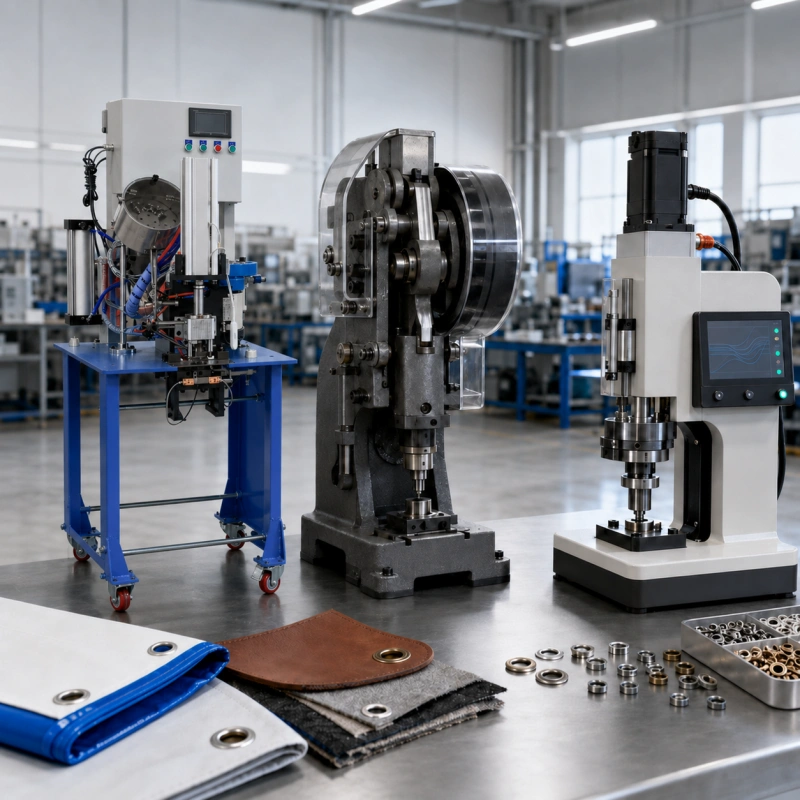
A machine can look excellent in a short video and become expensive after it reaches your factory. The demo shows a clean eyelet and a fast cycle. It rarely shows the compressor load, the force available at the exact working position, the sound beside the operator, or the parts that need attention after six months.
That is why a serious comparison of pneumatic vs mechanical vs servo eyelet machines must go beyond speed and maximum tonnage. All three technologies can produce a strong, attractive eyelet. The better machine is the one that produces the same result through your real material, at your required output, with utilities and maintenance your factory can support.
This guide compares the three drives through four pieces of proof: utilities, force curve, noise, and maintenance. These are the documents and test results a supplier should be able to show before you place an order.
First, Separate the Press Drive from the Feeding System
Eyelet machine names are often confusing. “Automatic,” “electric,” and “servo” do not always describe how the eyelet is pressed. They may only describe the feeder, worktable, or positioning axis.
A pneumatic eyelet machine uses compressed air to move the working cylinder. A mechanical eyelet machine normally uses an electric motor with a cam, crank, eccentric, toggle, or flywheel mechanism. A true servo eyelet press uses a servo motor with position feedback to control the pressing motion. Some machines combine these systems.
For example, a pneumatic press may use electric vibratory bowls, while a mechanical press may use a servo-controlled indexing table.
Ask one direct question: “What moves the final setting punch?” If the servo motor only moves the material or feeds the eyelet, the pressing force is not servo controlled. That does not make the machine bad. It simply means you should compare it under its real drive type.
The Quick Answer
Pneumatic machines are usually the practical all-rounder. They are simple to adjust, reduce operator effort, and suit many medium- to high-volume jobs. They make the most sense when clean, dry compressed air is already available.
Mechanical machines suit repetitive production where the eyelet, material, and setup stay stable for long runs. A well-built mechanical drive can be fast and durable, but its force changes with ram position. Correct tooling height is critical.
Servo machines are the strongest choice when the process needs recipes, programmable speed, force or position monitoring, and production records. Their purchase price and control complexity are higher. They earn that price when traceability, reduced scrap, or fast changeovers have real value.
How a Pneumatic Eyelet Machine Works?
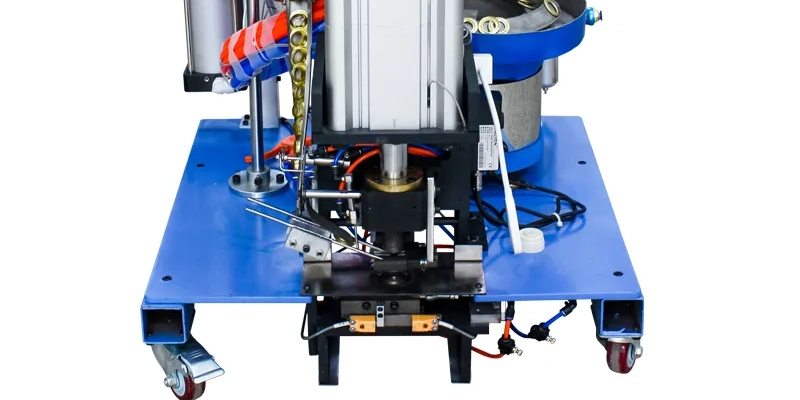
Compressed air enters a cylinder and pushes a piston. The piston moves the punch toward the die. On a direct-acting design, the available force is mainly related to air pressure, piston area, friction, and losses in the air circuit. With stable pressure, the press can deliver a relatively consistent push through its working stroke.
That simple action is useful for fabric, leather, paperboard, PVC, banners, shoes, bags, and many other eyelet jobs. The operator positions the material and triggers the cycle. A semi-automatic machine may feed the eyelet while the washer is loaded by hand. A more automatic model may feed both parts and combine punching and setting in one cycle.
Pneumatic adjustment is familiar to many factories. Pressure and flow controls are easy to understand. The machine can be compact, and the press head does not need a large drive motor. However, the air supply is part of the machine whether it appears in the quotation or not.
Low or unstable pressure can produce loose settings. Wet or dirty air can block valves, damage seals, and make cylinder movement inconsistent. Air leaks may not stop production immediately, but the compressor works longer to replace the lost air. A pneumatic machine is inexpensive to buy only when the complete air system is kept in good condition.
Best fit: mixed products, moderate or high output, straightforward setting requirements, and factories with a reliable compressed-air network.
How a Mechanical Eyelet Machine Works?
A mechanical eyelet machine converts motor rotation into the downward movement of the punch. The mechanism may use a crank, cam, eccentric, toggle, or flywheel. These details matter because they determine ram speed, working energy, and the force available at each point in the stroke.
Mechanical drives are attractive for stable, repetitive work. Once the dies, shut height, and feed are correctly adjusted, the machine can repeat the same motion for a long production run. There is no working-air requirement, so installation may be simpler in a workshop without a compressor.
The common buying mistake is to treat rated tonnage as if it were available everywhere. On a crank-style press, mechanical advantage rises as the ram approaches bottom dead center. The machine may deliver its rated force only within a specified distance above the bottom position. If the eyelet starts forming too early in the stroke, the available force can be lower than the nameplate suggests.
This is why die height and eyelet stack height cannot be guessed. A small change in material thickness, washer shape, or eyelet barrel length changes the point where load begins. If the setup is too high, the press may be overloaded before it reaches its strongest zone. If it is too low, the eyelet may not flare enough.
Best fit: long runs, stable materials, proven tooling, limited changeovers, and maintenance teams comfortable with bearings, belts, cams, guides, and alignment.
How a Servo Eyelet Machine Works?
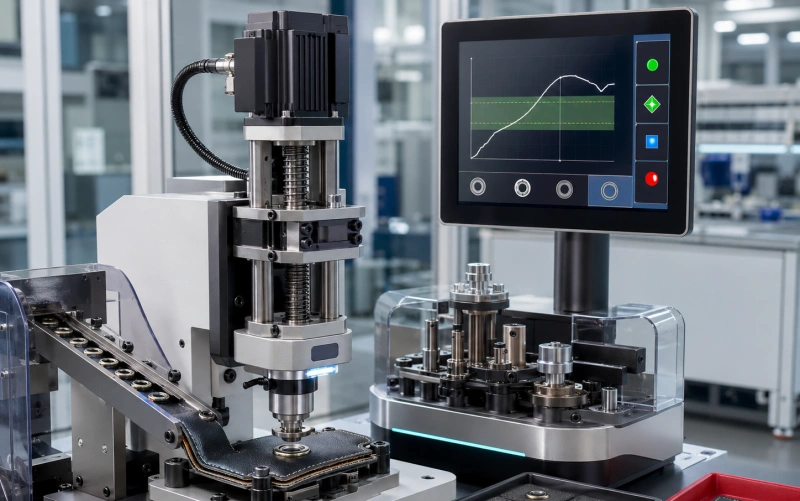
A true servo press uses a servo motor, feedback device, controller, and mechanical transmission—often a screw or another electromechanical actuator—to move the punch. The controller can command different speeds and positions during the cycle. With the correct load cell and software, it can also monitor force against displacement.
This control changes what the machine can prove. Instead of confirming only that the ram reached the bottom, a monitored servo process can check when the eyelet contacted the material, how the force rose, where peak force occurred, and where the punch finished.
A stored recipe can call the same motion for the next batch. A force–displacement window can flag a missing washer, wrong eyelet, doubled material layer, or incomplete flare if the defect changes the curve enough to cross the limits.
Servo does not mean unlimited force. Every servo system has maximum force, speed, duty cycle, motor torque, screw life, and thermal limits. Architecture also matters. A direct electric spindle may control force across its usable stroke, while a servo motor attached to a crank press still works through the crank mechanism’s force curve.
The software also deserves attention. Ask how recipes are backed up, how curve data is exported, what happens after a controller replacement, and whether the supplier can support the system remotely. A basic pneumatic valve may be available locally. A servo drive with a locked program may not be.
Best fit: quality-critical eyelets, frequent recipe changes, valuable materials, audited production, automated lines, and applications where data can prevent more cost than the servo system adds.
Required Proof 1: Utilities
Do not accept “air powered” or “electric powered” as a utility specification. Ask for a one-page utility sheet covering the complete machine, including the feeder, safety system, controls, lighting, and accessories.
For a pneumatic eyelet machine, the sheet should state required pressure, allowable pressure range, air consumption per cycle, minimum flow, connection size, and required air quality. Pressure without air consumption is incomplete.
A small compressor may reach the required pressure while idle and then lose pressure during continuous production. Ask for consumption at the quoted cycle rate, not only the cylinder volume on paper.
Also confirm whether the machine needs electricity. A pneumatic press head may still use 110 V, 220 V, or 380 V for vibratory bowls, a PLC, sensors, a laser guide, guards, or a touchscreen. If a supplier says “no electricity,” check whether that applies to the whole machine or only the press cylinder.
For mechanical and servo machines, request voltage, phase, frequency, installed power, normal running current, and peak or starting current. Ask whether the machine requires a transformer, voltage stabilizer, special grounding, cabinet cooling, or an external energy-storage unit. For fair operating-cost comparison, request measured energy per 1,000 good eyelets at the same cycle rate and material.
Utility proof to request: a signed utility sheet plus a test record at your expected production speed.
Required Proof 2: Force Curve
The force curve is where many quotations become vague. A single “maximum force” number does not tell you how the eyelet is formed.
A direct-acting pneumatic press can produce a relatively flat force characteristic through the stroke when pressure is stable. A pneumatic toggle press is different: its force rises sharply near the end of the stroke. Both machines may be called pneumatic, but they do not behave the same way.
A mechanical crank or eccentric press also builds mechanical advantage near bottom dead center. The supplier should state the rated-force point and provide available force versus ram position. The working energy per stroke matters too. A press can have enough peak force on paper and still slow, stall, or overheat when it must deliver that force repeatedly at production speed.
A servo press should provide more than a smooth screen animation. Ask for the real force–displacement curve from a load cell. Confirm sampling rate, force accuracy, position repeatability, allowed curve limits, data storage, and whether each cycle can be linked to a product or batch number.
The most useful curve is not a generic factory graph. It is a curve made with your eyelet, your washer, your die, and every material thickness you intend to run. Thin fabric, multilayer canvas, leather, and coated PVC do not load the tool in the same way. The eyelet barrel length and die cavity change the curve again.
Inspect the finished part while reading the curve. A beautiful graph cannot rescue the wrong die. The machine supplies force; the die turns that force into the flare. Check the front flange, the rear roll or split, washer grip, material damage, and resistance to spinning or pull-out.
Force proof to request: cold and warm force–displacement curves for actual production samples, with the acceptance limits explained.
Required Proof 3: Noise
Noise claims need test conditions. “Low noise” is marketing language until the supplier states where, how, and during which operation the sound was measured.
Pneumatic noise comes from valve switching, air exhaust, cylinder impact, feeders, and the compressor. Exhaust silencers can reduce noise at the machine, but a compressor beside the operator may dominate the result. If the compressor is located in another room, say so in the comparison.
Mechanical noise can come from the motor, flywheel, gears, belts, clutch or brake, frame vibration, feeder, and the moment the punch breaks through the material. A fast, rigid machine may still create a sharp impact sound even when the drive runs smoothly.
Servo systems are often quieter while idle and during approach because the motor moves only as commanded and can slow before contact. That does not eliminate punching noise. Cutting through dense leather or thick coated fabric still releases energy at breakthrough. A badly matched die can make a quiet drive sound harsh.
Ask for an A-weighted sound reading at the operator position. The report should state measurement distance, machine speed, material, eyelet size, feeder status, compressor location, and background sound. Compare complete working cycles under the same conditions.
Noise proof to request: a measured result or video that shows the sound meter, test position, material, and full cycle—not an idle machine.
Required Proof 4: Maintenance
Maintenance is not simply “low” or “high.” It is a list of tasks, intervals, parts, skills, and lead times.
Pneumatic maintenance starts with air quality. Drain the compressor and receiver as specified. Service filters and dryers. Check regulators, tubing, fittings, valves, cylinder seals, cushioning, and leaks. Use the lubricant stated by the manufacturer; the wrong oil can damage pneumatic components.
If force becomes unstable, check supply flow, pressure drop, condensate, dirt, lubrication, alignment, and seal condition before increasing pressure.
Mechanical maintenance focuses on lubrication, wear, and alignment. Inspect bearings, belts, cams, gears, guides, fasteners, guards, and any clutch or brake components. Listen for changes in sound. Check ram play and die alignment. A worn guide or loose bearing may first appear as an uneven rear flare rather than an obvious machine failure.
Servo systems remove some pneumatic parts and may remove clutch/brake wear, but they add electrical and control responsibilities. Inspect the screw or transmission, bearings, lubrication points, load cell, encoder, cables, cooling fans, filters, drive alarms, and cabinet temperature. Back up programs and recipes before a failure.
Confirm how force sensors are checked or calibrated and who can restore the machine after replacing a drive or controller.
Tooling maintenance applies to all three drives. Clean the dies, remove material debris, check the cutting edge, monitor eyelet feeding, and replace worn punches before they create ragged holes. Keep at least one proven spare die set for each regular eyelet. A machine with perfect mechanics will still make bad parts with a dull or mismatched die.
Maintenance proof to request: daily, weekly, monthly, and annual schedules; lubricant specifications; a two-year wear-parts list; recommended stock quantities; prices; lead times; and remote-support details.
Which Machine Is Better for Different Eyelet Jobs?
For a banner or tarpaulin workshop running several sizes, pneumatic is often the sensible starting point. It offers useful force, easy adjustment, and lower operator fatigue. Make sure the compressor can support continuous cycles and the dies are matched to coated material.
For a factory producing one shoe or bag style in long batches, a mechanical machine can be an efficient choice when the setup is proven and changeovers are limited. Pressure consistency is not the only concern; correct shut height and maintenance of alignment are just as important.
For safety products, medical items, automotive parts, premium leather goods, or contracts requiring production records, servo monitoring can justify the investment. The value comes from detecting a bad cycle before thousands of parts move downstream.
For a factory with many short orders, do not assume the fastest cycle wins. Measure changeover time from the last good part of one order to the first good part of the next. A slower machine with saved recipes and quick-change dies may produce more good parts during the week.
How to Run a Supplier Trial?
Send enough real material for a meaningful test. Include the thinnest and thickest versions, all layers used in production, the actual eyelets and washers, and a drawing or approved finished sample. Do not allow the supplier to substitute easier material or a different fastener.
Ask for a cold start, a continuous run, and another inspection after the machine is warm. Record cycle rate, rejects, adjustments, utility conditions, and operator interventions. Check at least the first parts, middle of the run, and final parts. Look at both sides of every setting.
If the machine has monitoring, introduce controlled faults: remove a washer, double the material, use a damaged eyelet, or lower the pressure within a safe test range. See whether the system detects the change. A monitoring screen that never rejects anything is not proof of control.
Finally, ask the supplier to return the samples. Photos hide small cracks, uneven rolling, loose washers, and marks on the front flange. Your production and quality teams should handle the parts before approving the machine.
FAQ
Is a servo eyelet machine always more accurate?
Not automatically. Servo motion can be highly repeatable, but finished quality still depends on frame rigidity, die alignment, load-cell integration, eyelet consistency, and correct recipes. A well-set pneumatic or mechanical machine can outperform a poorly engineered servo machine.
Is a pneumatic machine cheaper to operate?
It depends on the factory. If you already have an efficient compressor with spare capacity and good leak control, pneumatic operation may be economical. If the compressor runs mainly for one machine, or the air network leaks badly, the true cost can be much higher than the machine quotation suggests.
Is mechanical always the fastest?
No. Cycle speed depends on the full system: feeding, material positioning, safety controls, punching, setting, and part removal. Mechanical drives can be very fast in stable applications, but a quoted stroke rate is not the same as good eyelets per hour.
Does servo mean maintenance-free?
No. Servo removes some air components and may reduce mechanical wear in certain designs, but the machine still has bearings, transmission parts, sensors, cables, cooling components, software, and tooling. The maintenance work changes; it does not disappear.
What information should be on the quotation?
At minimum: exact drive type, eyelet and material range, feeding method, cycle-rate test conditions, utilities, force curve or rated-force position, safety configuration, noise test conditions, maintenance schedule, spare-parts list, warranty, training, and after-sales response method.
Final Decision: Buy the Proof, Not the Label
There is no universal winner in pneumatic vs mechanical vs servo eyelet machines.
Choose pneumatic grommet press when you want a flexible, practical press and can supply clean, stable air. Choose mechanical when the job is repetitive, the tooling position is proven, and high output matters more than recipe flexibility. Choose servo when controlled motion, force–displacement monitoring, and traceability can reduce the cost of defects and changeovers.
Before paying a deposit, collect the four proofs: the complete utility sheet, the real force curve, the measured noise result, and the preventive-maintenance plan. Then confirm them with your own eyelets, washers, and materials.
The name on the brochure does not set the eyelet. The complete machine, tooling, utilities, and process do. Buy the system that proves it can make good parts through a full working shift.