

In modern garment, bag, and footwear manufacturing, speed is no longer a competitive advantage—it is a basic requirement. What truly separates efficient factories from those constantly fighting quality issues is consistency. And in high-speed snap button machines, consistency lives or dies at one critical point: the feed system.
If you have ever experienced frequent jamming, missing snaps, incorrect button orientation, or unexplained downtime, chances are the root cause was not the riveting head—but the feeding process that supplies it. This article explains, in practical and technical terms, how feed systems reduce errors in high-speed snap button machines, and why investing in a precision feeding solution is essential for sustainable, high-volume production.
Throughout this article, you’ll see how a well-designed feed system transforms a snap button machine from a fast machine into a reliable production solution, and how QC Machinery positions itself as a trusted partner in solving these challenges.
What Is a Feed System in a Snap Button Machine?
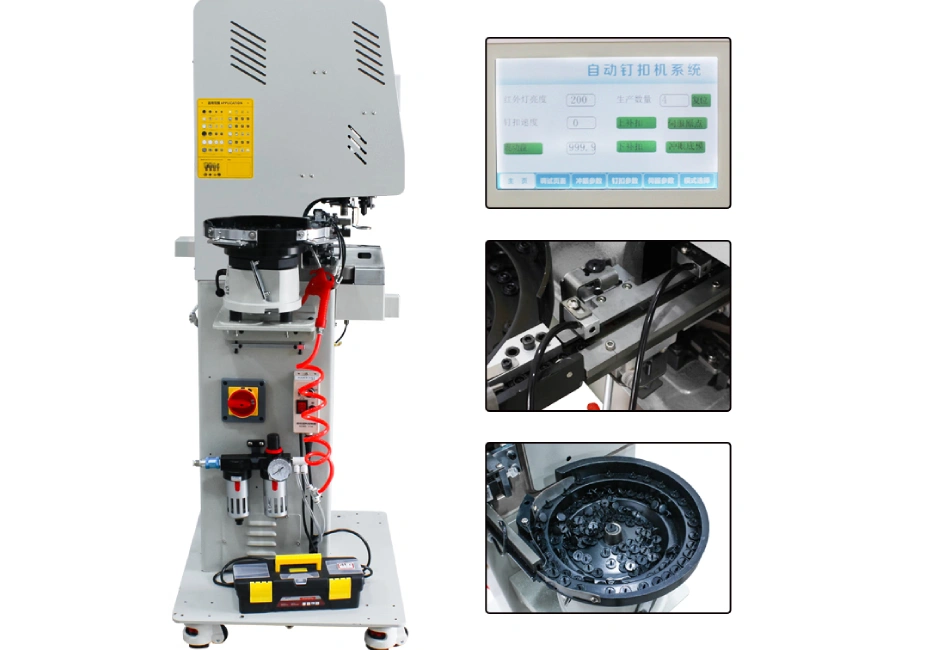
In the context of high-speed snap button machines, a feed system is the integrated mechanical and electronic unit responsible for automatically transporting snaps, buttons, eyelets, or rivets from bulk storage to the riveting position in a stable, orderly, and continuous manner.
On the QC Machinery website, the feed system is described as a precision component that ensures materials are delivered:
- Automatically
- Stably
- In the correct orientation
- At a speed synchronized with riveting
Its core purpose is simple but crucial:
to remove uncertainty from the production process.
Without a reliable feed system, even the most advanced snap button machine becomes dependent on manual intervention, operator skill, and constant adjustments—each of which introduces errors.
A precision feed system replaces variability with control. By doing so, it addresses problems at the source rather than correcting them after defects appear.
Why Errors Increase at High Speed
Before exploring solutions, it’s important to understand why errors become more frequent as production speed increases.
At low speeds, operators can visually monitor material flow, manually adjust feeding, and react to problems before they escalate. However, in high-speed snap button production:
- Riveting cycles occur in fractions of a second
- Human reaction time becomes irrelevant
- Minor inconsistencies multiply into major defects
Common high-speed errors include:
- Material jamming
- Misaligned snaps
- Empty riveting strokes
- Crushed or deformed buttons
- Unexpected machine stoppages
In nearly all cases, these issues trace back to one factor: unstable or poorly controlled feeding.
How Feed Systems Reduce Errors: The Core Mechanisms
A high-quality feed system does not simply “move parts.” It actively controls motion, timing, and orientation, ensuring that each snap arrives at the exact place, in the exact position, at the exact moment it is needed.
Let’s break down the key mechanisms that make this possible.
Ordered Feeding: Eliminating Chaos at the Source
One of the most overlooked causes of errors is material disorder.
Snaps and eyelets are small, symmetrical, and often lightweight. Without proper guidance, they can:
- Flip unpredictably
- Stack incorrectly
- Enter the tooling in the wrong orientation
QC Machinery’s feed systems address this through precision tray rotation and raceway design.
According to the QC Machinery website:
“The rotation speed of the material tray is uniform, the eyelets in raceway are arranged in order.”
Why This Matters
Uniform tray rotation ensures that materials enter the raceway at a predictable pace. The raceway itself acts as a filter—only parts in the correct orientation proceed forward.
By the time the snap reaches the riveting point, orientation is no longer a variable. This eliminates:
- Directional errors
- Misfeeds
- Tooling damage caused by incorrect placement
In high-speed environments, order equals reliability.
Stable Feeding Speed: Preventing Jams and Missed Rivets
Feeding speed must match riveting speed—not approximately, but precisely.
QC Machinery emphasizes this through:
“Excellent voltage stabilizing performance ensures stable feeding speed.”
The Role of Voltage Stability
Voltage fluctuations may seem like a minor electrical issue, but in automated feeding systems, they directly affect motor speed and vibration frequency.
When feeding speed fluctuates:
- Material arrives too late → empty riveting stroke
- Material arrives too early → collision or jamming
- Speed mismatch → cumulative timing errors
By stabilizing voltage, QC Machinery ensures that feeding speed remains constant even when external power conditions change.
The Result
- No “machine waiting for material”
- No “material chasing the machine”
- Smooth, uninterrupted operation
In high-speed snap button machines, timing is quality.
Self-Designed Vibrating Plates: Consistency by Design
At the heart of many feed systems is the vibrating plate (or vibrating bowl). This component determines how materials move, align, and advance.
QC Machinery highlights:
“Self designed vibrating plate with consistent speed.”
Why Self-Design Matters
Off-the-shelf vibrating plates are designed for general use. They may work adequately at low speeds or with uniform materials, but high-speed snap production demands more:
- Precise vibration frequency
- Controlled amplitude
- Material-specific track geometry
By designing vibrating plates in-house, QC Machinery controls every variable that affects feeding consistency.
Error Reduction Benefits
- Uniform vibration prevents material bouncing
- Controlled speed reduces overlapping or skipping
- Custom track design ensures correct orientation
This level of control is essential for maintaining accuracy at scale.
Synchronization with High-Speed Riveting
A feed system does not operate in isolation. It must function as part of a synchronized mechanical ecosystem.
QC Machinery states:
“The riveting speed is fast and stable.”
A fast riveting head is only an advantage if feeding keeps up perfectly.
Precision Matching
QC Machinery feed systems are engineered to:
- Match feeding rhythm to riveting cycles
- Maintain consistent intervals between parts
- Avoid acceleration or deceleration mismatches
This synchronization eliminates:
- Empty hits
- Double feeds
- Sudden stops due to timing errors
In other words, feeding and riveting operate as one coordinated system, not two independent mechanisms.
Reducing Dependence on Operators
Manual feeding introduces three unavoidable risks:
- Fatigue
- Inconsistency
- Human error
Even skilled operators cannot match the precision of an automated feed system operating at high speed for extended periods.
How Automation Improves Consistency
With automatic feeding:
- Each snap is handled the same way
- Speed does not change with shift length
- Accuracy does not depend on experience level
This leads to:
- Lower training costs
- Fewer production interruptions
- More predictable output quality
For factories aiming to scale production, reducing operator dependency is not optional—it is strategic.
Feed Systems as a Quality Control Tool
Traditionally, quality control focuses on inspection after production. However, the most effective quality control happens before defects occur.
A precision feed system acts as a preventive quality mechanism by:
- Ensuring correct orientation
- Eliminating timing errors
- Preventing mechanical stress
QC Machinery reinforces this approach through its emphasis on:
- Complete machine assembly
- Integrated quality control testing
Each feed system is tested as part of the full machine, ensuring long-term stability rather than short-term performance.
QC Machinery’s Engineering Advantage
Feed systems are not generic components—they are engineering solutions.
QC Machinery distinguishes itself through:
In-House Development
Self-designed vibrating plates and voltage-stabilized feeding systems give QC full control over performance and reliability.
System-Level Thinking
Feed systems are engineered as part of the entire snap button machine, not as add-ons.
Process-Oriented Quality Control
Every system undergoes functional testing under real operating conditions.
This depth of engineering expertise is what transforms a machine supplier into a solution provider.
Customization for Different Materials
Not all snaps are the same.
Differences in:
- Diameter
- Thickness
- Weight
- Material composition
can dramatically affect feeding behavior.
QC Machinery addresses this through its commitment to:
“We can provide customized machine.”
Why Custom Feeding Matters
A feed system optimized for one snap type may perform poorly with another. Customization ensures:
- Correct vibration characteristics
- Proper track geometry
- Stable flow regardless of material variation
This flexibility is critical for manufacturers working with diverse product lines.
Long-Term Reliability and ROI
A feed system is not just a component—it is an investment.
Poor feeding leads to:
- Scrap
- Downtime
- Tooling damage
- Lost production hours
A precision feed system reduces these hidden costs by ensuring stable operation over the long term.
The result is:
- Higher overall equipment effectiveness (OEE)
- Lower maintenance costs
- Faster return on investment
Feed Systems as Part of a Production Solution
When evaluating a snap button machine, focusing only on speed or price is short-sighted.
The real question is:
How reliably can this machine produce quality output at scale?
Feed systems play a central role in answering that question.
QC Machinery positions its feed systems not as accessories, but as core elements of a complete production solution.
From Equipment Supplier to Long-Term Partner
By investing in feeding technology, QC Machinery demonstrates a deeper understanding of manufacturing realities.
This approach shifts the relationship from:
- Vendor → Customer
to:
- Engineering Partner → Manufacturer
The goal is not just to sell machines, but to support long-term production success.
FAQ
Why is the feed system so critical in high-speed snap button machines?
The feed system controls how snaps are delivered to the riveting point. In high-speed snap button machines, even a small feeding inconsistency can cause jams, missed rivets, or orientation errors. A precision feed system ensures stable speed, correct alignment, and continuous material flow, which directly reduces downtime and quality defects.
How does a stable feeding speed help reduce production errors?
Stable feeding speed keeps the material supply perfectly synchronized with the riveting cycle. When speed fluctuates, snaps may arrive too early or too late, causing empty strokes or collisions. Voltage-stabilized feed systems maintain consistent timing, allowing the machine to operate smoothly and reliably at high production speeds.
What role does the vibrating plate play in reducing feeding errors?
The vibrating plate is responsible for moving and orienting snaps before they enter the raceway. A well-designed vibrating plate ensures uniform vibration and controlled movement, preventing snaps from overlapping, bouncing, or flipping incorrectly. This consistency significantly lowers the risk of misfeeds and tool damage.
Can a customized feed system really improve production efficiency?
Yes, customization is extremely important. Different snap sizes, shapes, and materials behave differently during feeding. A customized feed system is designed specifically for your materials, ensuring stable flow and correct orientation. This reduces adjustment time, minimizes scrap, and improves long-term production efficiency.
How does an automatic feed system reduce reliance on machine operators?
Automatic feed systems remove the need for manual material placement, which is prone to fatigue and inconsistency. By automating feeding, the machine delivers the same accuracy throughout every shift, reducing operator workload, lowering training requirements, and ensuring consistent quality regardless of who operates the machine.
How does a high-quality feed system improve long-term return on investment (ROI)?
A reliable feed system reduces downtime, material waste, and maintenance costs over time. By preventing jams and misfeeds, it protects tooling and ensures continuous production. This leads to higher overall equipment effectiveness, lower operating costs, and faster payback on your snap button machine investment.
Conclusion
In high-speed snap button machines, errors do not happen randomly. They are the predictable result of instability, inconsistency, and poor synchronization—most often originating in the feed system.
A precision feed system:
- Eliminates material disorder
- Stabilizes speed and timing
- Reduces human error
- Protects tooling and materials
- Improves overall production efficiency
QC Machinery’s focus on self-designed feeding solutions, voltage stability, quality control, and customization reflects a clear understanding of what modern manufacturers truly need.