Imagine this. A small clothing brand launches a beautiful new denim jacket. It looks perfect on display. But after a few weeks, customers start returning it. The pocket corners are tearing. The flap won’t stay closed. The issue wasn’t the fabric. It wasn’t the stitching. It was the wrong fastener.
This is exactly why understanding Snap Button vs. Rivet vs. Eyelet matters more than many manufacturers realize.
At first glance, snap buttons, rivets, and eyelets may look similar. They’re small metal pieces pressed into fabric or leather. But in practice, they perform completely different functions. Choosing the wrong one can lead to product failure, wasted materials, and slower production.
Choosing the right one, on the other hand, improves durability, enhances appearance, and increases efficiency—especially when installed using a reliable multifunctional system from QC Machinery.
Let’s explore everything you need to know so you can make the right choice every time.
Understanding the Basics: Why Fasteners Matter More Than You Think
Fasteners may be small, but they carry enormous responsibility. They hold stress points together. They allow garments to open and close. They protect materials from tearing. In industrial settings, they even secure structures under tension.
In the debate of Snap Button vs. Rivet vs. Eyelet, the real question isn’t which is better overall. It’s which is better for your specific purpose.
A fastener must match:
- The material thickness
- The tension applied
- The frequency of use
- The visual design
- The production environment
When these factors align, your product lasts longer and performs better.
Snap Buttons: The Reusable and User-Friendly Option
Snap buttons are designed for movement. They are made of two main parts: a stud and a socket. When pressed together, they “snap” into place. When pulled apart, they separate cleanly without damage.
That simple clicking sound represents convenience.
Where Snap Buttons Shine
Snap buttons are commonly used in:
- Jackets
- Baby clothing
- Handbags
- Upholstery covers
- Reusable packaging
They work best when repeated opening and closing is required. A high-quality snap button can handle thousands of cycles without losing its grip.
Materials Used
Snap buttons can be made from:
- Stainless steel
- Brass
- Plastic
- Resin
Because they are available in many finishes and colors, they often become decorative elements as well as functional parts.
Strengths and Limitations
Strengths:
- Reusable
- Easy to operate
- Visually appealing
- Suitable for light to medium materials
Limitations:
- Not ideal for extreme stress points
- Requires precise pressure during installation
When installed improperly, snap buttons may loosen. That’s why professional machinery makes such a difference.
Rivets: The Permanent Strength Solution
If snap buttons represent flexibility, rivets represent commitment.
A rivet is designed to permanently join two materials together. Once installed, it cannot be removed without damage. That permanence is exactly why it is trusted in high-stress applications.
Common Uses of Rivets
- Reinforcing jean pockets
- Securing leather straps
- Industrial workwear
- Heavy canvas goods
- Structural components
Rivets are typically made of:
- Copper
- Steel
- Aluminum
They distribute stress across a wider surface area, preventing tearing at connection points.
Why Rivets Are So Strong
The strength of a rivet comes from its design. When pressed, the tail expands and locks into place. This creates a mechanical bond that resists pulling force.
In heavy-duty products, rivets protect critical stress areas that would otherwise fail over time.
When Rivets Are Not Ideal
Because they are permanent, rivets are not suitable when separation is required. They also require enough material thickness to hold securely.
Eyelets: The Protective Reinforcement Expert
Eyelets serve a completely different purpose. They don’t join two materials together. Instead, they reinforce holes.
If a rope, lace, or hook passes through a fabric hole repeatedly, the material can tear. An eyelet prevents that damage.
Where Eyelets Are Commonly Used
- Shoelace holes
- Tarpaulins
- Tents
- Banners
- Curtains
- Display signage
Eyelets are usually made of:
- Brass
- Nickel-plated steel
- Aluminum
The Real Power of Eyelets
Eyelets distribute tension evenly around a hole. This prevents stress from concentrating on one point.
For outdoor products like tarpaulins or tents, eyelets are absolutely essential. Without them, tie-down areas would fail quickly.
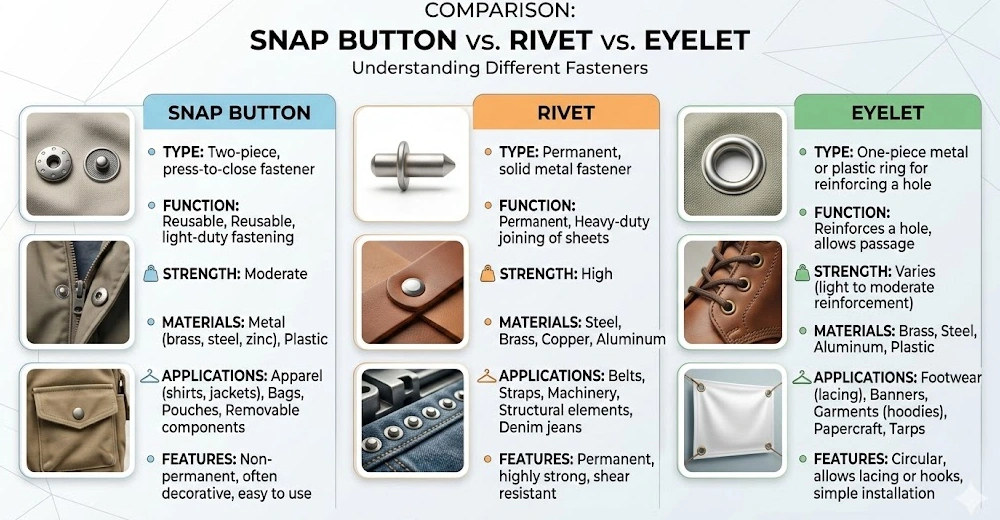
Snap Button vs. Rivet vs. Eyelet: Direct Comparison
Let’s simplify things with a clear comparison:
| Feature | Snap Button | Rivet | Eyelet |
|---|---|---|---|
| Function | Reusable closure | Permanent bond | Reinforce hole |
| Reusability | High | None | Not applicable |
| Best For | Garments, bags | Stress points, leather | Rope or lace pass-through |
| Strength Level | Moderate | Very high | Protects material |
| Visual Impact | Decorative | Industrial or rustic | Functional with design options |
Now the differences become clearer.
Application Guide: Choosing the Right Fastener for Your Industry
Apparel Manufacturing
For clothing like jackets and baby wear:
- Use snap buttons for closures.
- Use rivets for reinforcing pockets or stress areas.
Delicate fabrics require controlled pressure. Advanced machinery ensures snaps are secure without damaging the material.
Leather Goods & Bags
Leather demands strength.
- Rivets secure straps permanently.
- Snap buttons provide convenient flap closures.
- Eyelets add decorative or lace features.
A powerful installation system is necessary to penetrate thick leather cleanly.
Outdoor & Industrial Products
Outdoor materials face wind, rain, and tension.
- Heavy-duty eyelets are essential for tie-down points.
Strong pressing force ensures proper eyelet formation in thick fabrics like tarpaulins.
Packaging & Specialty Materials
PVC sheets, cardboard displays, and plastic sheeting require flexibility.
- Snap buttons allow reusable packaging.
- Eyelets reinforce hanging holes in signage.
Not all machines handle these materials effectively. Specialized systems make the difference.
The Efficiency Factor: Why Machinery Changes Everything
Even the best fastener fails if installed poorly.
Manual hand tools may seem affordable, but they create problems:
- Slow output
- Inconsistent pressure
- Worker fatigue
- Higher defect rates
Over time, these inefficiencies cost more than investing in automated solutions.
The QC Machinery Advantage
Modern production requires versatility and stability.
QC Machinery’s multifunctional snap button machine handles snap buttons, rivets, and eyelets with a simple tooling change. That means:
- No need for three separate machines
- Faster production changeovers
- Reduced floor space usage
The self-designed vibrating plate ensures consistent fastener feeding. The raceway design allows smooth transfer. Voltage stabilizing performance reduces noise and maintains steady operation.
The result?
- Higher efficiency
- Lower defect rates
- Improved working conditions
When productivity and precision matter, machinery becomes your competitive advantage.
Snap Button and Rivet and Eyelet installation
Snap Button, Rivet, and Eyelet installation equipment is available in both pneumatic (air-powered) and electric models, giving manufacturers flexible options based on their production scale and factory setup. Pneumatic machines use compressed air to deliver strong, fast, and consistent pressure, making them ideal for high-volume production lines where speed and durability are critical.
They are especially suitable for thick materials like leather, canvas, and industrial fabrics because the air pressure provides powerful and stable punching force. On the other hand, electric models operate with motor-driven systems that offer precise control, quieter performance, and easier installation without the need for an air compressor.
Electric machines are often preferred by small to medium-sized workshops that require steady performance with lower maintenance complexity.
Both pneumatic and electric types significantly improve efficiency compared to manual tools, ensuring uniform fastening quality for snap buttons, rivets, and eyelets while reducing labor intensity and increasing overall productivity.
FAQ
1. Which fastener is strongest?
Rivets provide the strongest and most permanent bond among the three options. Unlike snap buttons, which are designed for repeated opening and closing, rivets are engineered to create a fixed mechanical connection that does not come apart once installed. When pressed, the rivet shaft expands and locks tightly into place, distributing force across the material surface. This makes rivets ideal for high-stress areas such as jean pocket corners, leather strap attachments, workwear reinforcement, and industrial applications. However, their strength also means they are not removable without damaging the material, so they should only be used when a permanent bond is required.
2. Can snap buttons be used on leather?
Yes, snap buttons can absolutely be used on leather, and they are commonly seen on leather jackets, bags, and accessories. However, proper pressure control during installation is critical. Leather is thicker and less flexible than fabric, so excessive force can crack, stretch, or deform the material. Insufficient pressure, on the other hand, may result in loose snaps that detach over time. Using a calibrated pneumatic or electric installation machine ensures balanced pressure, clean penetration, and a secure hold without damaging the leather surface. In some cases, adding a small reinforcement backing can further improve durability.
3. Are eyelets waterproof?
Eyelets themselves are not waterproof components. Their main purpose is to reinforce holes and prevent tearing when tension is applied, such as when ropes or laces pass through. When installed on waterproof materials like tarpaulins or tents, eyelets help maintain structural integrity, but they do not seal the hole completely. In fact, inserting an eyelet creates an opening, which may allow minimal moisture penetration unless additional sealing measures are applied. For applications requiring full waterproof performance, manufacturers often combine eyelets with sealing washers or specialized coatings.
4. Can one machine install all three fasteners?
Yes, a multifunctional installation machine can handle snap buttons, rivets, and eyelets by changing the tooling dies. Modern pneumatic and electric systems are designed for versatility. Instead of purchasing three separate machines, manufacturers can switch molds or attachments depending on the fastener type. This reduces equipment costs, saves factory space, and improves workflow efficiency. The key is ensuring the machine provides adjustable pressure settings to accommodate different materials and fastener sizes. Proper tooling alignment is also essential to maintain consistent quality across all applications.
5. What causes snap buttons to loosen?
Several factors can cause snap buttons to loosen over time. The most common reason is incorrect installation pressure—either too much or too little. Excessive force may deform the snap components, weakening their locking structure. Insufficient force may prevent the stud and socket from securing tightly. Misalignment during installation can also compromise performance, as even slight positioning errors affect the locking mechanism. Additionally, low-quality materials or incompatible fabric thickness can lead to early failure. Using high-quality fasteners and precision machinery significantly reduces these risks.
6. Are rivets suitable for thin fabrics?
Generally, rivets are not recommended for thin or lightweight fabrics unless reinforcement is added. Because rivets create a permanent mechanical bond through material compression, thin fabrics may tear or distort under pressure. If rivets must be used on lighter materials, manufacturers often add backing washers or reinforcement patches to distribute stress more evenly. Without reinforcement, repeated tension or movement may cause the surrounding fabric to weaken and fail. For lightweight garments, snap buttons are usually a safer and more practical choice.
Final Thoughts: Make the Smart Choice
The discussion of Snap Button vs. Rivet vs. Eyelet isn’t about which one is superior. It’s about understanding purpose.
- Need a reusable closure? Choose snap buttons.
- Need permanent strength? Choose rivets.
- Need reinforced holes? Choose eyelets.
But remember—installation quality matters just as much as selection.
At QC Machinery, we don’t just sell equipment. We provide complete fastener solutions. With over 15 years of experience and exports to more than 50 countries, our specialists help you select the right tooling for your specific material—whether it’s delicate silk or heavy-duty PVC.
Still not sure which solution fits your production line?
Contact QC Machinery today and let’s build something stronger, faster, and smarter—together.