
There is a common assumption in manufacturing that an eyelet is simply an eyelet. It is a metal ring. It reinforces a hole. You buy it from a catalog, press it into the fabric, and move on to the next operation. This assumption holds true for perhaps eighty percent of applications.
It is the remaining twenty percent that separate competent manufacturers from exceptional ones.
I have spent fifteen years inside a factory that produces both eyelets and the machinery that sets them. I have watched standard components fail in spectacular and expensive ways. I have also watched custom engineering transform problematic products into market leaders. The difference is not the cost of the fastener. The difference is knowing when standard is sufficient and when standard is a compromise you cannot afford.
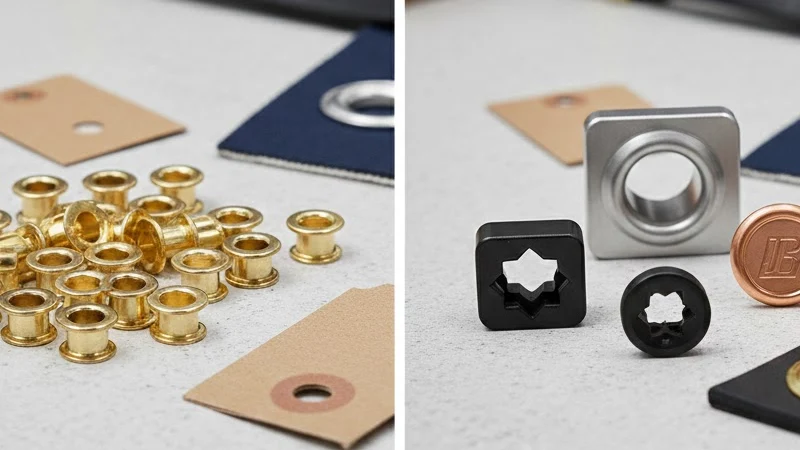
Standard eyelets work perfectly—until the fabric is too thick and the barrel splits. Until the coating corrodes in a marine environment. Until the color clashes with a luxury handbag collection and the buyer rejects an entire shipment. Until the flange is too wide for a narrow belt loop and the product cannot be assembled.
These are not hypothetical scenarios. They are daily conversations in our engineering department.
We are not a distributor. We are a manufacturing facility with in-house tooling, material sourcing, and a dedicated engineering team. We do not just stock eyelets; we design and produce them, along with the machinery that sets them. This gives us a perspective that pure traders or pure machine builders cannot offer. We see the full system—the component, the tooling, the substrate, and the interaction between them.
This article is about that system. It is about understanding when to specify standard eyelets and when to demand custom engineering. More importantly, it is about how to have that conversation with your supplier, and what questions to ask before you commit to a production run.
Defining the Baseline: What “Standard” Actually Means
Before you can decide whether you need custom eyelets, you must understand what standard represents. Standardization exists because certain sizes, materials, and finishes satisfy the majority of commercial applications. These parameters have evolved over decades to balance performance, cost, and availability.
The Common Sizes:
Standard eyelets typically range from 3mm to 12mm inside diameter. The most common sizes are 3mm, 5mm, 8mm, and 10mm. For curtain grommets, the range extends larger—often 16mm, 19mm, and 25mm—accommodating standard curtain rod diameters. These dimensions correspond to the cords, laces, hooks, and hardware that dominate the global supply chain.
The Common Materials:
Brass is the most versatile standard material. It is strong enough for most applications, corrosion-resistant enough for indoor use, and malleable enough to set cleanly without cracking. It also has a warm, traditional aesthetic that ages gracefully.
Steel offers greater tensile strength at lower cost. Its primary disadvantage is susceptibility to rust. Standard steel eyelets are typically plated—zinc, nickel, or chrome—to provide corrosion resistance.
Aluminum is lightweight and naturally corrosion-resistant. It is softer than brass, which makes it easier to set, but also less resistant to deformation under load. It is common in marine canvas, camping equipment, and lightweight bags.
Plastic grommets are economical, rust-proof, and available in molded colors. They lack the strength of metal and are unsuitable for high-tension applications, but they dominate the curtain and light packaging sectors.
The Common Finishes:
Standard finishes include raw brass (which will patina naturally), nickel-plated (bright silver appearance), antique brass (darkened, aged look), and black oxide. These four finishes account for perhaps eighty-five percent of commercial demand.
The Performance Baseline:
A standard 8mm brass eyelet, properly set in medium-weight cotton canvas, will resist pull-out forces of approximately twenty-five pounds. This is sufficient for most apparel, accessories, and decorative applications. It is not sufficient for industrial tarps, suspension seating, or heavy-duty equipment covers.
The Availability Factor:
Standard eyelets are available immediately. They are manufactured in high volumes and stocked by distributors globally. If your requirements fall within standard parameters, you can have components on your loading dock within days.
This is the value proposition of standard components. It is a valid proposition for the majority of manufacturers. The challenge is recognizing when your product has moved outside that majority.
When Standards Fail: The Anatomy of a Mismatch
Standard components fail not because they are defective, but because they are applied outside their design envelope. Understanding this envelope is the first step in diagnosing why your eyelets are failing.
Problem 1: Material Thickness Mismatch
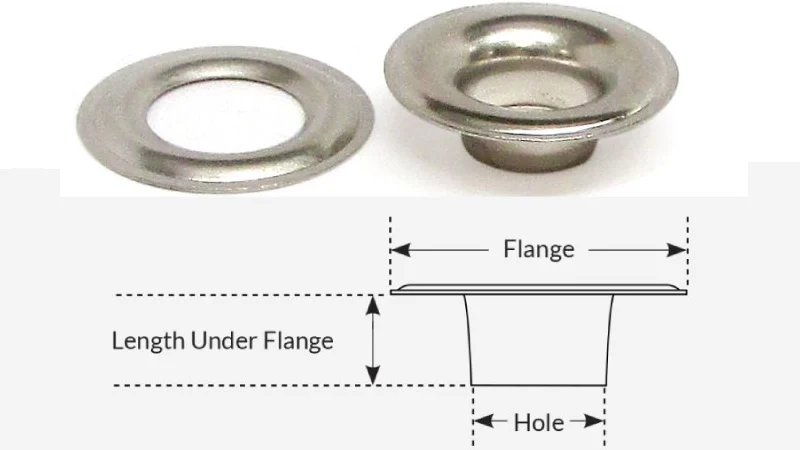
A standard eyelet has a barrel length designed for a specific material thickness range, typically 0.8mm to 1.5mm for most apparel-grade eyelets. If your fabric is thinner than this range, the barrel extrudes too far beyond the material surface and cannot flare properly. The result is a loose, rattling washer that provides minimal grip.
If your fabric is thicker than the barrel length, the eyelet cannot penetrate fully. The barrel buckles during flaring, or splits along its seam. The rejection rate climbs. Operators begin sorting rather than producing.
Real-World Example: A manufacturer of heavy canvas tool bags attempted to use standard 8mm eyelets. Their canvas was 3mm thick—double the design specification of the eyelet. The barrel split during flaring on thirty percent of pieces. They assumed the eyelets were defective. They switched suppliers. The problem persisted. The defect was not the component; it was the specification.
Problem 2: Environmental Exposure
Standard brass will patina. This is a chemical fact, not a manufacturing defect. For some products—traditional luggage, heritage apparel, architectural textiles—this patina is desirable. It signals authenticity and age.
For other products, it is unacceptable. Marine canvas exposed to saltwater will develop green corrosion within months. Outdoor furniture cushions in coastal environments will stain adjacent fabrics. Medical or food-contact applications cannot tolerate corrosion products.
Problem 3: Aesthetic Demands
Fashion brands do not accept “close enough.” I have stood in meetings where a buyer rejected an entire production run because the antique brass finish was three percent redder than the approved sample. To the untrained eye, the difference was invisible. To the brand manager, it was a violation of identity.
Standard finishes vary from batch to batch. This is inherent in the plating process. For mass-market products, the variation is acceptable. For premium brands, it is not.
Problem 4: Mechanical Load
Not all eyelets are decorative. Some are structural.
Industrial tarps experience wind loads measured in hundreds of pounds. Suspension seating distributes a human body’s weight through four or six attachment points. Heavy-duty equipment covers are dragged, stretched, and abused.
Standard eyelets are not engineered for these forces. Their pull-out strength is adequate for a shoelace. It is inadequate for a cargo tarp.
Problem 5: Unusual Substrates
Modern technical fabrics bear little resemblance to the cotton and linen for which standard eyelet geometries were developed.
PVC-coated polyester behaves plastically under compression; it does not spring back. Synthetic meshes have open structures that cannot support a standard barrel. Recycled materials have inconsistent density. Laminates and membranes introduce layers that can delaminate during setting.
Each of these substrates requires a different approach. Standard eyelets were not designed for them.
The Custom Engineering Process: From Problem to Solution
Custom eyelet engineering is not magic. It is a disciplined process of defining requirements, selecting materials, specifying dimensions, and validating performance. When conducted properly, it transforms a chronic quality issue into a non-issue.
Step 1: Requirement Definition
The process begins with a question: What is the specific failure or limitation of the standard component?
This seems obvious, but most manufacturers skip this step. They assume they need a stronger eyelet, or a longer barrel, or a different finish. Sometimes they do. Sometimes the problem is actually the die, or the machine pressure, or the operator technique.
We ask customers to send us samples. Not drawings—actual production samples showing the failure mode. A split barrel tells us the material is too thick or the die angle is too aggressive. A spinning washer tells us the flare is incomplete or the board is crushing. A corrosion stain tells us the environment is more aggressive than standard brass can tolerate.
With the physical evidence in hand, we define the requirements precisely:
- What is the exact material thickness?
- What is the required pull-out force?
- What is the environmental exposure?
- What is the aesthetic target?
- What is the production volume?
Step 2: Material Selection
Once the requirements are clear, we select the appropriate material.
For corrosion resistance beyond standard brass, we move to stainless steel or nickel-plated brass. Stainless is more expensive and harder to set, but it is virtually immune to saltwater corrosion.
For weight reduction, we specify aluminum or high-durability polymers. Aluminum eyelets weigh approximately one-third of brass equivalents.
For cost reduction in high-volume applications, we engineer hybrid constructions or advanced polymers with molded-in color, eliminating secondary finishing operations.
Step 3: Dimensional Engineering
This is where the component takes shape.
Barrel length is extended for thick materials—leather, multiple fabric layers, foam-backed substrates. The standard 4mm barrel becomes 6mm, 8mm, or longer. The die must change accordingly.
Barrel wall thickness is increased for higher pull-out resistance. Thicker walls require greater setting pressure but provide substantially higher retention forces.
Flange diameter is widened for greater load distribution on soft or fragile substrates. A wider flange spreads the tensile stress over a larger area, reducing the risk of pull-through.
Flange diameter is narrowed for tight spaces—narrow belt loops, trim applications, miniaturized products.
Inside diameter is adjusted for custom cordage or mating hardware. A standard 8mm eyelet accepts 5mm cord. If your cord is 6mm, the standard component will bind or abrade.
Step 4: Finish and Color
Finish specification is both technical and aesthetic.
Plated finishes: Nickel, chrome, antique brass, antique copper, black nickel, and countless variations. Each requires specific plating chemistry and cycle times.
Painted finishes: Custom RAL or Pantone colors for brand matching. Painted finishes also provide additional corrosion protection.
Mechanical finishes: Brushed, polished, matte, or textured surfaces achieved through physical finishing operations.
Step 5: Prototyping and Testing
This is the step that separates serious suppliers from catalog resellers.
We produce sample quantities—typically fifty to one hundred pieces—using production-representative tooling. These samples are shipped to the customer for testing in their actual application. Not laboratory simulation. Actual production.
The customer sets the samples using their machinery, their operators, their quality criteria. They send us feedback. We adjust the geometry, the material temper, the finish formulation. We produce second-round samples. We iterate until the component performs exactly as required.
Only then do we commit to production tooling and volume manufacturing.
Our Capability:
We manufacture both the eyelets and the machinery that sets them. This closed-loop capability is rare and strategically important.
When we engineer a custom eyelet, we simultaneously engineer the setting parameters. We know what die profile will produce the optimal flare. We know what pressure curve will set the barrel without crushing the substrate. We know what feed mechanism will handle the non-standard flange geometry.
There is no handoff between component supplier and machine supplier. There is no miscommunication. There is no “we can only modify the component, not the tooling.” We control the entire system.
Case Studies: When Custom Was the Only Answer
Case Study A: Heavy Leather Belt Manufacturer
The Problem: A manufacturer of premium leather belts used standard 5mm brass eyelets for their buckle attachment. The belts were constructed from 4mm thick bridle leather—substantially thicker than the 1.5mm material for which the eyelets were designed. Thirty percent of the eyelets split during setting. The remaining seventy percent exhibited stress cracks that would propagate during customer use.
The Investigation: We examined the split barrels under magnification. The failure was consistent: the barrel wall thickness was insufficient to withstand the compression required to flare through thick leather. The die was forcing the barrel to expand beyond its material limit.
The Solution: We engineered a custom eyelet with a barrel extended by 2.5mm and wall thickness increased by 0.15mm. We also modified the die geometry to a shallower flare angle, allowing the thicker material to roll gradually rather than snap abruptly.
The Result: Zero splitting. The rejection rate dropped from fifteen percent to under one percent. The customer now specifies this custom component for all heavy leather production and has eliminated incoming inspection for this item.
Case Study B: Marine Canvas Fabricator
The Problem: A fabricator of boat covers and bimini tops used standard brass eyelets for all attachments. Within six months of installation in saltwater environments, the eyelets developed green corrosion. The corrosion was cosmetic initially, but progressive. By twelve months, some eyelets exhibited sufficient material loss to compromise retention.
The Investigation: Standard brass contains approximately 70% copper and 30% zinc. In saltwater environments, the zinc leaches preferentially, leaving a porous copper structure. This is the green patina. It is decorative on architectural copper. It is structural failure on marine hardware.
The Solution: We replaced brass with 304 stainless steel. To allow the customer to use existing setting equipment, we matched the external dimensions exactly to their standard brass component.
The Result: Five-year corrosion-free service life. The customer now specifies stainless steel for all coastal clients and offers it as a premium upgrade for inland customers.
Case Study C: Luxury Fashion House
The Problem: A European luxury brand specified antique brass eyelets for a handbag collection. The standard antique finish varied visibly from batch to batch. Some shipments were golden; others were nearly brown. On the retail floor, bags from different production runs displayed noticeably different hardware. The brand could not maintain consistent presentation.
The Investigation: Antique brass is typically achieved by applying a darkening chemical to polished brass and then selectively highlighting the raised surfaces. The process is manual and inherently variable. No two batches are identical. For mass-market products, this variation is imperceptible. For luxury goods displayed under focused retail lighting, it was unacceptable.
The Solution: We developed a custom color-matched finish with a sealed topcoat to prevent further patina development. The color specification was verified using spectrophotometric measurement with defined tolerance windows.
The Result: Consistent appearance across all production runs. The brand maintained its premium pricing position and eliminated a recurring source of quality complaints.
Case Study D: Technical Outerwear Brand
The Problem: A manufacturer of waterproof breathable jackets used standard eyelets for ventilation ports and drawcord exits. Water penetrated around the eyelet barrel during rain, compromising the garment’s waterproof integrity.
The Investigation: The eyelet itself was watertight. The leak path was between the barrel exterior and the fabric hole. Standard setting compresses the fabric but does not create a hydraulic seal.
The Solution: We engineered a custom eyelet with an integrated rubber gasket on the underside of the flange. We also modified the setting process to compress the gasket to a specific thickness without over-compressing and damaging the breathable membrane.
The Result: True waterproof eyelet without secondary sealing operations. The customer eliminated a manual sealing step and improved both quality and throughput.
The Machinery Connection: Why Your Eyelet Supplier Should Understand Setting Equipment
The most common mistake in custom eyelet procurement is treating the component and the setting equipment as independent decisions.
Companies source custom eyelets from a specialty fastener supplier. They source setting machinery from an equipment manufacturer. The eyelets arrive. The machine arrives. They do not work together.
The die geometry does not match the custom barrel profile. The feed system cannot handle the non-standard flange shape. The machine pressure range is insufficient for the thicker barrel wall. The stroke length is too short for the extended barrel.
These problems are not discovered until production is scheduled to begin. The solution—rework, retooling, expedited shipping—is always expensive and always stressful.
Our Advantage:
We manufacture both. This is not a marketing position; it is an engineering capability.
When we engineer a custom eyelet, we simultaneously engineer the setting parameters. We do not guess what die profile will work. We know, because we manufacture the dies. We do not estimate the required pressure. We know, because we build the pressure systems.
Specific Machinery Considerations for Custom Eyelets:
Barrel length: Longer barrels require dies with deeper die cavities and machines with longer stroke lengths. Our semi-automatic eyelet machines feature adjustable stroke and interchangeable die holders to accommodate custom geometries.
Barrel wall thickness: Thicker walls require higher setting pressure. Our machines feature voltage stabilization systems that maintain consistent pressure regardless of line fluctuations. This is essential for custom components because the acceptable pressure window is often narrower than for standard components.
Flange diameter: Oversized flanges may not feed correctly in standard vibratory bowls. We design our own feeding systems and can modify raceway geometry to accommodate non-standard flange dimensions.
Exotic materials: Stainless steel is substantially harder to flare than brass. Our machines can deliver the additional force required without sacrificing die life or cycle speed.
Dual-head configurations: Some custom applications require simultaneous setting of left and right components. Our dual-head machines feature electronically synchronized pressure delivery, ensuring both eyelets receive identical force at identical timing.
The Integration Benefit:
When a customer brings us a custom requirement, we do not ask, “What machine do you have?” We ask, “What is your material, your volume, and your quality standard?” We then engineer the component and recommend the machine configuration simultaneously.
This integration eliminates the compatibility risk entirely.
The Procurement Decision: How to Evaluate Custom Eyelet Suppliers
Not all custom capabilities are equal. Here is the checklist we recommend to procurement managers and design engineers evaluating custom fastener suppliers.
Checklist 1: In-House vs. Brokered
Does the supplier manufacture, or do they import and resell?
In-house manufacturers control their production schedules, their quality systems, and their engineering resources. When a problem arises, they can walk to the production floor and observe the forming process. They can adjust tooling parameters and produce new samples within hours.
Brokers can only relay information. They contact their factory. The factory responds when convenient. The communication delay compounds with each iteration.
Our position: We manufacture. Our factory is 5,000 square meters. Our production team operates the forming presses, the plating lines, and the assembly equipment. When you speak with our engineering department, you are speaking with the people who design and supervise the manufacturing process.
Checklist 2: Engineering Resources
Is there a design engineer accessible by phone or email? Can they discuss material properties, temper, and plating chemistry? Or are you speaking with a salesperson reading from a catalog?
Custom engineering requires substantive technical conversation. The supplier should be able to recommend specific brass alloys (C2600 vs. C2680), temper conditions (half-hard vs. three-quarter hard), and plating thicknesses (5 microns vs. 10 microns).
Our position: Our engineering team is available during business hours. We regularly consult with customers on material selection, dimensional optimization, and process integration.
Checklist 3: Prototyping Speed
How quickly can you receive samples?
Two weeks is reasonable for simple modifications to existing tooling. Four weeks is slow. Eight weeks indicates the supplier is waiting on their own supplier and has limited control over their process.
Our position: Sample lead time is typically five to ten business days after design approval, depending on complexity and material availability.
Checklist 4: Minimum Order Quantities
Custom work carries higher MOQs than standard production. Tooling must be amortized, setup time is substantial, and process validation requires minimum run quantities.
However, a rigid supplier who demands 50,000 pieces before producing a sample is not a development partner. They are a high-volume production house with no interest in your prototyping phase.
Our position: We offer flexible MOQs scaled to project phase. Prototype quantities are measured in dozens. Pilot production is measured in thousands. Full-scale production MOQs are negotiated based on tooling investment and annual volume.
Checklist 5: Machinery Compatibility
Ask the supplier: “What die profile do you recommend for this custom barrel?”
The answer should be specific. “A standard radius die” is not an acceptable answer for a non-standard component. The supplier should be able to reference die part numbers, dimensional specifications, or at minimum, the critical geometric parameters.
Our position: We manufacture our own dies. We can supply the exact die specifications for any custom eyelet we produce. We can also supply the dies themselves, the complete machine, or simply the technical specifications for your existing equipment.
Conclusion
Standard eyelets exist for a reason. They are economical, immediately available, and perfectly adequate for thousands of applications. If your fabric thickness falls within the standard range, your environment is benign, your aesthetic requirements are conventional, and your mechanical loads are modest—use standard components. There is no virtue in over-engineering.
But if your product requires something different—if the material is unusually thick, the environment unusually harsh, the aesthetic unusually specific, or the load unusually demanding—standard components will cost you more in the long run than custom engineering.
The cost is not the eyelet. The cost is the rejections, the field failures, the customer complaints, the brand erosion, the expedited shipping, the overtime inspection, the lost contracts. These are the hidden costs of forcing a square peg into a round hole.
Custom eyelets are not expensive. Misapplied standard eyelets are.
We have spent fifteen years building the capability to serve both markets. We stock standard brass eyelets in common sizes and finishes, ready to ship from inventory. And we maintain a fully equipped engineering shop with in-house tooling, material inventories, and finishing lines for customers whose requirements fall outside the catalog.
The question is not whether you need custom eyelets. The question is whether you need them today, or whether you will need them six months from now, after the standard ones have already failed.
FAQ
What is the lead time for custom eyelet samples?
Typical sample lead time is five to ten business days after design approval, depending on complexity and material availability. Simple dimensional modifications to existing tooling are on the shorter end; new material formulations or complex finishing requirements are on the longer end.
Is there a minimum order quantity for custom eyelets?
Yes, custom production typically requires minimum quantities to amortize tooling and setup costs. The specific MOQ depends on eyelet size, material, and complexity. Prototype quantities are substantially lower than production MOQs. Contact us with your requirements for a specific quotation.
Can you match a specific Pantone color for a painted grommet?
Yes. We can formulate custom painted finishes to match Pantone, RAL, or brand-specific color standards. We recommend submitting a physical color standard for spectrophotometric matching to achieve the closest possible tolerance.
Do you provide custom tooling for non-standard eyelet dimensions?
Yes. We manufacture our own tooling in-house. This includes custom forming dies for eyelet production as well as custom setting dies for application machinery.
Can you produce eyelets in materials other than brass, steel, aluminum, and plastic?
We regularly work with stainless steel (304, 316), copper, and specialty alloys. We also offer hybrid constructions combining metal and polymer components. Contact us with your specific material requirement.
How do I know if I need a custom eyelet or just a different standard size?
If your material thickness or inside diameter requirement falls outside our published standard size ranges, you likely need a custom barrel length or flange diameter. We can help you determine this based on your sample materials and production requirements.
Do you offer color-matched plastic grommets?
Yes. Our robust plastic grommets can be formulated in a wide range of molded colors to match curtain fabrics, packaging materials, or product designs.
What information should I provide when requesting a custom eyelet quote?
Please provide:
- Inside diameter required
- Material thickness to be fastened
- Fabric or substrate type
- Environmental exposure conditions
- Aesthetic requirements (finish, color)
- Estimated annual volume
- Sample materials if available
Can you modify existing standard eyelets, or must we start from scratch?
Both approaches are possible. Often, a custom requirement can be met by modifying an existing standard tool with minor adjustments to barrel length, flange diameter, or wall thickness. This reduces lead time and tooling cost. We evaluate each request individually.
Do you offer machinery specifically calibrated for custom eyelets?
Yes. We can supply setting machinery with pressure curves, stroke lengths, and die geometries optimized for your custom component. This is the highest-reliability approach for high-volume custom applications.