
An eyelet that costs only a few cents can create a much larger loss. If the setting is crooked, loose, cracked, missing a washer, or placed in the wrong position, you may lose the eyelet, the material, the labor already invested in the workpiece, and the time needed to stop and restart the line.
If the defect reaches your customer, you may also pay for sorting, replacement, freight, complaint handling, or a rejected order.
That is why a scrap percentage alone does not tell you what eyelet-setting defects are costing you.
You need a cost-of-poor-quality method that follows each failed setting to its financial result. Once you can see the cost by product, defect, machine, shift, hardware lot, and point of detection, you can direct improvement work toward the losses that matter most.
This guide shows you how to build that method. It does not repeat the technical corrections for individual defects; for those, use QC Machinery’s common eyelet-setting defects guide.
Quick Answer: How Do You Calculate Eyelet-Setting Scrap Cost?
Start with three separate measures:
- Scrap rate tells you how many attempted settings or workpieces became unrecoverable.
- First-pass yield tells you how many settings passed without repair, sorting, or a second cycle.
- Cost of poor quality (COPQ) converts internal failures and customer escapes into money.
For one scrap event, use:
Eyelet-setting scrap cost = hardware lost + workpiece value lost + processing added before detection + disposal + replacement-run cost – salvage value
For the full process, use:
Eyelet-setting COPQ = internal scrap + rework + reinspection and sorting + quality-related downtime + external failure cost
Then make the number comparable across products and months:
COPQ per good setting = total eyelet-setting COPQ / accepted eyelet settings
The last measure is usually more useful than scrap cost as a percentage of material purchases. It shows how much quality loss is attached to every setting you can actually ship.
Scrap Cost Is Not the Same as the Cost of Poor Quality
Keep these terms separate or your report will become difficult to trust.
Scrap is material or product that cannot be economically recovered. A rejected eyelet alone may be scrap. A damaged curtain panel, shoe upper, leather bag part, banner, tarpaulin, or packaging component may also become scrap because of one failed setting.
Rework is recoverable output. You remove or correct the bad setting, replace hardware if necessary, set it again, and reinspect it. The workpiece may ship, but the extra labor, hardware, inspection, and machine time are still a quality loss.
Cost of quality is the broad framework. It includes prevention, appraisal, internal failure, and external failure costs. Cost of poor quality is the failure portion: internal failures found before shipment and external failures found after shipment. Do not hide prevention spending inside COPQ. You need to show when a modest investment in training, tooling, gauges, maintenance, or process control reduces a larger failure cost.
You should also track a setting defect and a scrapped workpiece separately. Ten rejected eyelets may cost less than one misplaced eyelet that ruins a nearly finished leather panel. Counting defects without their consequences can send your team toward the wrong project.
Decide What You Are Counting Before You Collect Data
Eyelet-setting operations can create several valid denominators. Choose the one that answers your question.
Setting-level measures
Use these when you want to compare machine heads, dies, feeders, eyelet lots, or setup conditions.
Setting scrap rate = unrecoverable rejected settings / total attempted settings x 100%
Rework rate = settings requiring correction / total attempted settings x 100%
First-pass yield = settings accepted without rework / total attempted settings x 100%
Workpiece-level measures
Use these when one bad setting can make the whole product unshippable.
Workpiece scrap rate = workpieces scrapped because of eyelet setting / workpieces entering the operation x 100%
Finished-product measures
Use these when different SKUs require different numbers of eyelets.
Eyelet COPQ per finished item = total eyelet-setting COPQ / accepted finished items
A curtain with eight eyelets, a banner with four grommets, and a shoe upper with several small eyelets do not carry the same exposure. Calculate by SKU or product family before combining the results. Eyeleting is used across footwear, leather goods, fashion, textiles, advertising, packaging, and stationery; the cost of one failure changes with the workpiece and with how late you detect it.
Build the True Cost of One Failed Setting
Use the following cost layers. You may not need every layer for every event, but you should make an explicit decision rather than assuming the eyelet price is the entire loss.
1. Hardware loss
Include the eyelet, washer, and any replacement hardware consumed during rework. If your feeder releases extra components during a jam or reset, record that loss as well.
2. Workpiece loss
Use the value of the material or semi-finished product at the stage where it becomes unusable. A defect made before cutting may waste little material. The same defect after printing, coating, sewing, welding, edging, or assembly can destroy far more value.
3. Processing already added
Include the conversion cost accumulated before detection. This may include prior operations, direct labor, and machine time. If your standard workpiece cost already contains these amounts, do not add them again.
4. Rework and reinspection
Time the complete recovery path: move the part to a rework area, remove the eyelet, repair or repunch the hole if allowed, install new hardware, inspect the setting, and return the part to the production flow. A second press cycle is only one part of rework time.
5. Quality-related downtime
Record time lost to feeder clearing, die correction, pressure adjustment, containment, trial settings, sorting, and approval after a stop. Use an agreed machine- or cell-hour rate. If that rate already includes operator labor, do not add the same labor again.
6. Replacement and delivery impact
Include incremental costs caused by the failure: a replacement run, overtime, rescheduling, premium freight, or a delayed downstream operation. Do not automatically assign every fixed overhead dollar to the defect. Use one consistent costing policy agreed with finance.
7. External failure
When a defect escapes, capture complaint handling, returned goods, customer sorting, replacement material, field service, credits, penalties, and extra freight. Lost trust is real, but it is difficult to value consistently. Keep it as a separately labeled estimate instead of mixing an unsupported number into reported COPQ.
Avoid the Five Most Common Costing Errors
Counting only the eyelet and washer
This makes a late-stage workpiece failure look harmless. Record the workpiece value at the point of loss.
Treating every reject as scrap
Scrap and rework have different cost paths. Separate them even if both start with the same defect code.
Using total strokes as the denominator
A fast line producing rejected settings is not efficient. Use attempted settings for defect rates and accepted settings for cost per good setting. QC Machinery’s cycle-time and real-output guide explains why machine motion and accepted output must be measured separately.
Double-counting labor or overhead
If workpiece standard cost already includes prior labor and machine burden, do not add those amounts again. If your cell-hour rate includes the operator, do not add operator wages a second time.
Comparing unlike production mixes
Scrap cost may rise because you ran more volume, more expensive materials, or products with more eyelets. Compare the same SKU, material family, machine configuration, and demand level, or normalize the result per 1,000 good settings.
A Worked Eyelet-Setting COPQ Example
Assume your line records 100,000 attempted settings in one month:
- 98,200 pass the first time.
- 1,200 require rework and then pass.
- 600 are unrecoverable.
- Accepted output is 99,400 settings.
Your simple setting scrap rate is 0.6%, while first-pass yield is 98.2%. Now add the costs:
| Cost element | Monthly calculation | Cost |
| Unrecoverable scrap | 600 x $1.80 average net loss | $1,080.00 |
| Rework and reinspection | 1,200 x $1.18 | $1,416.00 |
| Quality-related downtime | 3.5 hours x $55 | $192.50 |
| Extra sorting | 6 hours x $24 | $144.00 |
| Customer failures | 3 cases x $180 | $540.00 |
| Total eyelet-setting COPQ | $3,372.50 |
COPQ per good setting = $3,372.50 / 99,400 = $0.0339
COPQ per 1,000 good settings = $33.93
If one finished product uses eight settings, the average eyelet-setting COPQ is about $0.27 per accepted product.
The visible scrap line is only $1,080. In this example, it captures less than one-third of the failure cost. That gap is the reason you need COPQ rather than a scrap-only report.
These numbers are illustrative, not an industry benchmark. Replace every input with your own production and accounting data.
Create a Scrap Record Your Team Can Actually Use
Your operator should be able to record an event in seconds. If the form is slow or the codes are vague, the data will be incomplete.
For each event, capture:
- date, shift, machine, and head;
- work order, SKU, and operation stage;
- material type, thickness or stack, and material lot;
- eyelet and washer part numbers and lots;
- die-set identification and approved machine setting;
- defect code;
- quantity affected;
- disposition: scrap, rework, use-as-is concession, or hold;
- detection point: setup, in-process, final inspection, or customer;
- stop and rework minutes;
- cost code or calculated event cost;
- suspected cause and confirmed cause as separate fields.
Do not create twenty overlapping defect names. Start with a short, observable list such as loose/spinning, crooked, incomplete flare, cracked barrel, damaged material, damaged flange, missing or loose washer, position error, feeding error, and pull-out failure. Link those codes to the technical defect guide so operators know what each code means.
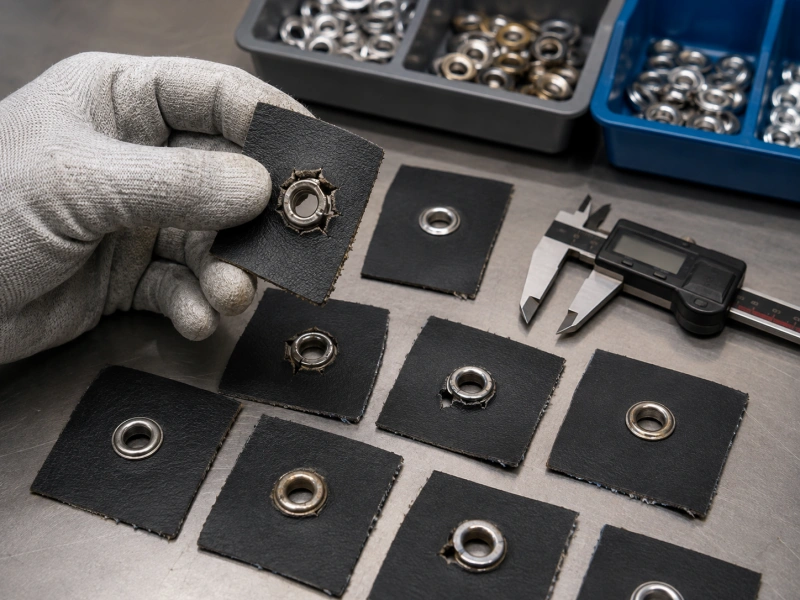
Record the operator or team for traceability, not for blame. A repeated defect on one shift may come from a material lot, setup method, worn die, unstable air supply, feeder condition, or product mix. Confirm the cause before assigning an action.
Rank Problems by Cost, Not Just Frequency
At the end of each week or month, build two Pareto charts:
- defect quantity by failure mode;
- COPQ by failure mode.
The first chart shows what happens most often. The second shows what consumes the most money. You need both.
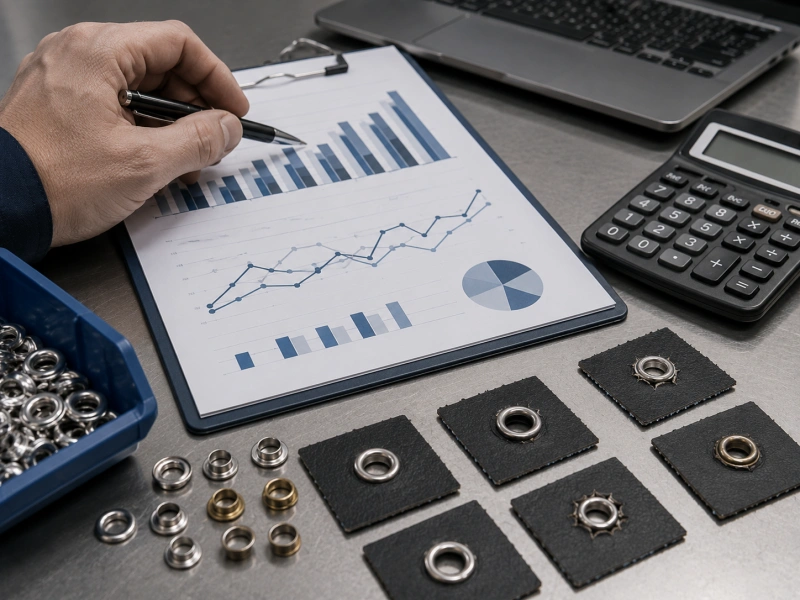
A frequent tipped-eyelet event may waste only hardware and a few seconds. A less frequent position error may ruin a high-value finished panel. If you use count alone, you may spend weeks reducing the cheap defect while the expensive one continues.
Then split the highest-cost category by machine, head, SKU, material lot, hardware lot, die set, shift, and detection point. Change one dimension at a time. Your goal is to find a concentration strong enough to test, not to create a dashboard with dozens of weak charts.
Reduce Eyelet-Setting COPQ in the Right Order
Step 1: Stop the loss from traveling downstream
Define clear stop and containment rules. If a critical retention failure, cracked barrel, missing washer, or repeated position error appears, stop the process, identify the last verified good piece, and contain the affected quantity. The later you find the defect, the more value it carries.
Use first-piece approval after a die change, hardware-lot change, material change, maintenance intervention, or major adjustment. A short controlled approval is cheaper than sorting a completed order.
Step 2: Stabilize the approved process window
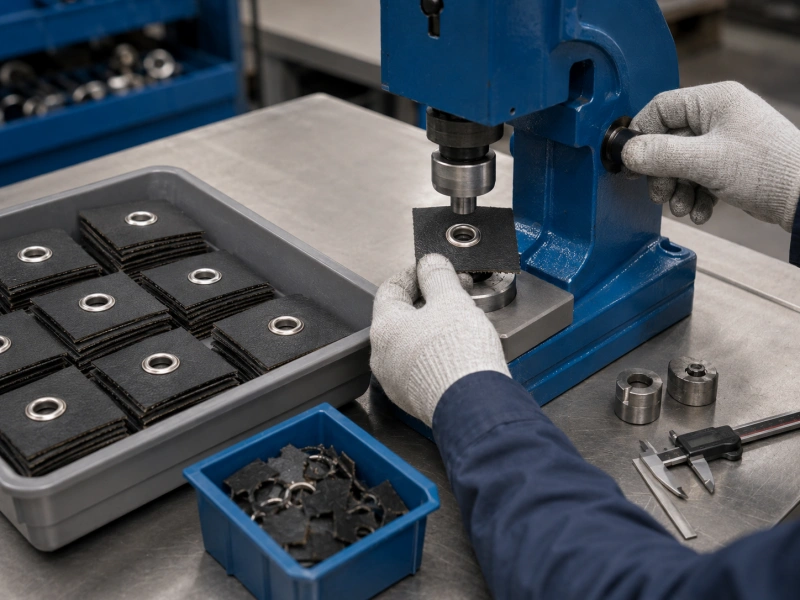
A single attractive sample is not proof of a stable setting. Establish lower and upper acceptable boundaries, then select a nominal setting with margin for normal variation. Record the machine control value, eyelet, washer, material stack, hole, die set, and inspection method together. Use the eyelet setting-force window guide for the validation procedure.
Step 3: Control incoming variation
Do not mix eyelets, washers, or materials that look similar but behave differently. Check critical dimensions and identify lots. When the eyelet, washer, material thickness, or coating changes, verify the setup before releasing the batch. For tooling compatibility, use the eyelet, washer, and die matching guide.
Step 4: Make setup repeatable
Create a setup card for each approved product family. Include tooling ID, guides, feeder recipe or mechanical positions, controlled pressure or closed-height value, speed, sensor settings, sample photographs, and pass/fail checks. Record revisions. If an operator has to remember the setup, you do not have a controlled setup.
Step 5: Reduce detection delay
Move inspection closer to the point where the defect begins. Combine front and back visual checks with the functional or retention test required by the product. Set a check frequency based on risk and process history. More inspection is not automatically better; your aim is to detect drift early while you work on prevention.
Step 6: Remove the confirmed cause
Now apply the technical correction: align or replace tooling, correct the force window, stabilize feeding, improve workpiece registration, control material thickness, qualify hardware, or revise the operator method. Do not change several inputs at once unless safety requires it. Otherwise, you will not know which change reduced the loss.
For recurring feed-related stops, use QC Machinery’s feeding stability guide. For wear control, use the eyelet punching machine maintenance checklist.
Step 7: Automate only after the economics are clear
Automatic feeding, guides, sensors, and programmable controls can reduce handling variation and improve repeatability, but automation does not correct an incompatible eyelet, washer, die, or material stack. Stabilize the process first, then compare the installed cost with verified labor, scrap, rework, and downtime savings. The automatic feeding break-even guide gives you a demand-based calculation.
Verify That the Savings Are Real
Use a fixed before-and-after comparison. Keep the SKU, material family, eyelet and washer specification, machine, inspection rule, and reporting period as similar as possible.
Track at least:
- first-pass yield;
- setting scrap rate;
- workpiece scrap rate;
- rework minutes per 1,000 attempts;
- quality downtime per 1,000 attempts;
- external failures;
- COPQ per 1,000 good settings;
- total prevention cost for the change.
Then calculate:
Monthly net saving = baseline COPQ – current COPQ – new recurring prevention cost
Payback period in months = one-time improvement cost / monthly net saving
Suppose a tooling, fixture, training, and validation project costs $4,800. After the change, verified COPQ falls by $1,600 per month, while the new recurring control cost is $180 per month.
Monthly net saving = $1,600 – $180 = $1,420
Payback period = $4,800 / $1,420 = 3.4 months
Do not annualize one unusually good week. Confirm the result over enough normal production to include changes, refills, restarts, different operators, and representative input lots. Ask finance to reconcile the cost method before you use the savings in an investment decision.
A Practical 30-Day Starting Plan
Days 1-3: Agree on the definitions for attempted setting, first-pass good, rework, setting scrap, workpiece scrap, downtime, internal failure, and external failure.
Days 4-7: Create a short defect and disposition code list. Train operators with real accepted and rejected samples.
Week 2: Record every event on one representative line. Check the log daily for missing quantities, time, lots, or dispositions.
Week 3: Apply the agreed cost rates. Build quantity and cost Pareto charts. Select one high-cost failure mode with a clear concentration.
Week 4: Contain the loss, confirm the cause, run a controlled correction, and compare COPQ per 1,000 good settings before and after the change.
At the end of 30 days, you should have a defensible baseline and one completed improvement cycle. Expand the method only after the first line records data consistently.
What to Ask an Eyelet Machine Manufacturer?
When you evaluate a new or modified process, send the manufacturer your actual eyelets, washers, material stacks, finished-product requirements, and expected demand. Ask for a trial that reports accepted output, not only empty-cycle speed.
Request:
- the tested machine and tooling configuration;
- the qualified setting window or reproducible machine control values;
- first-piece and in-process inspection criteria;
- observed good settings per minute over a representative run;
- reject, rework, jam, and intervention counts;
- changeover and feeder-refill time;
- maintenance points and expected wear-part controls;
- sample results for the front, back, position, and retention requirements you specify.
QC Machinery supplies automatic and semi-automatic eyelet equipment for applications including garments, shoes, bags, curtains, banners, tarpaulins, outdoor products, packaging, and other materials. The correct solution depends on the complete application, not on eyelet diameter alone.
Conclusion
You cannot reduce eyelet-setting scrap cost reliably until you measure more than rejected eyelets.
Separate scrap from rework. Count workpiece losses as well as hardware. Include the value added before detection, quality downtime, sorting, replacement activity, and customer failures. Normalize the result per good setting, then rank problems by cost.
Once the expensive loss is visible, follow a simple order: contain it, stabilize the process window, control input variation, standardize setup, shorten detection time, remove the confirmed cause, and verify the saving.
A low scrap percentage can still hide an expensive process. A cost-based view shows you where the margin is actually going—and which improvement will bring it back.
FAQ
What is a good eyelet-setting scrap rate?
There is no universal rate you can safely copy. Your acceptable level depends on product value, material, eyelet count, customer requirements, process type, and the consequence of a failure. Compare like-for-like product families and focus on the trend in COPQ per 1,000 good settings.
Should you measure scrap by eyelet or by finished product?
Measure both when one failed setting can ruin the workpiece. Setting-level data helps you diagnose the process. Workpiece-level data captures the financial consequence.
Does reworked output count as good output?
It can count as accepted final output after it passes every requirement, but it should not count as first-pass good. Keep first-pass yield and final yield separate so rework does not disappear from the report.
Should inspection cost be included in COPQ?
Routine planned inspection is normally an appraisal cost, not COPQ. Extra inspection, sorting, and retesting caused by a failure can be assigned to the internal or external failure event. Define the boundary once and use it consistently.
How often should you review eyelet-setting COPQ?
Review the event log daily while the method is new, use a weekly Pareto for production action, and close the financial report monthly. A severe retention defect or customer escape should trigger immediate containment rather than wait for the reporting cycle.
Can an automatic eyelet machine eliminate scrap?
No. Automation can reduce handling variation and improve repeatability, but it can also produce defects quickly when the setup, tooling, hardware, material, or feeding system is wrong. Verify the complete process under production conditions.