
A small component fails, and the eyelet line stops. Maintenance identifies the fault, but the replacement in the storeroom fits a different model. The repair waits while someone checks a drawing, finds a supplier, and places an order.
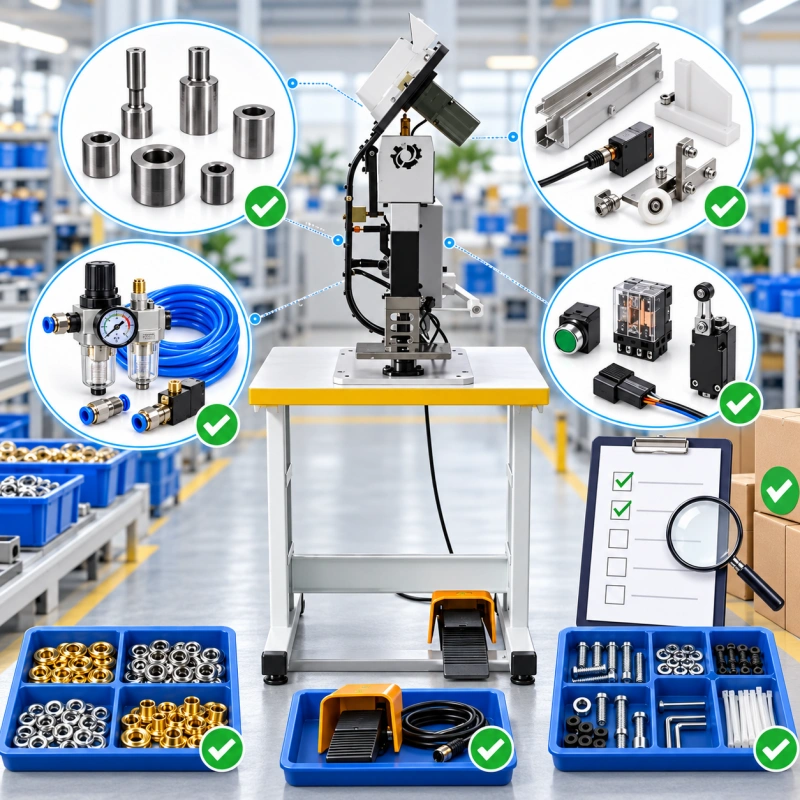
Your eyelet machine spare parts checklist should identify each machine and its compatible parts, rank the consequence of a failure, record usable stock, and set a reorder trigger that accounts for lead time. Include wear parts, line-stop spares, and changeover tooling, but manage each for a different reason.
There is no universal parts list: a manually fed press, a pneumatic machine and an automatic system can have very different assemblies.
Start With the Machine, Then the Part
Put every eyelet machine in an asset list with its model, serial number, location and current configuration. Note whether the machine uses automatic eyelet or washer feeding, pneumatic equipment, or a particular electrical control arrangement.
If you have a manual, parts drawing, supplied tooling list or commissioning record, keep its revision with the asset record. Two machines sold under the same model name may still have different component revisions.
Next, walk through the actual line with maintenance and the operator. Look at the setting head, cutting or punching station, feed path, actuation system and controls that your machine has. Record parts that have been replaced, parts that show wear, and components whose failure has previously stopped output.
Where the original documentation is incomplete, mark a component “identification pending.” Photograph its location and any legible markings, and confirm the specification before buying.
Classify Parts by Use and Production Risk
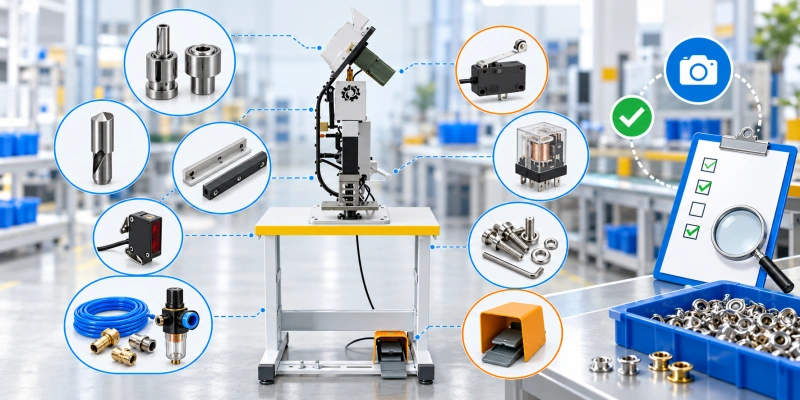
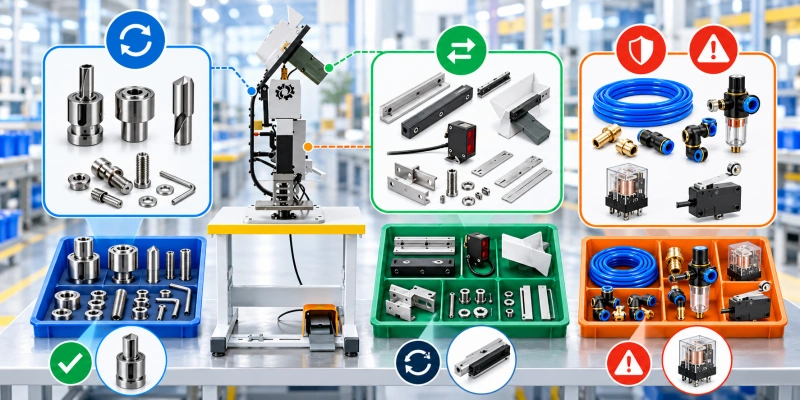
First record what the item does: routine wear replacement, changeover tooling, or another replaceable component. Then assess the consequence of being without it and decide whether to stock it. These labels can overlap.
A setting die may be both a wear item and a line-stop spare; an unused die for another eyelet size is changeover tooling. “Critical” describes the consequence of having no usable replacement, rather than the part’s price. A modest sensor on an automatic feeder may stop the entire line; an expensive assembly may be repairable or available through a backup machine.
| Planning group | Decision question | Typical handling |
| Line-stop spare | Would failure halt the required job, with no acceptable workaround during replenishment? | Confirm compatibility and lead time; decide whether an on-site spare is justified. |
| Routine wear part | Does recorded use or inspection show recurring replacement? | Track replacement frequency and withdrawals; replenish against actual use and lead time. |
| Changeover tooling | Is it needed to run an approved eyelet, washer, material or product setup? | Store as a complete, labeled setup kit; reserve it for the scheduled job. |
| Low-frequency strategic spare | Is failure rare but replacement slow or difficult to repair? | Review downtime exposure against cost, obsolescence and alternatives. |
| Order on demand | Can the item wait for normal supply without unacceptable loss? | Keep its identification and supplier details even if stock is zero. |
Use these groups as review prompts, not mutually exclusive bins. Record the item’s function and its stock policy in separate fields so that a reserved changeover tool is never mistaken for an available breakdown spare.
Build a Checklist That Can Be Used During a Stop
A useful register lets someone answer three questions quickly: Is this the correct part? Is a serviceable unit available? When should we replenish it? One row per distinct part specification and compatible configuration is usually easier to control than a single row headed “eyelet dies.”
| Field | What to record |
| Part and system | Clear name, function and machine location, such as “lower setting die, station 1.” |
| Machine identity | Asset ID, model, serial number and applicable configuration or revision. |
| Part identity | OEM or approved supplier number; drawing or specification reference if available. |
| Fit details | Relevant dimensions, connector or voltage for electrical parts, pneumatic rating for air components, or eyelet and washer specification for tooling. |
| Stock decision | Criticality, why it matters, and whether it is stocked, reserved for changeover or ordered on demand. |
| Inventory control | Serviceable quantity on hand, reserved quantity, bin location, minimum reserve, reorder point and target stock where used. |
| Supply record | Approved source, confirmed lead time, last confirmation date and any approved substitute. |
| Traceability | Last issue or replacement date, drawing revision and photo reference. |
Separate “on hand” from “available.” If the only die set is tagged for tomorrow’s customer job, it is not an emergency spare for today’s failed die. Likewise, damaged or unverified stock should not count as usable inventory.
Which Eyelet Machine Parts Might Deserve Stock?
Use the following categories as prompts for a machine-specific review, not as a QC Machinery parts package. Confirm the installed design and the correct replacement against the machine record. Prioritize parts with a clear failure mode, significant production impact and a realistic replenishment path.
Punching and Setting Tooling
Depending on the process, you may need a cutter or punch, upper and lower setting dies, or other fitted tooling. These are strong candidates to review because a damaged working surface can affect both output and product quality.
Record the matching eyelet and washer specifications, the approved material and thickness range where relevant, tool identification, and whether the item is a working set, changeover set or emergency replacement.
Keep matched tooling together where its design calls for it. A die that resembles another in a tray is not automatically interchangeable. For fit decisions, use the separate guide to selecting dies for eyelet and grommet machines rather than relying on a generic size label.
For decisions about whether a used die remains serviceable, see the signs of die wear. Use your approved inspection criteria and usage history to decide when to replace a tool.
Feeding and Guiding Components
On a machine equipped with automatic feeding, identify the installed tracks, guides, escapements, transfer parts, sensors and small retaining hardware that could interrupt delivery of an eyelet or washer. A change part for one format may be essential for a scheduled run even though it has not failed.
Before marking every jam-related component as a spare, distinguish wear or damage from setup, material variation and contamination. QC Machinery’s feeding stability discussion covers the diagnostic side. This inventory list should record the confirmed component and its fit, not retell the feeder adjustment procedure.
Pneumatic and Control Components
Where the machine uses compressed air, inspect its actual parts documentation for replaceable seals, filter elements, hoses, fittings, valves and regulators. For electrical or automated equipment, check the installed switches, sensors, relays and control components. Record electrical and connection details before approving a substitute.
A familiar-looking switch can have a different electrical specification or mounting arrangement.
For a high-value controller or assembly, ask whether repair, supplier exchange or an approved backup machine can restore production within your acceptable downtime. That assessment may support stock, a repair agreement or an order-on-demand decision.
Set Minimum Stock From Risk and Real Demand
Begin with a practical question: if the next part fails or wears out, how long can this line wait? Estimate the production and delivery effect, then compare it with total replenishment time, including identification, approval, supplier preparation, shipping, receipt and any required verification before use. Consider how many machines draw from the same bin and whether their demand can occur together.
For recurring wear parts, review stock withdrawals linked to work orders and normal usage over a representative production period. Check whether usage rises during a heavy campaign, whether a supplier’s quoted lead time has changed, and whether an approved alternate exists.
Use the observations to set a minimum reserve, a reorder point and, if useful, a target quantity after replenishment. The minimum reserve is the buffer you intend to protect; the reorder point tells you when to act, and the target quantity tells you how far to replenish. They need not be the same number. “Keep two of everything” ignores both downtime risk and the cost of obsolete stock.
A part that has never been issued presents a different problem. Its historical average demand may be zero, while a single failure could stop a line for weeks. Assess that item as a strategic or line-stop spare using failure consequences, feasible repair, lead time and backup capacity.
Do not let a zero average automatically set its stock level to zero. If its specification may become obsolete, check whether the supplier can still provide the correct revision before relying on future ordering.
Reorder Before Serviceable Stock Reaches Zero
For a part with repeatable consumption, a starting rule is:
Reorder point = expected use during replenishment lead time + safety stock.
Expected use is your estimate of consumption while the next order travels from request to usable receipt. Safety stock covers reasonable uncertainty in consumption or delivery. Both inputs should come from your operation and current supplier information; this is a planning formula, not a QC Machinery machine specification.
If use is sporadic or the item is a rare strategic spare, decide its stock policy from downtime risk instead of trusting an average-use calculation.
Trigger a review or order when available stock reaches the reorder point. For this check, start with serviceable units on hand, subtract reservations for other jobs, and include units already on order only when their arrival is confirmed in time to cover expected use.
Record late or uncertain orders separately; they cannot prevent an immediate shortage. Assign an owner to maintain quantities, update lead times and log parts taken from the store. Where a part serves several machines, make the shared demand visible so each team does not assume it has exclusive access to the same spare.

Keep Changeover Kits Separate From Emergency Spares
A die set used for the next eyelet size is production tooling, even when it sits on the spare-parts shelf. Give it a setup or job identifier, include the matched components and an approved reference sample where applicable, and record which eyelet and washer specifications it supports. Reserve a scheduled kit so it is not quietly used to repair a different machine.
An emergency spare serves a different event: an unexpected failure of the approved working part. If one physical item must serve both purposes, show the reservation and the resulting exposure in your register. A “one in stock” count can mislead if that one is already allocated to a changeover.
The site’s die changeover article explains how to stage and verify tooling for the next run; keep the inventory discussion here focused on availability and identification.
Identify the Exact Part Before You Order
“The valve on our eyelet machine” is too vague for a reliable replacement request. Start with the machine model and serial number. Add a clear photo of the component in place, its label or marking, its installation location, and any part or drawing number you have.
For electrical parts, include the verified voltage and connector details where relevant; for pneumatic parts, the documented specification and connection details. For tooling, send the eyelet and washer specification and the approved setup or drawing reference.
If a label is unreadable or a machine has been modified, say so. Ask the supplier to confirm fit against the serial number, drawing and current configuration before ordering. A photo alone may miss an internal revision or electrical difference. Keep the confirmed answer and any approved supersession in the parts record for the next request.
Store and Review the Stock You Actually Have
Label each bin with the part identity and the machines or configurations it serves. Protect precision tooling from impact and corrosion in suitable storage; keep sensitive electrical and pneumatic items according to their documentation. Do not mix visually similar dies, guides or connectors. Put superseded revisions in a separately identified location until compatibility is confirmed.
Quarantine damaged, unverified or removed parts awaiting inspection so a technician cannot mistake them for ready spares. Count serviceable parts against the register, reconcile stock withdrawals after maintenance, and review slow-moving items when a machine is modified or retired.
Stock that cannot be located or whose revision is unknown will not shorten a breakdown. Use the shift handover checklist to transfer open machine issues between crews; update the spare-parts register itself when a component is taken, returned or reserved.
Troubleshoot Before Consuming a Replacement
A crooked setting or missed eyelet is a symptom, not a part diagnosis. Variation in the eyelets or washers, setup, feed alignment, contamination, loose connections or an incorrect setting may produce a similar result. Have an authorized technician confirm the cause under the machine documentation and your site’s safety procedures before replacing a component. Do not bypass guards or interlocks to keep production moving.
The eyelet machine troubleshooting guide addresses operating faults. This checklist starts after you identify the component you need, or when you plan stock against a known risk. Record the verified cause of each replacement so the inventory history remains useful.
Eyelet Machine Spare Parts Inventory Review
Use this list during your next storeroom review. Copy the field table above into a sheet or maintenance system and attach the supporting drawings and photos to each record.
☐ List machines by asset ID, model, serial number and configuration.
☐ Collect current manuals, drawings, tooling lists and revision details.
☐ Walk each line with production and maintenance to identify line-stop risks.
☐ Separate routine wear parts, changeover kits, strategic spares and order-on-demand items.
☐ Confirm part identity and fit; mark uncertain matches for verification.
☐ Count serviceable, reserved, incoming and quarantined quantities separately.
☐ Record approved source, confirmed lead time, storage bin and backup option.
☐ Set a minimum reserve, reorder trigger and replenishment target where they apply.
☐ Record each part withdrawal by machine and reason, then review the policy as usage changes.
If a part on your list still lacks a confirmed identity, contact QC Machinery with the machine model and serial number, photos of the part and its location, any drawing or marking, the eyelet specification and a short description of the issue. Ask the team to confirm the correct replacement and availability before you commit a purchase. A reliable checklist begins with the part you can actually identify and use.