
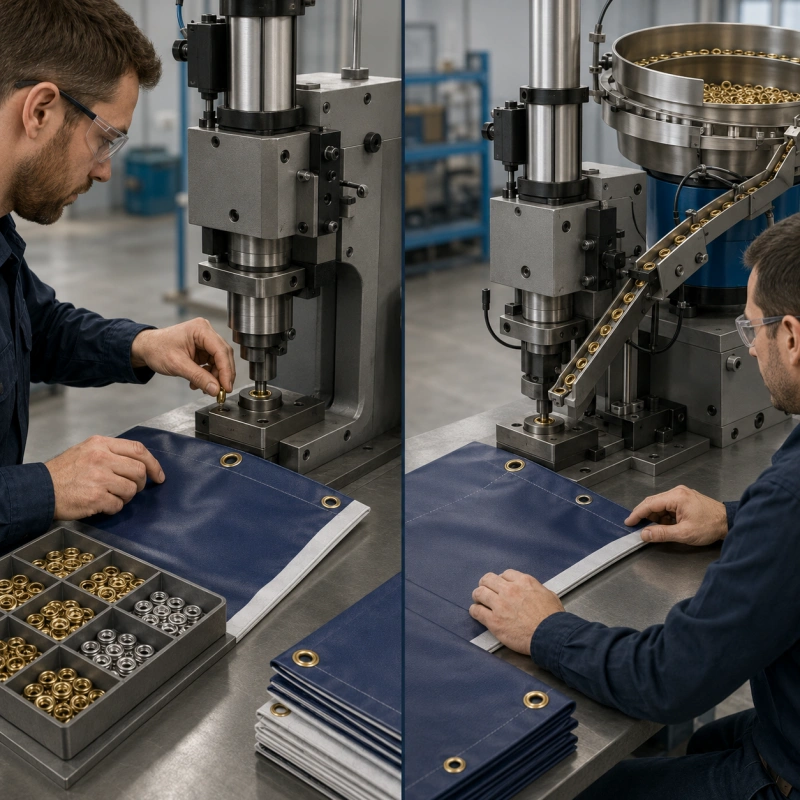
Automatic feeding is easy to justify when you watch a feeder deliver eyelets one after another. The operator no longer picks up each part, turns it the right way, places it on the die, and checks that it has not tipped. The cycle looks faster and the work looks easier.
But speed alone does not tell you whether the investment will pay back.
If you run long, stable batches, the saved handling seconds can accumulate into hundreds of labor hours. If you run short orders with frequent eyelet changes, feeder setup and first-piece approval can consume much of that saving. A hand-fed station may still be the less expensive choice even though its cycle is slower.
Quick answer: automatic feeding usually becomes economical when you have repeatable eyelets, enough settings per batch to spread the longer setup time, and enough annual good settings to recover the installed cost within your target payback period. Hand feeding is often more economical when demand is low, batches are short, styles change frequently, or the operator must handle irregular products that limit the machine’s pace.
This guide shows you how to calculate that threshold from your own production records. It focuses on feeding labor and batch economics. If you first need a general comparison of machine categories, read QC Machinery’s manual vs semi-automatic vs automatic eyelet machine guide. For capacity planning after you select a process, use the eyelet machine capacity planning guide.
First, Make Sure You Are Comparing Feeding Methods
“Manual” and “automatic” can describe several different parts of an eyeleting process. If you do not separate them, you may compare two machines that automate different jobs.
There are three independent questions:
- How are the eyelet and washer supplied? With hand feeding, the operator places one or both parts for every setting. With automatic feeding, a hopper, bowl, track, magazine, or escapement presents at least one part.
- How is the setting force produced? The press can be hand-lever, foot-operated, pneumatic, electric, or mechanical. A machine can automatically feed an eyelet but still require the operator to pull a handle. Automatic feeding does not always mean a fully automatic machine.
- How is the workpiece positioned? On many automatic-feed presses, the operator still presents and aligns every banner, bag, curtain, shoe upper, or tag. A more integrated system may also feed, index, or unload the product.
For this break-even calculation, compare the first question: the cost of placing eyelets and washers by hand versus presenting them automatically. Keep the press drive, number of heads, punching method, and material-positioning method as similar as possible.
That distinction matters because an automatic feeder removes part-handling labor, not necessarily the operator. Stimpson describes automatic machines as systems that feed parts into position so the operator does not place them by hand. In many real applications, the operator is still responsible for material alignment, activation, inspection, feeder refills, and minor-stop recovery.
Why Settings per Minute Is the Wrong Starting Point?
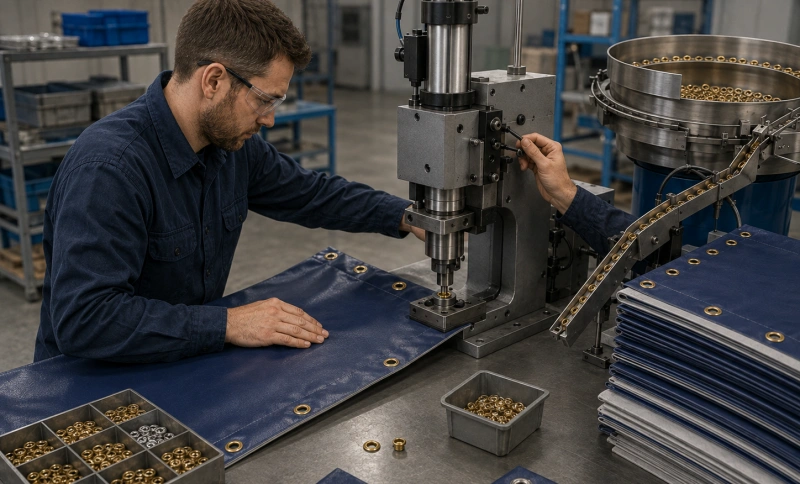
A catalogue may show a maximum cycle rate, but you do not invoice customers for empty press cycles. You need good eyelet settings on finished products.
Your observed rate includes:
- picking up and orienting the eyelet and washer;
- positioning the material;
- activating the press;
- removing or advancing the product;
- refilling the feeder;
- clearing misfeeds and jams;
- checking the first piece and periodic samples;
- rejecting and reworking bad settings;
- changing eyelet size, finish, tooling, guides, or feeder parts.
Measure good settings per scheduled hour, not the fastest ten-cycle demonstration. A machine advertised at 50 settings per minute may deliver far less if a large curtain panel takes several seconds to move and align. Conversely, even a modest saving of two seconds per setting can be valuable when you repeat it one million times a year.
The best rate for your calculation comes from a sustained trial using your production eyelets, washers, material stacks, and normal operator method. Record accepted settings, not only total strokes.
The Five Numbers That Decide Your Break-Even Point
You can build a useful first estimate with five groups of inputs.
1. Annual good settings
Start with finished demand:
Annual good settings = annual finished items x eyelet settings per item
Calculate by SKU when products use different numbers of eyelets. A banner with four grommets and a curtain with eight eyelets do not create the same load, even if both count as one finished item.
Do not automatically use last year’s total. Run at least a base case and a realistic peak case. If the investment depends on an unconfirmed sales forecast, show that forecast separately.
2. Loaded labor cost per hour
Use the cost of employing the operator for a productive hour, not only the wage printed on a payslip.
Depending on your accounting practice, loaded labor can include:
- wage or salary;
- employer taxes and benefits;
- shift premium and overtime premium;
- paid breaks and non-productive time;
- supervision and training;
- the cost of temporary labor or turnover.
Use the same definition for both feeding methods. If automatic feeding lets one operator tend two stations, do not assume a 50% labor saving until a trial proves that the workpiece handling and stop frequency allow it.
3. Labor seconds per good setting
Time the complete repeatable work, not just the moment the ram moves.
For hand feeding, include picking, orienting, and placing each eyelet and washer. For automatic feeding, include material presentation, activation, routine inspection, feeder refill time allocated across the batch, and normal minor-stop recovery.
Convert attempted-cycle time to good-setting time:
Labor seconds per good setting = observed labor seconds / quality rate
If a hand-fed process takes 5.5 labor seconds per attempt and produces 98.5% good settings, it uses 5.58 labor seconds per good setting. This prevents reject-heavy processes from looking cheaper than they are.
4. Cost of scrap and rework per good setting
Feeding affects more than labor. A tipped eyelet, missing washer, wrong orientation, or inconsistent placement can damage both the fastener and the product.
Calculate the difference in expected scrap and rework cost. Include only costs that genuinely change between the two methods:
- eyelet and washer cost;
- damaged material or finished-product value;
- operator rework time;
- inspection and sorting time;
- disposal or concession cost.
Be careful with high-value products. One damaged finished bag may cost more than hundreds of loose eyelets, so a small change in defect rate can materially change the answer.
5. Added automatic-feeding costs
Automatic feeding adds costs that hand feeding may not have:
- the price difference between the installed alternatives;
- feeder bowl, track, escapement, sensors, guards, and controls;
- dedicated tooling or change parts for each eyelet and washer;
- installation, freight, commissioning, and training;
- compressed air or electricity;
- preventive maintenance and spare parts;
- setup and first-piece approval time;
- downtime when feed stability is poor;
- inventory tied up in machine-specific fasteners or change parts.
Use incremental cost, not the full price of the automatic machine, if you would buy a hand-fed press anyway.
The Core Break-Even Formulas
First calculate labor cost per good setting for each method:
Labor cost per good setting = loaded labor cost per hour x labor seconds per good setting / 3,600
Then calculate the saving created by automatic feeding:
Variable saving per good setting = hand-feed variable cost – automatic-feed variable cost
Variable cost should include labor plus expected scrap and rework. You may include energy per setting if it is material, although it is often simpler to place utilities in annual added costs.
Next calculate the annual penalty from longer automatic-feed changeovers:
Annual changeover penalty = batches per year x extra automatic setup minutes per batch x loaded labor cost per hour / 60
Your annual net saving is:
Annual net saving = annual good settings x variable saving per good setting – annual changeover penalty – added annual maintenance and utilities
Finally:
Simple payback in months = incremental installed investment / annual net saving x 12
If annual net saving is zero or negative, there is no payback under those assumptions.
To find the annual demand required for a chosen payback period:
Break-even annual settings = [incremental investment / target payback years + added annual costs + annual changeover penalty] / variable saving per good setting
For a 12-month payback, target payback years equals 1. For a 24-month payback, it equals 2.
Worked Example: The Same Annual Demand Can Produce Two Answers
The following numbers are illustrative. They are not specifications or guaranteed results for a QC Machinery model.
Assume you compare a hand-fed station with an automatic-feed station and collect these inputs:
| Input | Hand feeding | Automatic feeding |
| Loaded labor cost | $25/hour | $25/hour |
| Labor seconds per good setting | 6.0 seconds | 2.5 seconds |
| Scrap and rework cost per good setting | $0.008 | $0.004 |
| Setup time per batch | 4 minutes | 10 minutes |
The labor saving is:
- Hand-feed labor cost: $25 x 6.0 / 3,600 = $0.0417 per good setting
- Automatic-feed labor cost: $25 x 2.5 / 3,600 = $0.0174 per good setting
- Labor saving: $0.0243 per good setting
- Scrap and rework saving: $0.0040 per good setting
- Total variable saving: $0.0283 per good setting
Now assume the automatic-feed alternative requires $22,000 more installed investment and $1,800 per year in added maintenance and utilities. Its setup takes six minutes longer per batch.
Scenario A: long production batches
You need 1,200,000 good settings per year across 300 batches. The average batch contains 4,000 settings.
- Gross variable saving: 1,200,000 x $0.0283 = $33,960
- Changeover penalty: 300 x 6 minutes x $25 / 60 = $750
- Annual net saving: $33,960 – $750 – $1,800 = $31,410
- Simple payback: $22,000 / $31,410 x 12 = 8.4 months
Under these assumptions, automatic feeding clears a 12-month payback target.
Scenario B: small, mixed batches
You need 300,000 good settings per year across 600 batches. The average batch contains only 500 settings.
- Gross variable saving: 300,000 x $0.0283 = $8,490
- Changeover penalty: 600 x 6 minutes x $25 / 60 = $1,500
- Annual net saving: $8,490 – $1,500 – $1,800 = $5,190
- Simple payback: $22,000 / $5,190 x 12 = 50.9 months
The automatic feeder still reduces variable cost, but it does not meet a short payback target. The difference is not only annual volume. It is the number of setups required to produce that volume.
With the Scenario A batch pattern, the annual demand for a 12-month payback is approximately:
[$22,000 + $1,800 + $750] / $0.0283 = 867,500 good settings per year
Treat that result as a decision threshold, not a promise. If the measured labor saving falls from 3.5 seconds to 2.0 seconds, or feeder stops rise, the threshold moves upward.
Batch Size Is the Hidden Variable
Two factories can use the same eyelet and produce the same annual quantity, yet reach different decisions.
Automatic feeding benefits from repetition. Once the feeder, track, tooling, pressure, and guides are stable, every additional setting in the batch spreads setup cost more thinly. Hand feeding has little feeder setup, so it can respond quickly to short orders and frequent changes.
Your automatic-feed batch is long enough when the variable savings earned during the run exceed the extra setup cost for that run.
Operating break-even batch size = extra automatic setup cost per batch / variable saving per good setting
In the example, six extra setup minutes cost $2.50. Dividing $2.50 by $0.0283 gives about 89 settings. Above that quantity, automatic feeding has the lower direct operating cost for the batch. However, that 89-setting threshold does not recover the $22,000 investment. You still need the annual-demand calculation for the capital decision.
This is why you should use both thresholds:
- Batch threshold: Is automatic feeding cheaper for this job after setup?
- Annual-demand threshold: Will all qualifying jobs recover the investment within your required period?
Do not force unsuitable small batches onto the automatic feeder just to keep it busy. A mixed cell can be more economical: use automatic feeding for stable runners and retain a hand-fed station for prototypes, urgent repairs, unusual finishes, and low-volume variants.
When Hand Feeding Is Likely to Win?
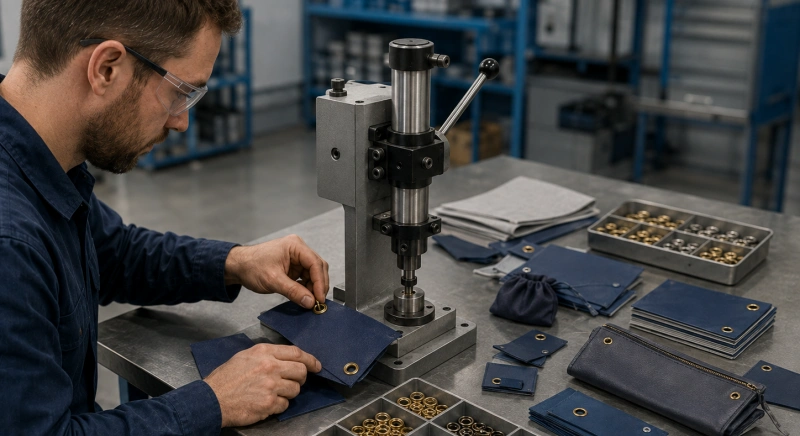
Hand feeding deserves serious consideration when:
- your annual setting demand is low or uncertain;
- most batches are short;
- you change eyelet size, washer, finish, or product several times per shift;
- the fasteners vary too much for stable bowl and track feeding;
- the material is bulky, irregular, pre-assembled, or difficult to present quickly;
- products need judgment at every position;
- you work on site or need portability;
- one damaged product has a high value and the process is not yet stable;
- you need one station to handle many experimental combinations.
A hand-fed process can also be the right development tool. You can prove die geometry, pressure, barrel roll, retention, and material behavior before investing in a dedicated feeding system.
When Automatic Feeding Is Likely to Win?
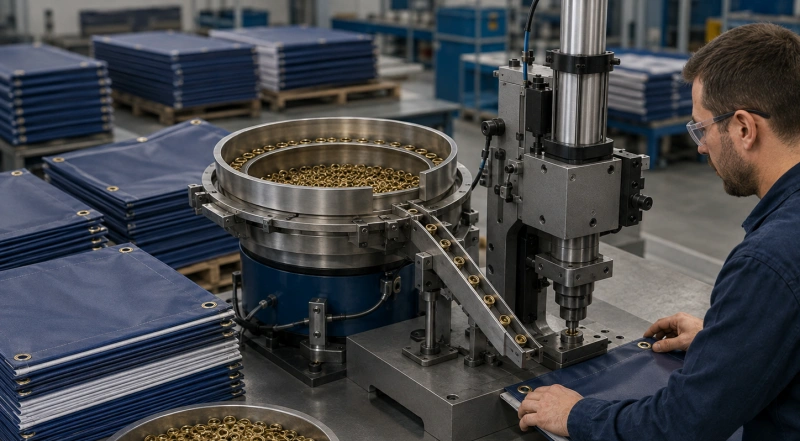
Automatic feeding becomes stronger when:
- you run repeatable eyelets and washers for long periods;
- your operators spend a measurable share of the cycle picking and orienting parts;
- demand is high enough to repeat the saving hundreds of thousands of times;
- fatigue or inconsistent part placement is causing defects;
- you have limited skilled labor or costly overtime;
- you can standardize fastener dimensions and supplier quality;
- batches are large enough to absorb feeder setup and first-piece approval;
- one operator can safely tend more than one process without starving either station;
- your delivery performance is constrained by eyelet-setting labor.
Automatic feeding is especially attractive when both the eyelet and washer are fed. A single-feed arrangement can remove part of the handling work while the operator still places the second component. That may be the right middle step, but measure the actual seconds saved rather than applying the labor claim from a dual-feed system.
Test the Assumptions Before You Approve the Investment
A break-even spreadsheet can be precise and still be wrong if its inputs come from a brochure. Validate the proposed process on representative production.
Run matched trials
Use the same eyelet, washer, material stack, position tolerance, and acceptance rule for both methods. Include normal and difficult variants. Give the operator reasonable practice time before recording results.
Record a complete batch
Do not time only a short clean run. Record setup, feeder loading, first-piece approval, normal operation, refills, minor stops, rejects, rework, and cleanup. For automatic feeding, count every manual intervention.
Check feedability, not only set quality
Small variation in flange diameter, barrel shape, finish, oil, burrs, or washer flatness can change feeder behavior. Use production-grade parts from the suppliers and lots you expect to run. QC Machinery’s guide to samples for an eyelet machine trial explains how to test consecutive feeding rather than approving one attractive sample. If jams or misfeeds appear during the trial, use the feeding stability checks before you lock the rate into your model.
Use a sensitivity range
Calculate at least three cases:
- Conservative: lower annual demand, smaller labor saving, more changeover time, and more feeder stops.
- Expected: the most likely order mix and validated sustained rates.
- Peak: high demand, overtime avoidance, and stable long batches.
If the purchase only works in the peak case, the decision depends on growth. If it still works in the conservative case, the economics are much more robust.
Common Break-Even Mistakes
Comparing machine price instead of incremental installed cost
Include the hand-fed equipment you would otherwise buy, then compare the difference. Add tooling, feeders, freight, commissioning, utilities, guarding, and training to the automatic alternative.
Valuing theoretical speed as labor saved
The operator may still be fully occupied positioning large products. A faster feeder does not create labor capacity unless another useful task can absorb the released time.
Ignoring batch mix
One million settings produced in ten long campaigns is not economically identical to one million settings spread across 2,000 small orders.
Counting the same loss twice
If your observed good-settings-per-hour rate already includes minor stops and rejects, do not reduce it again with separate availability and quality factors.
Assuming every eyelet will feed on the same tooling
Automatic feeders are sensitive to geometry and variation. A new size or finish may require a different track, bowl, escapement, or setting tool. Confirm the change-part list before you calculate payback.
Treating released labor as cash automatically saved
If no position, overtime hour, subcontracting cost, or capacity constraint changes, the saving may be productive capacity rather than immediate cash. State which benefit you are counting.
Your Decision Checklist
Before you choose automatic feeding, you should be able to answer these questions with measured data:
- How many good eyelet settings do you need in a normal year and a peak year?
- How many batches create that demand, and what is the average and 80th-percentile batch size?
- How many labor seconds per good setting does hand feeding use?
- How many labor seconds per good setting remain with automatic feeding?
- What scrap and rework cost changes between the methods?
- How long does each method take to set up and approve the first piece?
- Which eyelet and washer variants need dedicated feeder change parts?
- What feeder stops occur during a representative run?
- What is the incremental installed investment?
- What payback period does your company require?
If several of these inputs are still guesses, the next step is not a quotation comparison. It is a timed trial.
Final Recommendation
Choose automatic feeding when your real production data shows that repeated part-handling savings outweigh setup, feeder support, and capital cost within your required payback period. Choose hand feeding when flexibility, short changeovers, portability, or low demand is worth more than the seconds saved per setting.
For many factories, the best answer is not an all-or-nothing replacement. Keep a flexible hand-fed station for samples and short runs, then route standardized, high-volume families to automatic feeding. That protects responsiveness while allowing your highest-repeat labor to be automated.
When you request a proposal from QC Machinery, send your annual good settings, batch-size distribution, loaded labor rate, current cycle study, eyelet and washer samples, material stack, and required payback period. With those inputs, you can evaluate an automatic feeder against your own economics instead of relying on a general speed claim.
FAQ
Does automatic feeding remove the eyelet machine operator?
Usually not. Automatic feeding removes the repeated task of selecting, orienting, and placing one or both fastener parts. The operator may still position the product, activate the press, inspect settings, refill the feeder, and recover minor stops. Measure the remaining labor before you claim a headcount saving.
What annual volume justifies an automatic eyelet machine?
There is no universal volume. Your threshold depends on labor seconds saved, loaded labor cost, scrap improvement, batch count, changeover time, feeder reliability, added annual costs, installed investment, and required payback period. Use the break-even annual settings formula in this guide.
Is an automatic-feed hand press the same as a fully automatic eyelet machine?
No. A hand-operated press can use a magazine or track that automatically presents an eyelet. That automates part feeding but not the press stroke or workpiece positioning. Define what is automated before comparing prices or labor savings.
Should you calculate by pieces or by eyelet settings?
Use good eyelet settings. Products can require different numbers of eyelets, so a piece count can hide the actual workload. Convert each SKU’s demand into required settings, then total them for the planning period.
What batch size makes automatic feeding worthwhile?
For direct operating cost, divide the extra automatic setup cost per batch by the variable saving per good setting. That gives a batch threshold. You must also calculate annual demand to determine whether the equipment investment pays back.
What data should you ask a machine manufacturer to prove?
Ask for sustained good settings per scheduled hour on your samples, setup and changeover time, feeder refill time, misfeeds and jams, scrap, manual interventions, change parts, utilities, maintenance items, and the operator tasks included in the test. A short dry-cycle video is not enough for a break-even decision.