
Snap Button Machines for Garments
Set metal or plastic snaps on workwear, PPE and baby garments with a machine configured around your actual fabric, reinforcement and fastener—not a generic catalogue specification.
• Automatic, multifunctional and programmable linear options
• Sample trials with your garment panels and snap components
• Setup records for pressure, tooling and inspection
• Pull and opening-force testing arranged to your buyer’s method
One Fastening Result, Three Very Different Garment Requirements
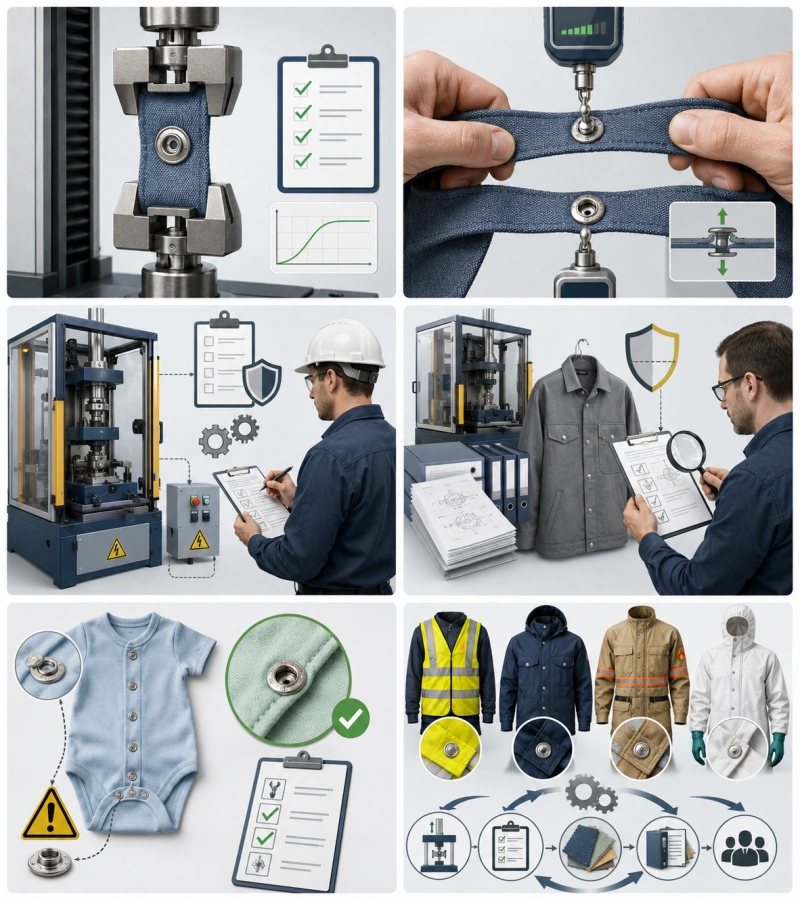
A snap that looks acceptable at the press can still fail in wear. The cap may sit off-centre, the prongs may not roll evenly, the fabric may be cut, or the attachment may loosen after repeated opening. That is why we start with the complete stack: snap type and post length, fabric and coatings, reinforcement, seam position, required opening feel, production rate and the customer’s inspection method.
Built Around the Garment—Not Just the Snap

Workwear and Uniforms
Heavy plackets, waistbands and reinforced pockets need enough setting force without crushing the fabric stack. For mixed styles or several snap sizes, the QC54221B multifunctional machine is the practical starting point. It offers adjustable speed, a 45 mm stroke and a stated working rate of 30–40 attachments per minute. We still confirm the die, post length and pressure on your material before recommending the final setup.

PPE and Technical Garments
A fastener must not undermine the performance of the finished protective garment. Coated, laminated, high-visibility or flame-resistant constructions can react differently to piercing and pressure. We run a material trial, inspect the setting and fabric around it, and prepare samples for the tests required by your PPE specification. The garment manufacturer or notified testing body remains responsible for validating the finished product against the applicable standard.

Baby Garments and Reusable Diapers
For babywear, secure attachment and repeatable records matter more than headline speed. The QC15001 can attach plastic or metal snaps and is listed for baby diapers and garments. Before production, approve the exact snap/fabric combination, record the tooling and pressure, and define a pull-test method, sample frequency and acceptance limit with the brand or laboratory. A universal pull-force number should not be copied from another buyer’s specification.
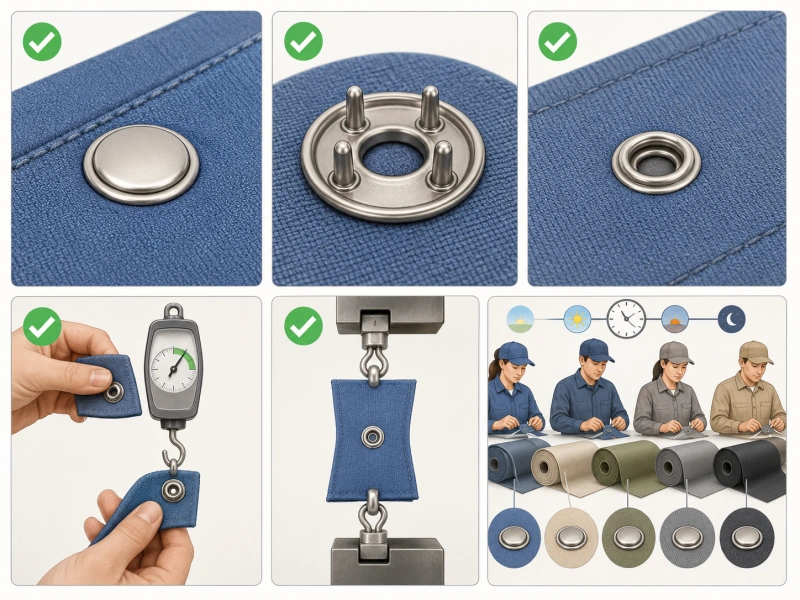
What a Good Snap Setting Should Prove
1. The cap and mating part are centred and sit flat.
2. Prongs or posts form evenly without cracking, folding or exposed sharp edges.
3. The surrounding fabric is not cut, puckered or delaminated.
4. The snap opens and closes within the approved force range.
5. Attachment strength meets the buyer’s method and acceptance limit.
6. Results remain stable across operators, shifts and approved material lots.
Choose the Machine by Style Mix and Production Flow
There is no single “best” snap button machine for every garment factory. The right choice depends on whether you need quick changeovers, automatic component feeding, repeated snap positions or a dedicated high-volume line. These three QC models cover the most common starting points.
| Model | English name | Published function | Best starting applications | Voltage | Throat | Stroke | Net weight | Dimensions | Must verify |
|---|---|---|---|---|---|---|---|---|---|
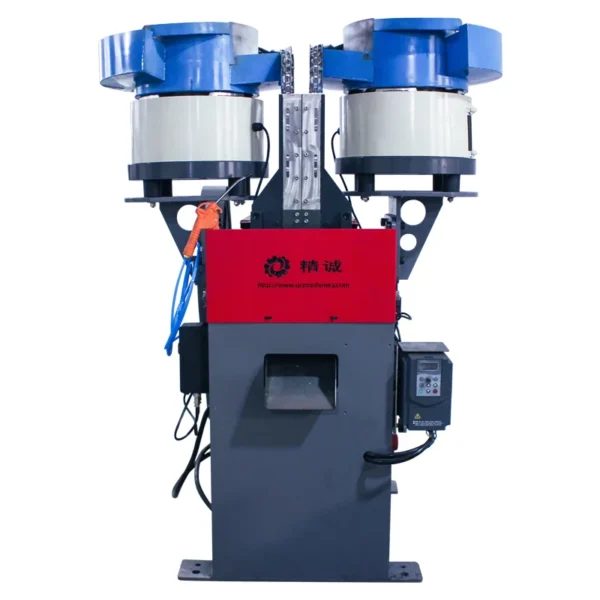
| QC15001 | Automatic Snap Button Machine | Automatic attachment; plastic and metal snaps | Jackets, rainwear, baby diapers/products, general garments | 220 V | 85 mm | 20 mm | 95 kg | 600 × 420 × 1180 mm | Feeder configuration, snap geometry, output, safety package, CE documents |
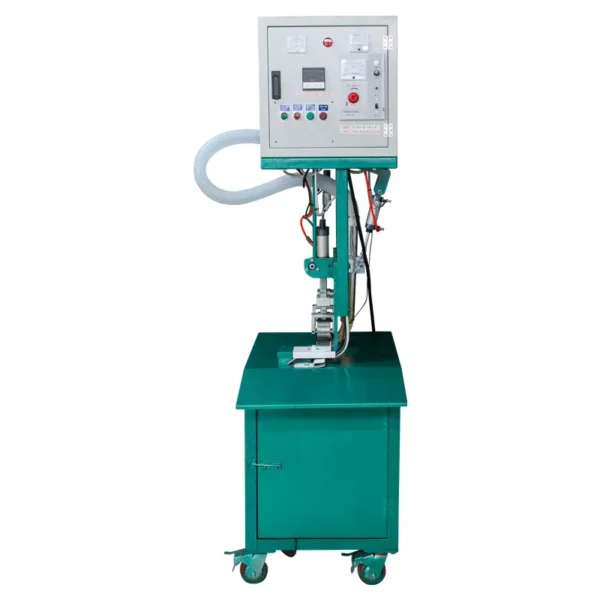
| QC54221B | Multifunctional Snap Button Machine | Several snap sizes; adjustable speed; thick fabric may be pre-punched | Workwear, jackets, down coats, leather goods | 220 V | 70 mm | 45 mm | 115 kg | Published as 680 × 78 × 1280 mm — verify likely typo | 30–40/min test conditions; dimensions; air requirement; guarding; documents |
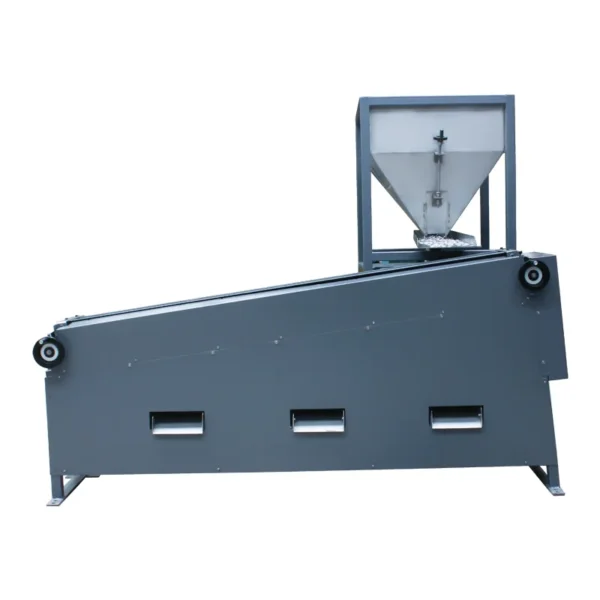
| QC15001A | Linear Snap Button Attaching System | Programmable snap spacing and quantity; plastic snap line | High-volume rainwear and repeated straight-line panels | 220 V | 85 mm | Not published | 200 kg | 1800 × 500 × 1100 mm; workbench 1200 × 300 × 650 mm | Cycle time, snap compatibility, component feeds, guarding, documents |
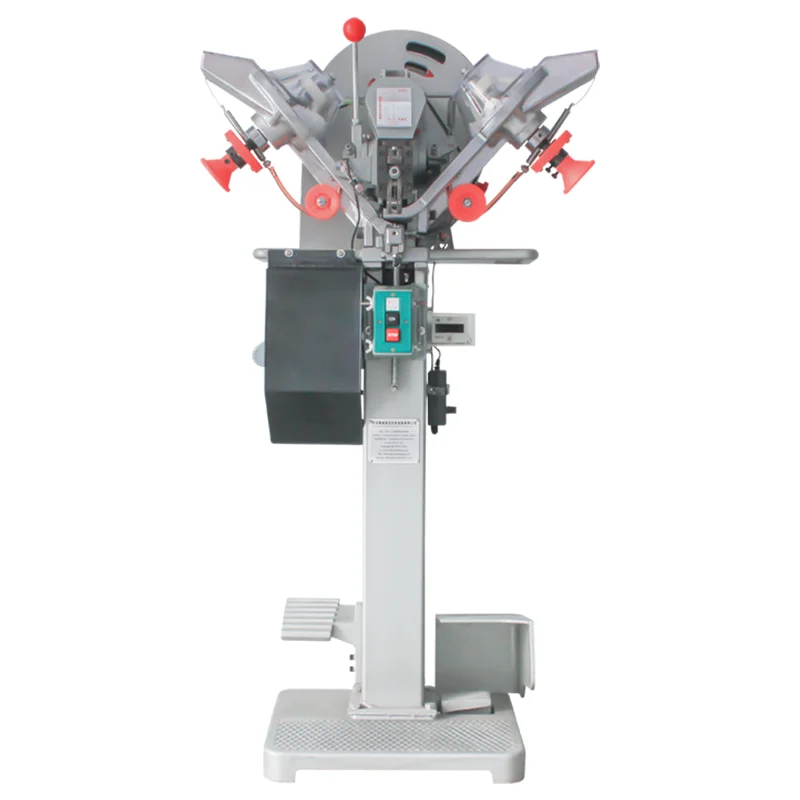
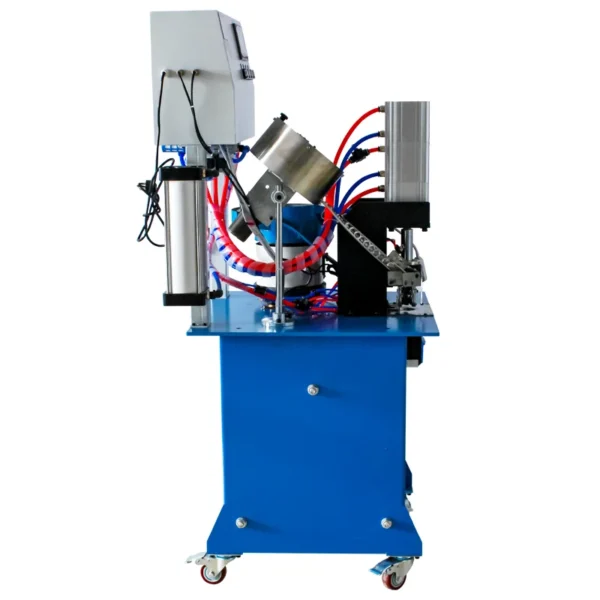
Best starting point for automatic attachment of plastic or metal snaps on garments such as jackets, rainwear and baby products. It uses 220 V power, has an 85 mm throat and a 20 mm riveting stroke. Confirm the feeding configuration, snap geometry and actual output during the sample trial.
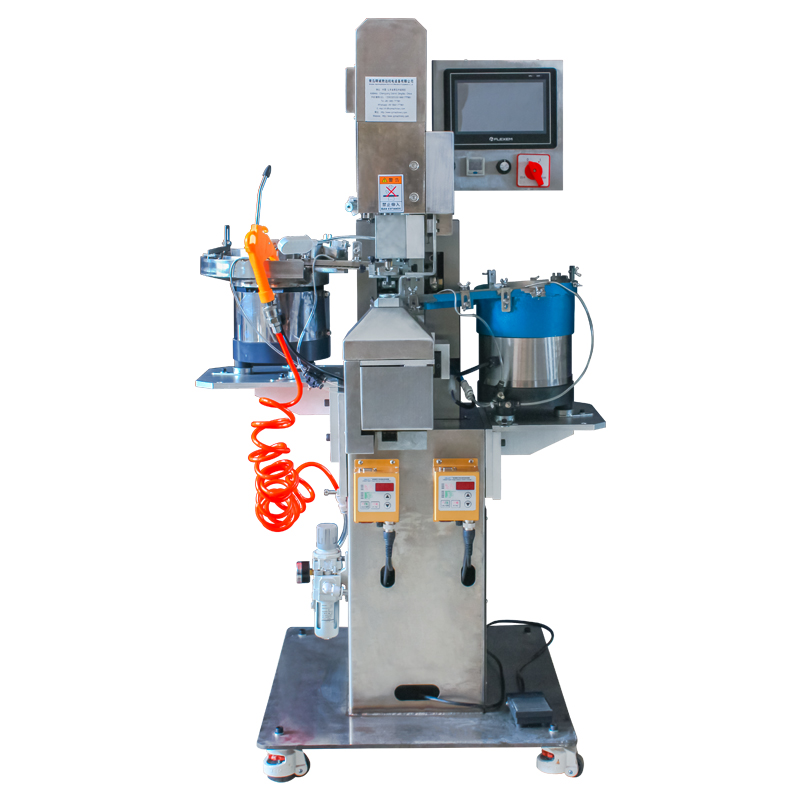
Best starting point for workwear, jackets, down coats and thicker constructions, especially when the factory handles several snap sizes. The published specification lists a 70 mm throat, 45 mm stroke and 30–40 attachments per minute. Pre-punching may be required for thick material.
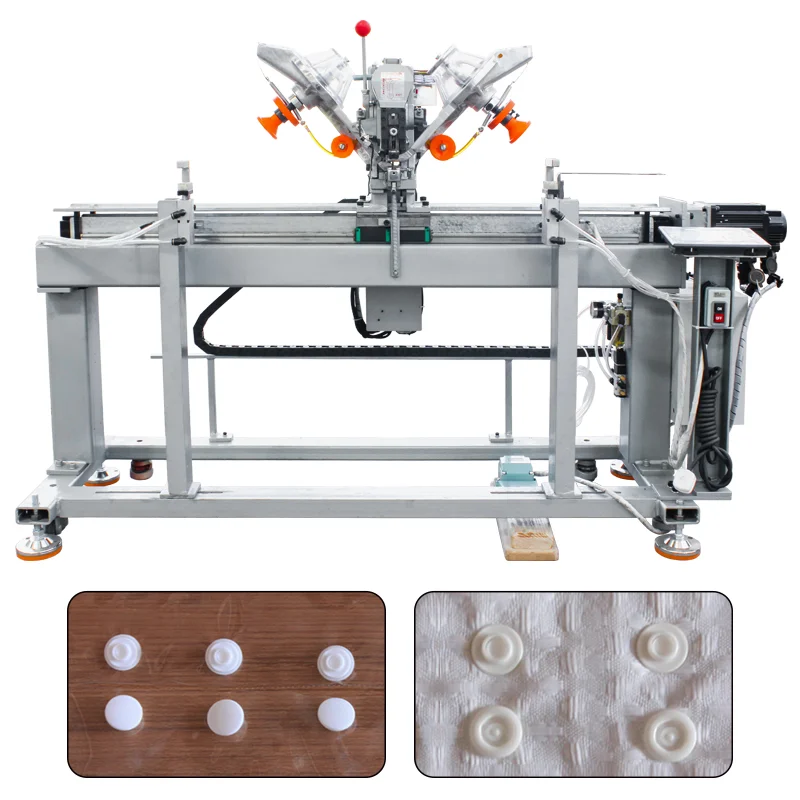
Best starting point for automatic attachment of plastic or metal snaps on garments such as jackets, rainwear and baby products. It uses 220 V power, has an 85 mm throat and a 20 mm riveting stroke. Confirm the feeding configuration, snap geometry and actual output during the sample trial.
From Sample to Production-Ready Setup
Provide finished snap components, fabric panels, reinforcement, coating or membrane details, seam location and target output. A photo is useful, but it cannot replace the physical stack when thickness and piercing behaviour matter.
Provide finished snap components, fabric panels, reinforcement, coating or membrane details, seam location and target output. A photo is useful, but it cannot replace the physical stack when thickness and piercing behaviour matter.
Trial pieces are checked for alignment, forming, fabric damage and opening feel. Record the machine, die identification, material and snap lot, pressure or stroke setting, operator and date. Add measured pull/opening results when that testing is included.
The brand, factory QA team or laboratory approves the sample and acceptance criteria. The approved piece and setup record become the reference for first-piece checks and changeovers.
Standards and Test Support—Without Vague Compliance Claims
ASTM D7142 covers the holding strength of prong-ring attached snap fasteners and can be used with the fastener attached to the intended apparel fabric. ASTM D4846 addresses resistance to unsnapping. Machine safety work may reference ISO 12100 for risk assessment, ISO 13849-1 for safety-related control systems, and IEC 60204-1 or IEC 60204-31 for electrical equipment, depending on the machine and market. These references do not automatically make a machine or garment compliant. Ask us for the documentation available for the selected configuration, then have your compliance specialist confirm the applicable requirements.
Babywear Note: In the United States, CPSC guidance says children’s clothing and accessories such as buttons are excluded from the small-parts ban, but detached buttons can still create a hazard and defective products can trigger reporting or corrective action. Treat attachment strength as a documented product-safety control even when a particular small-parts test is not mandatory.
PPE Note: PPE standards depend on the protective function—high visibility, weather protection, heat/flame, chemical protection and other categories use different tests. Qualify the snap and setting process within the finished garment’s own certification and change-control plan.
A Machine Recommendation You Can Audit
We manufacture snap button attaching equipment and configure each recommendation around the customer’s fastener and garment. For a serious production enquiry, our useful output is not a brochure promise. It is a tested sample, a defined machine and die configuration, a list of utilities and options, and a setup record your production and QA teams can review.
What to Send for an Accurate Recommendation?
• Garment type and application market
• Fabric composition, layers and total thickness
• Coating, membrane or reinforcement details
• Complete snap set, size, material, finish and post length
• Snap positions and distance from seams/edges
• Daily output, style changes and operator pattern
• Required voltage and compressed-air availability
• Buyer test method, sample frequency and acceptance limits
• Target delivery country and required machine documentation
Contact Us
FAQs
Which snap button machine is best for a garment factory?
The best machine depends on style mix, snap system, fabric stack and volume. QC15001 is the automatic starting point for common plastic or metal snaps; QC54221B suits mixed sizes and thicker workwear constructions; QC15001A suits repeated straight-line plastic-snap placement. A sample trial should confirm the final choice.
Click Here for a more detailed description
Can one machine set both plastic and metal snaps?
QC15001 is published for both plastic and metal snaps, but compatibility is not universal. Each snap geometry needs the correct feeder path and die set. Send the complete four-part snap set for confirmation.
Do thick fabrics need a pre-punched hole?
Sometimes. Fabric construction, coating, reinforcement, snap post length and die geometry all matter. The QC54221B page notes pre-punching for thick fabrics. We decide after checking the actual material stack.
What pull force should a baby-garment snap pass?
There is no safe universal number to copy into every programme. The brand, market, garment category, snap type and test method determine the acceptance limit. Define the method and threshold with the buyer or accredited laboratory, then record it in the control plan.
Can you support ASTM D7142 testing?
ASTM D7142 is relevant to the holding strength of prong-ring attached snap fasteners. Tell us the exact fastener and buyer protocol. We can confirm whether the trial can be prepared or tested in-house, or whether an external laboratory is needed. [CONFIRM QC TEST CAPABILITY BEFORE PUBLISHING]
How do I prevent snaps from damaging coated or laminated PPE fabric?
Do not qualify the fastener on thickness alone. Test piercing, die profile, pressure and reinforcement on the full material stack, then inspect for cutting, cracking, puckering and delamination. The finished PPE must still pass its applicable product tests.
What information is needed for a quotation?
Send the snap samples, garment panels, layer/thickness details, snap positions, expected output, voltage, air supply, destination country and required tests. This prevents a low-value quote for the wrong feeder or die.
How long does a model changeover take?
Changeover time depends on whether only the die changes or the feeder track, bowl and control recipe also change. We will quote changeover scope after reviewing the snap components. [INSERT VERIFIED CHANGEOVER TIME ONLY FOR A DEFINED CONFIGURATION]
Get More Info About Eyelet Machines
Start With the Garment You Actually Produce
Send us your fabric stack, snap set and target output. We will recommend a model, confirm what must be tested and tell you what we still need before a reliable quotation.