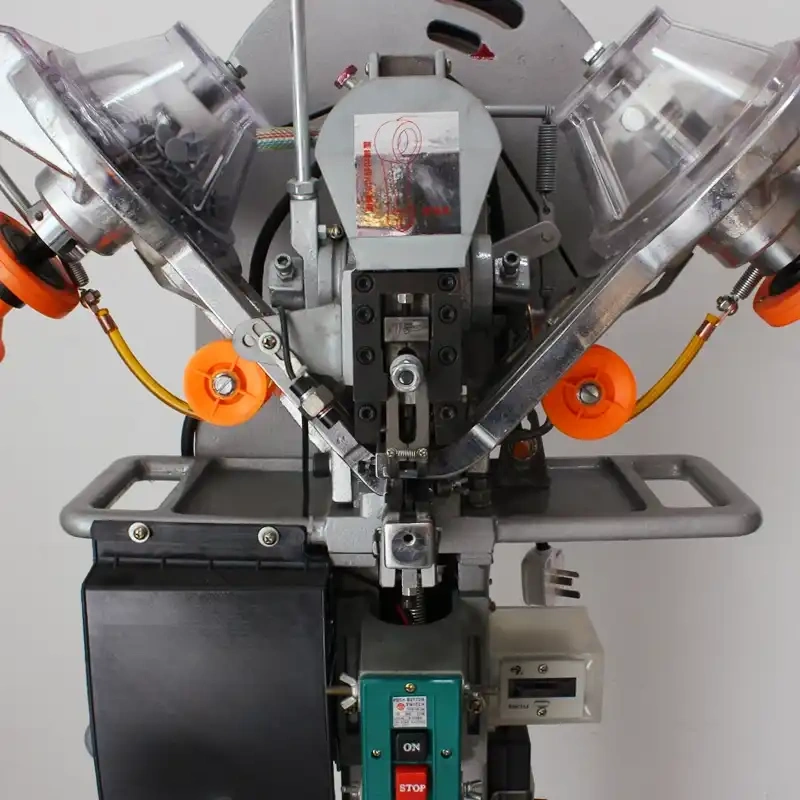
Choosing between snap button machine suppliers is not simply a matter of comparing machine speed or asking for the lowest quotation. You are buying a complete fastening process: the machine, the feeding system, the dies, the compatible snap components, the safety controls, the sample-setting method, and the technical support that keeps production running.
That distinction matters because two machines that look similar in a video may be built for very different jobs. One may handle metal ring-spring snaps on denim, while another is designed for plastic prong snaps on babywear. Some suppliers provide a flexible press that accepts multiple die sets.
Others build automatic systems around their own fastener families. Before you shortlist a company, you need to confirm that its equipment processes the same type of snap, material, and production volume that you use.
This guide compares ten established industrial suppliers whose product ranges include snap button, press-stud, or snap-fastener attaching equipment. The order prioritizes verified product fit, machine range, industrial specialization, and practical value for buyers. It is not a universal sales-volume ranking.
Quick Answer: Which Snap Button Machine Suppliers Should You Compare?
If you need an efficient starting point, compare these ten suppliers:
1. QC Machinery
2. Prym Fashion
3. YKK STOCKO FASTENERS
4. Morito Scovill Americas
5. Stimpson
6. SICOM
7. Huen Chen Machinery
8. MICRON
9. Edward Segal Inc.
10. Mikron by Ron Makina
All ten supply industrial equipment for attaching snap buttons or closely equivalent press-fastener systems. However, their strongest applications are not identical. Your best choice depends on whether you process metal or plastic snaps, whether you want automatic feeding, how often you change products, and whether you prefer an open machine-and-die platform or a supplier-controlled fastening system.
Snap Button Machine Supplier Comparison
| Supplier | Base | Relevant machine range | Best fit for |
| QC Machinery | China | Automatic, electric, pneumatic, multifunctional, and linear systems | Garments, bags, leather goods, baby products, plastic files, and customized production |
| Prym Fashion | Germany | Manual, pneumatic, electric, and fully automatic attaching machines | Factories already using Prym press fasteners, jeans buttons, and rivets |
| YKK STOCKO FASTENERS | Germany / YKK Group | Manual, semi-automatic, and fully automatic attaching machines | Branded snap systems, workwear, fashion, technical textiles, and repeatable series production |
| Morito Scovill Americas | United States | Manual, semi-automatic, automatic, and fully automatic machines | Apparel, marine, outdoor, military, infantwear, and branded Scovill fasteners |
| Stimpson | United States | Automatic servo snap-fastener machines and broader attaching equipment | Canvas, webbing, leather, sailcloth, and industrial 20- or 24-line snaps |
| SICOM | Italy | Semi-automatic and automatic snap-fastener and jeans-button machines | European garment and denim production requiring several feeder configurations |
| Huen Chen Machinery | Taiwan | Fully automatic snap fastening and riveting machines | Raincoats, paper or plastic bags, belts, footwear, and leather accessories |
| MICRON | Europe / international distribution | Fully automatic and pneumatic multifunction fastening machines | Babywear, denim, workwear, plastic snaps, ring snaps, spring snaps, and mixed fasteners |
| Edward Segal Inc. | United States | Snap-fastener machines and custom attaching or assembly systems | Buyers needing engineered systems beyond a standard catalogue machine |
| Mikron by Ron Makina | Türkiye | Hand, pneumatic, magnetic, tandem, and industrial snap attaching machines | Workshops and factories needing several automation levels for textiles and leather |
1. QC Machinery

QC Machinery is a practical first choice when you want a machine supplier that focuses directly on eyelet, rivet, and snap-button attachment rather than treating the snap machine as a minor product category. Based in Qingdao, China, the company offers automatic, electric, pneumatic, multifunctional, and production-line solutions for fabric, leather, plastic, and other soft materials.
You can start with the snap button machine range and then narrow the selection around your actual components. The QC15001 automatic snap button machine, for example, is designed to attach male and female snaps and can be configured for metal or plastic components.
For factories running several snap sizes or thicker materials, the multifunctional snap button machine gives you a more flexible path. Higher-volume projects can also be evaluated around a linear snap button attaching system.
QC Machinery is especially relevant when you need customization. Instead of selecting a model from the voltage and speed alone, you can send your snap set, material layers, finished-product photos, target output, and positioning requirements. The machine and tooling can then be reviewed as one application.
Best for you if: you manufacture garments, rainwear, baby products, bags, wallets, footwear, outdoor products, or plastic stationery and want a configurable industrial solution with direct factory communication.
Confirm before ordering: snap dimensions, barrel or prong length, material thickness, whether pre-punching is required, automatic feeding scope, voltage, air requirements, guarding, and the approved sample result.
2. Prym Fashion
Prym Fashion is a strong supplier when your factory wants the fastener and attaching technology to come from the same ecosystem. Its machine range covers hand presses, pneumatic attaching machines, electric equipment, and fully automatic systems for press fasteners, jeans buttons, rivets, eyelets, and washers.
For lower or mixed production, you can consider manual or pneumatic equipment such as the SP and PP series. For mass production, Prym lists machines such as the NE 25-3K and NE 25-4K for Gripfix and Plastidur press fasteners, along with the NE 16 S for S-spring and ring-spring systems.
Features vary by model but can include multiple hoppers, fabric-thickness compensation, finger protection, and single- or continuous-stroke operation.
The main advantage is controlled compatibility. You are not only buying a press; you are buying a defined combination of Prym fastener, feeder, channel, die, and machine. That can simplify validation when you produce branded apparel or technical garments with a stable bill of materials. The trade-off is that you should check how closely the system ties you to specific Prym components and tooling.
Best for you if: you already specify Prym press fasteners or need an integrated fastening system for fashion, workwear, denim, sportswear, or technical textiles.
Confirm before ordering: the exact Prym fastener family, number of hoppers, required electrical supply, changeover procedure, available local service, and whether one machine completes the full snap combination.
3. YKK STOCKO FASTENERS
YKK STOCKO FASTENERS combines snap and fastening products with in-house attaching technology. Its range starts with manual equipment and extends to compressed-air semi-automatic machines and electrically driven fully automatic machines for series production.
The EH30 is a useful example of the supplier’s automatic approach. Depending on the configuration, it can be equipped with two, three, or four feeders. The two-channel version processes several snap systems and jeans buttons, while higher-channel versions can assemble complete multi-component systems.
YKK STOCKO also offers semi-automatic options such as the N6.S BASIC for snaps, jeans buttons, clothing rivets, posts, and eyelets.
You should consider YKK STOCKO when repeatability and component-machine compatibility are more important than buying a generic press. Its processing technology is designed around its own fastening systems, and the company also describes technical-center support for machine maintenance and customer advice.
Best for you if: you produce fashion, workwear, automotive textiles, safety products, or technical goods using YKK STOCKO snap systems and want a validated processing route.
Confirm before ordering: whether your snap requires two machines, the required feeder count, fabric-thickness range, cycle mode, tooling ownership, service coverage, and the procedure for introducing a new fastener finish or leg length.
4. Morito Scovill Americas
Morito Scovill Americas is one of the broadest choices on this list because it supplies both well-known fastener families and the equipment used to apply them. Its machine catalogue includes manual, semi-automatic, automatic, and fully automatic options for snaps, buttons, burrs, grommets, and related hardware.
The Model 150 and Model 7057 cover automatic attachment for several metal and plastic fasteners. For higher automation, the MAC-2000L uses motorized supply hoppers and a servo-driven system and is designed for a wide range of Scovill fasteners. The company’s application base includes apparel, infantwear, marine products, outdoor equipment, medical goods, and military or government products.
Scovill is a logical choice when your snap specification is already tied to brands such as DOT, Gripper, Duramark, Maxi-Snap, Mighty Snaps, or related systems. You gain a clearer route from component selection to machine tooling and technical support. As with other integrated fastener suppliers, you should verify the cost and flexibility of changing to non-standard components.
Best for you if: you need established fastener systems for marine, outdoor, workwear, children’s clothing, denim, or demanding industrial products.
Confirm before ordering: the approved fastener list for the machine, cycle speed under your real material, anti-jam features, tooling lead time, feeder changeover, electrical standard, and spare-part availability in your region.
5. Stimpson
Stimpson is a focused option for industrial buyers working with heavy fabrics and established snap standards. Its MS-10 fully automatic snap fastener machine uses an electric servo motor and two hoppers to feed male and female components. It is intended for Stimpson 20- and 24-line plain stud fasteners with the correct tooling.
The electric drive means you do not need compressed air for the press cycle. Adjustable speed and consistent torque are useful when you process materials such as sailcloth, marine fabric, webbing, canvas, and leather. A foot-actuated cycle also keeps the operator’s hands available for positioning the workpiece.
Stimpson makes the most sense when your snap system and material fall within the machine’s defined range. It is less suitable when you want one machine to change freely between many unrelated plastic and metal snap families without dedicated engineering.
Best for you if: you produce canvas goods, boat covers, straps, leather products, industrial textiles, or outdoor equipment using compatible line snaps.
Confirm before ordering: the precise snap line and style, tooling for stud and socket sides, material-thickness adjustment, actual output at your operator’s handling pace, electrical requirements, and maintenance support.
6. SICOM
SICOM is an Italian manufacturer worth comparing when you need automatic or semi-automatic machinery specifically for snap fasteners, jeans buttons, rivets, and studs. Its product range is detailed enough to help you choose a feeding architecture rather than buying a generic press.
The M11P-E is a semi-automatic machine for snap fasteners. The M21P-E is an automatic model, while the M31P-E uses three feeders and can be configured for snap fasteners, claw buttons, plastic buttons, or jeans buttons. SICOM also offers alternatives such as the M61P-E with two selectable feeders, which can be useful when you need product flexibility without moving immediately to a fully automatic line.
One important point is that some complete snap combinations require two machines: one for the cap and spring, and another for the stud and post. That is not a defect; it is a process-layout decision that affects investment, floor space, staffing, and balanced output.
Best for you if: you operate a garment, denim, or fashion-accessory factory and want a European machine range with several feeder and automation choices.
Confirm before ordering: whether your complete snap needs one or two stations, feeder configuration, tooling-change time, pneumatic versus motorized versions, component orientation, and local maintenance arrangements.
7. Huen Chen Machinery
Huen Chen Machinery is a Taiwan-based machine manufacturer with automatic snap-fastening equipment for leather goods, footwear, rainwear, stationery, and similar products. Its HC-5FA is intended for leather belts, shoe uppers, and leather accessories, with automatic loading of snaps and washers. The HC-5XA targets raincoats and paper or plastic stationery bags.
This application split is useful because it shows that the supplier is not presenting one machine as suitable for every material. Leather accessories, thin raincoat materials, and plastic document products create different feeding, pressure, and positioning demands. You should select the model around the component and workpiece rather than the label “automatic snap machine.”
Huen Chen is also relevant when snap fastening is only one part of your plant. The company offers riveting, eyeleting, cutting, and customized equipment, which can help if your product requires several hardware-setting operations.
Best for you if: you make belts, shoes, bags, raincoats, plastic files, paper products, or leather accessories and need automatic component feeding.
Confirm before ordering: compatible snap face diameter, shank or barrel dimensions, washer feeding, material support, machine footprint, customization scope, and test samples at the thickest and thinnest production conditions.
8. MICRON
MICRON supplies a wide range of industrial fastening machines through international distribution, including automatic snap machines and pneumatic multifunction presses. Its M-9001 automatic snap machine is offered for configurations such as prong snaps, plastic snaps, jean rivets, ring snaps, and spring snaps.
Its MC-20 pneumatic machines provide a broader platform for snaps, grommets, rivets, jeans buttons, and other fasteners through interchangeable tooling.
This makes MICRON attractive when you want to compare a dedicated automatic feeder with a more flexible pneumatic press. The automatic route is better for stable, repetitive volume. The multifunction route is better when your batches change and the operator can load components manually.
Pay close attention to system architecture. Some M-9001 configurations require one machine for the cap-and-socket side and a second machine for the stud-and-prong side. Dedicated channeling can also limit changeovers between fastener families. Your quotation should show the complete production cell, not just the price of one unit.
Best for you if: you produce babywear, workwear, denim, textile products, or mixed fastener applications and need a choice between dedicated automation and flexible pneumatic pressing.
Confirm before ordering: number of machines required, dedicated channel limitations, included dies, compressor requirements, safety sensors, voltage, installation support, and the total cost of the complete snap-setting process.
9. Edward Segal Inc.
Edward Segal Inc. is a useful supplier to include when your project may require more than a standard snap-setting machine. The company manufactures attaching machines for eyelets, rivets, grommets, and snap fasteners and also offers assembly-system capabilities.
For a straightforward application, you can discuss a standard snap-fastener machine and the correct dies. For a complex product, you can ask whether several operations can be combined, indexed, counted, inspected, or integrated into a custom assembly system. That engineering capability can matter when your snap is only one operation in a larger manufacturing sequence.
You should approach Edward Segal with a clear process specification. Custom engineering creates value when you have stable volume, a defined component set, measurable quality requirements, and enough labor or scrap savings to justify the project. It is usually unnecessary when a simple pneumatic press and die set will meet your needs.
Best for you if: you need North American engineering support, custom automation, or a fastening station integrated into a broader assembly process.
Confirm before ordering: whether a standard model is sufficient, required automation functions, cycle-time target, validation plan, controls platform, spare tooling, documentation, and long-term support for custom components.
10. Mikron by Ron Makina
Mikron by Ron Makina offers snap button attaching machines across several operating levels. Its range includes hand presses, pneumatic impact presses, magnetic attaching machines, tandem configurations, and industrial C125 models for textile, garment, leather, and accessory production.
This breadth is helpful when you are scaling gradually. A workshop may begin with a manual or pneumatic machine for samples and short runs, while a larger factory may need a more structured production station. You can also compare whether a tandem setup improves handling when the two sides of a snap require separate operations.
Mikron’s positioning emphasizes controlled pressure, alignment, repeatability, and adaptation to different snap systems. Those are the right starting points, but your buying decision still needs a component trial. A snap that feeds well at low speed may rotate, scratch, or jam when the cycle rate rises.
Best for you if: you want several investment levels from one supplier for apparel, leather goods, accessories, upholstery, or mixed production.
Confirm before ordering: the exact machine model, pressure range, compatible dies, manual versus automatic component loading, operator guarding, production rate, service response, and a sustained feeding test with your real snaps.
How to Choose Between Snap Button Machine Suppliers?
A supplier name cannot replace application testing. Use the following process to reduce risk before you compare final quotations.
1. Define the snap system first
Send the complete snap set, not only the cap. Include the socket, stud, post or prong, washer if used, material, finish, face diameter, barrel length, and drawings. Metal ring-spring snaps, S-spring snaps, plastic prong snaps, and jeans hardware do not use the same feeding channels or dies.
2. Show the real material stack
Your supplier needs the minimum and maximum thickness at the setting point. Include coatings, reinforcement tape, folded seams, foam, leather grain, laminated layers, or elastic fabric. The same snap can set correctly on one layer and fail on a folded seam.
For heavy materials, review this guide to choosing a snap button machine for denim and heavy fabric.
3. Choose the right automation level
A manual or pneumatic press may be more profitable for short batches and frequent style changes. Automatic feeders are valuable when the snap is stable, volume is high, and the operator’s main task is positioning material. A linear or custom system becomes relevant when snap setting must match an assembly-line takt time.
The automatic versus pneumatic snap button machine comparison can help you separate labor savings from flexibility.
4. Test feeding, not only pressing
A clean sample proves the dies can form the snap. It does not prove the feeder can run for a full shift. Ask for a sustained trial using production-grade components. Watch for upside-down parts, scratches, double feeds, empty tracks, rotated caps, and slow recovery after a jam.
QC Machinery’s guide to common problems in automatic snap button feeding systems explains why bowl, track, escapement, and component tolerances must be checked together.
5. Calculate the complete cell cost
Include the machine, feeders, dies, air compressor, transformer, safety equipment, shipping, installation, training, spare parts, and any second machine required to complete the snap set. Also include the cost of changeover time and the number of die sets you need for current products.
6. Verify after-sales support in writing
Ask who supports installation, how remote troubleshooting works, which spare parts are stocked, and how quickly replacement dies can be made. A low purchase price loses its advantage when a proprietary feeder component stops production for weeks.
For a broader evaluation framework, use this guide to selecting an eyelet and snap button machinery supplier.
Questions to Ask Every Supplier Before You Buy
Send the same questions to every company so you can compare answers directly:
- Can you process my exact snap components without changing their dimensions?
- Does the machine set both halves of the snap, or do I need two machines?
- Which components are automatically fed, and which are loaded by hand?
- What is the demonstrated output with my material and operator method?
- How do you compensate for changes in fabric or leather thickness?
- What prevents finger access during the setting cycle?
- What happens when a snap enters the track upside down or doubled?
- How long does a full product changeover take?
- Which dies, channels, sensors, and spare parts are included?
- Can you provide an approval sample and a continuous test video?
- What electrical power and compressed-air quality are required?
- Who provides installation, training, warranty service, and future tooling?
You should also agree on die inspection and replacement. The snap button die maintenance guide gives you a useful starting point for daily checks and tooling decisions.
FAQ About Snap Button Machine Suppliers
What is the difference between a snap button machine supplier and a snap button manufacturer?
A snap button machine supplier provides the equipment used to attach fasteners. A snap button manufacturer produces the metal or plastic snap components. Some companies do both, while machine specialists may design equipment to process components from several brands. You need to know which model you are buying because it affects tooling compatibility and future sourcing freedom.
Should you buy the snaps and machine from the same supplier?
It can reduce compatibility risk because the supplier controls the fastener, feeder, and tooling specifications. It may also simplify technical support. However, you should check component pricing, minimum orders, lead times, and whether the machine can process alternative brands. An open system offers more sourcing flexibility but requires stronger validation.
Is an automatic snap button machine always better?
No. Automatic feeding works best for stable, high-volume production. A pneumatic or electric press can be more economical when you run many styles, change snap sizes frequently, or process irregular products that need careful manual positioning. Compare cost per accepted piece, not the advertised cycle speed.
Why do some snap systems require two machines?
A four-part snap normally has two separate assemblies: cap with socket, and stud with post or prong. Some automatic machines are dedicated to one assembly because the two sides need different feeders and tooling. Two machines can increase output, but they also increase investment and floor-space requirements.
What sample should you send to snap button machine suppliers?
Send at least several hundred production-quality snap sets for a feeding test, plus the thinnest and thickest material stacks you expect to run. Include finished or semi-finished products, dimensioned snap positions, target output, defect standards, and photos showing seams or obstructions.
How can you compare machine speed fairly?
Ask for accepted pieces per minute using your material, snap, operator method, and inspection standard. Machine cycles per minute do not include loading, positioning, jam clearing, bundle handling, or rejected pieces. A slightly slower machine with stable feeding can deliver more good products per shift.
Final Recommendation
The best snap button machine suppliers do more than send you a catalogue and a price. They ask for your snap components, material stack, production target, and finished-product details. They explain which parts feed automatically, which tooling is dedicated, whether you need one or two stations, and how the process will be supported after installation.
Use this list to create your shortlist, then make the final decision through sample testing. If you want a configurable solution for garments, leather goods, plastic products, babywear, bags, or custom applications, review QC Machinery’s automatic snap button attaching machine options and send your components through the contact page.
You will get a more useful recommendation when your enquiry includes the complete snap set, material samples, required output, voltage, and clear photos or drawings of the setting position.