
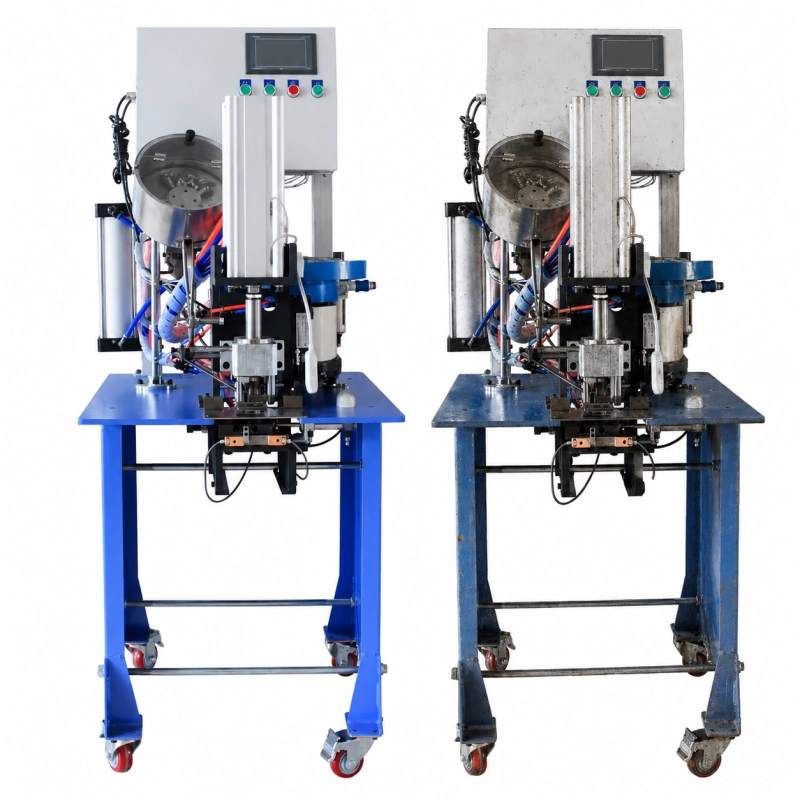
A fresh coat of paint is not condition evidence. Neither is a 30-second video of an eyelet press cycling with no material under the die.
When you compare new vs used eyelet machines, the asking price is only the first number. What you are really buying is a certain amount of reliable production: clean holes, secure settings, repeatable placement, safe operation, available tooling, and support when something wears out.
A new machine usually gives you clearer specifications, a known build history, current safety design, warranty coverage, and a supplier who can configure it around your samples. A used eyelet machine for sale may cost less and arrive sooner, but you must prove its condition, identify modifications, test the tooling, and price the repairs between delivery and stable production.
This guide stays on condition and ownership risk. It does not repeat the differences between manual, pneumatic, semi-automatic, and automatic models. If you have not chosen the category, start with our manual vs pneumatic vs automatic eyelet machine guide. Then use the 12 checks below to choose new or used.
Quick Answer: Should You Buy a New or Used Eyelet Machine?
Buy new when unplanned downtime would stop an important line, your material or fastener needs a custom setup, your destination requires clear safety and conformity documents, or you need training, warranty, and long-term parts support from one accountable supplier.
Consider used when your application is stable, the exact machine can be inspected, replacement parts and dies are still available, and the seller will run your real materials, eyelets, and washers for a meaningful test. The final ready-to-run cost must still leave a worthwhile saving after inspection, repairs, tooling, freight, installation, and a sensible downtime reserve.
Walk away when the nameplate is missing, the history changes during the conversation, the seller refuses a live test, the machine cannot run your fasteners, safety devices have been bypassed, or essential parts are obsolete with no practical substitute.
New vs Used Eyelet Machine at a Glance
| Buying point | New machine | Used machine |
| Purchase price | Higher and easier to define | Lower, but often excludes restoration and missing items |
| Condition | Known build and commissioning history | Must be proved by inspection, records, and testing |
| Application fit | Can be configured around your samples | Limited by the existing frame, controls, feeders, and tooling |
| Delivery | Includes manufacturing and test lead time | May be available immediately, but may need repair before production |
| Safety and documents | Current package should be specified in the order | May be incomplete, outdated, altered, or missing |
| Tooling | New dies and change parts can be supplied for your fasteners | Included tools may be worn, wrong, or impossible to replace |
| Warranty and support | Normally defined by the manufacturer | Varies from dealer warranty to an as-is private sale |
| Downtime risk | Lower at startup when specification and FAT are controlled | Higher until the machine proves itself under real production conditions |
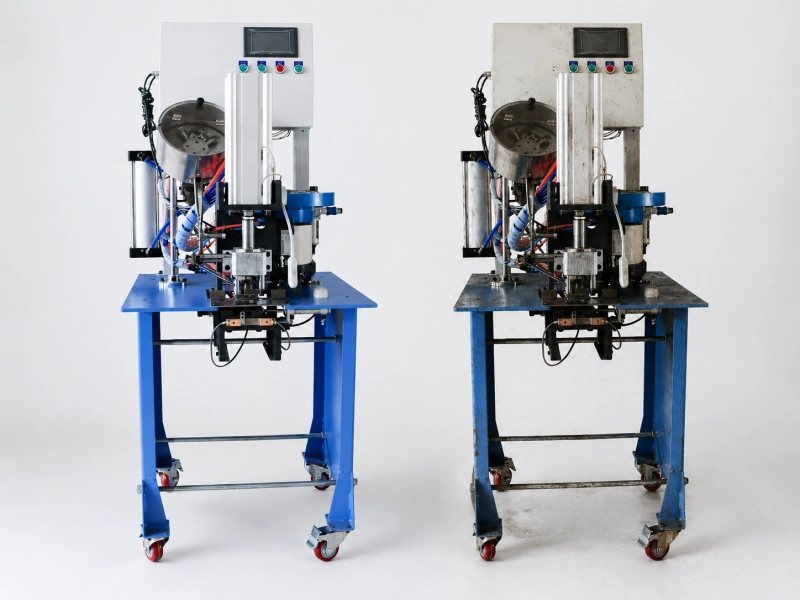
1. Define the Job Before You Look at Condition
A well-maintained machine can still be the wrong purchase. Before you search for an eyelet machine for sale, write down the job it must perform.
Record your materials, thickness range, layer stack, eyelet and washer dimensions, hole size, throat reach, product clearance, placement tolerance, daily demand, utilities, and floor space. Separate non-negotiable requirements from conveniences.
This matters even more with used equipment. A seller may describe a machine as “suitable for fabric” or “standard grommet press,” but those labels do not prove that your work will fit under the head or that the installed dies match your fastener. Stimpson’s machinery overview shows how machines serving similar fastening jobs can have different size limits, tooling arrangements, and feeding methods. You need the exact model and setup, not a familiar-looking category.
If throat reach could be a constraint, measure from the product edge to the eyelet center and check the surrounding clearance. Our guide to eyelet machine throat depth covers that measurement in more detail.
Checkpoint: Do not compare prices until both candidates can perform the same defined job.
2. Verify Identity, Age, Ownership, and Modification History
Start with the nameplate. Record the manufacturer, exact model, serial number, manufacturing date, voltage, frequency, phase, rated power, and air requirement where applicable. Match those details to the quotation, invoice, manuals, service records, and photos.
For a used eyelet press, ask who owns it and whether any finance claim, lien, or other restriction could affect the sale. Requirements differ by country, so use local legal and import checks before payment. Ask how many owners it has had, where it ran, why it was removed, and how long it has been idle.
Then ask what has changed since the machine left the factory. A replacement motor, homemade guard, rewired control cabinet, non-original cylinder, modified die holder, or added feeder can affect safety, performance, parts selection, and documentation. Modifications are not an automatic rejection. Undocumented modifications are the problem.
With a new machine, make sure the quotation and final order name the exact configuration, component brands, utilities, tooling, accessories, and documents. “Equivalent component” should not permit an unapproved substitution.
Checkpoint: If you cannot establish exactly what the machine is, you cannot reliably value, maintain, or insure it.
3. Read the Service History Against the Physical Wear
A claimed low cycle count means little on its own. Some eyelet machines have counters or controller runtime data; others do not. Counters can also be replaced or reset. Read the paperwork and the metal together.
Ask for preventive-maintenance logs, lubrication records, repair invoices, replaced-parts lists, inspection reports, and notes on recurring faults. Find out which material and fastener combinations the machine ran. Abrasive coated fabric, heavy tarpaulin, hard fasteners, continuous high-force work, and poor housekeeping can age a machine differently from light, occasional use.
Now compare that story with what you see. Look for polished or elongated holes, worn pins, side play at the ram, loose guides, scored die holders, oil mist, damaged threads, repeated weld repairs, fresh paint over one small area, heat discoloration, dirt packed around lubrication points, and makeshift wiring. Normal cosmetic wear is not the same as structural or precision wear.
For a new machine, ask for the manufacturing inspection record, pre-shipment test evidence, and the component list rather than assuming “new” means “verified.” Assembly errors and configuration mistakes are still possible. New condition reduces uncertainty; it does not replace acceptance testing.
Checkpoint: The records, observed wear, and seller’s explanation should tell the same story.
4. Inspect the Frame, Ram, Guides, Drive, and Work Support
The setting result depends on the upper and lower tools meeting squarely and repeatedly. Wear in the force path can turn a cheap purchase into a permanent scrap problem.
With the machine isolated and a qualified technician present, check the frame for cracks, distortion, non-factory welds, and corrosion. Check the ram and guides for side play, scoring, binding, or uneven movement. Inspect die seats and threads. Confirm the worktable and guides are flat and secure.
Then evaluate the drive components fitted to that model. Mechanical systems may need checks for bearings, linkages, clutch or brake behavior, belts, gears, and abnormal backlash. Pneumatic systems may need checks for cylinder seals, valves, regulators, hoses, fittings, pressure stability, and air leakage. Electric or servo-driven systems may require drive diagnostics, encoder checks, and control backups. This is a condition inspection, not a reason to favor one drive type over another.
Run the machine from cold and again after it has reached a normal working temperature. Listen for knocks, grinding, air leaks, chatter, or a change in cycle sound. Feel for abnormal vibration from a safe location. A fault that appears only when warm is still your fault after purchase.
Checkpoint: Cosmetic condition never compensates for looseness or misalignment in the force path.
5. Treat Dies, Feed Parts, and Accessories as Part of the Machine
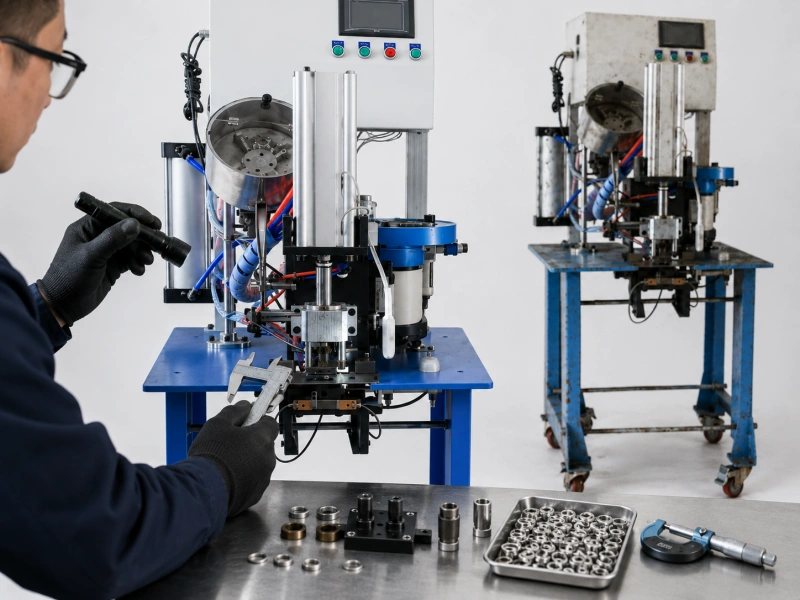
The press frame is only half the purchase. Your results depend on the punch, dies, anvils, holders, guides, tracks, escapements, sensors, and change parts that connect it to your exact eyelet and washer.
List everything shown in the advertisement and lay it out during inspection. Record part numbers where available. Check working surfaces under good light for rounding, chipping, scoring, mushrooming, cracks, and poor regrinding. Confirm that upper and lower tools are a matched set and that they align in the machine.
Do not assume a box of dies has value because it is heavy. If none of them fit your fasteners, you are buying scrap steel. Ask the original manufacturer or a competent toolmaker whether new tooling can still be made for the model. Send dimensioned drawings or physical samples before relying on a verbal answer.
If the machine includes feed equipment, test it with production-grade eyelets and washers from your normal supplier. Small variations in flange diameter, barrel length, finish, or washer profile can expose worn or overly narrow feed settings.
A new machine gives you the chance to specify fresh tooling around your samples. A used machine earns value only when the usable tooling is identified and replacement tooling remains practical.
Checkpoint: Price the missing or worn tooling before you negotiate the machine price, not after delivery.
6. Check Utilities, Controls, and Electrical or Pneumatic Integrity
A machine that runs in the seller’s workshop may not be ready for yours. Compare the nameplate and actual components with your site’s voltage, frequency, phase, plug or disconnect method, compressed-air pressure, air quality, and available floor services.
Open control cabinets only under safe procedures with a qualified person. Look for labeled wiring, secure terminals, proper grounding or earthing, suitable protection, and components that match the drawings. Red flags include loose wires, taped joints, bypassed relays, scorched insulation, and undocumented repairs.
On pneumatic equipment, check the filter-regulator-lubricator arrangement where fitted, pressure gauge, drains, hose condition, fittings, valve response, and leakage. Watch whether pressure falls during repeated cycles. A machine that completes one cycle but becomes inconsistent under sustained use has not passed.
For programmable controls, ask for the program backup, parameter record, maintenance passwords, controller model, and recovery method. An obsolete controller with no backup can make a small fault economically fatal.
With new equipment, put the destination utilities and preferred component standards in the purchase specification. With used equipment, cost any transformer, converter, new control panel, air treatment, or rewiring as part of the purchase.
Checkpoint: “Powers on” is not the same as compatible, serviceable, or production-ready.
7. Audit Safety and Destination-Market Compliance
Eyelet machines concentrate force at a small point. You must take the point of operation, moving drive parts, unexpected cycling, stored pneumatic energy, and maintenance access seriously.
Check the guards, interlocks, emergency stop, start controls, foot pedal protection, two-hand control or sensing devices where fitted, isolation points, anti-restart behavior, labels, and operator instructions. Test safety functions under an agreed safe procedure; do not accept a guard that is present but bypassed.
Do not assume an old CE plate, a generic certificate, or a sticker added by a reseller proves that the machine is acceptable in your destination. Rules depend on the country, machine configuration, date of manufacture, and any substantial modification. For US workplaces, OSHA states that machine guarding must protect employees from point-of-operation and other machine hazards. UK HSE guidance also makes clear that second-hand work equipment must be supplied with necessary safeguards and adequate use information. Treat those as starting points and confirm your local obligations with a competent safety professional.
A new machine should arrive with the safety package and documents named in the contract. A used machine may require a risk assessment, new guards, control upgrades, instructions, and validation before it can be released to production. Put those costs and the lost time in your comparison.
For a closer look at common functions, use our eyelet machine safety features guide.
Checkpoint: If the used machine only reaches your budget by leaving safety work unfinished, it is not within budget.
8. Run Your Real Materials, Eyelets, and Washers
A no-load cycle proves movement. It does not prove production.
Test the thinnest and thickest materials in your range, complete layer stacks, real coatings or reinforcement, and traceable production fasteners. Include the difficult combination. If your product is large or shaped, confirm that it clears the frame, head, guards, and table.
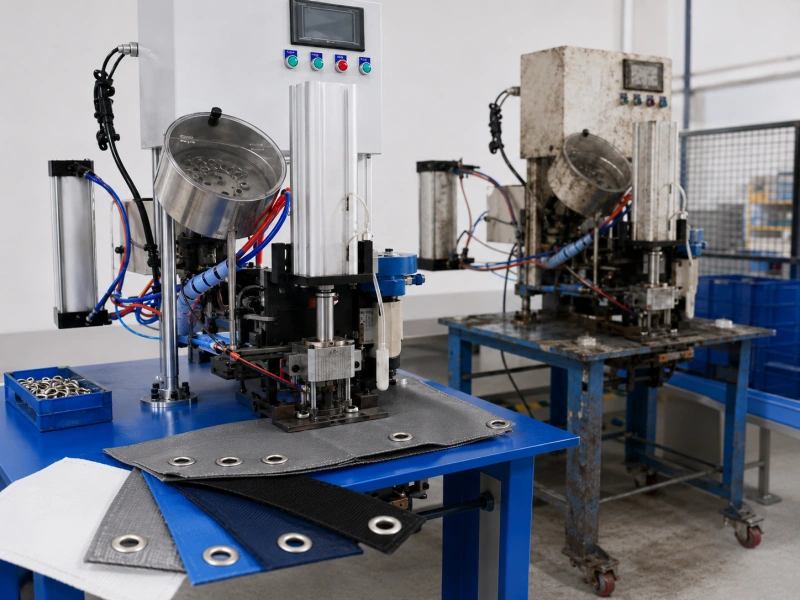
Begin with setup and a short quality check. Then run enough consecutive cycles to expose warm-machine behavior, leaks, looseness, intermittent controls, and feed instability. Record the agreed speed, number of cycles, stops, misfeeds, rejected settings, operator interventions, and reason for every interruption. A seller who repeatedly reaches into the feed path or hand-corrects components is showing you the machine’s real process.
If you are arranging a remote purchase, require a live, continuous video call or an independent inspection. Start with the nameplate and cold machine, show the full machine and control cabinet, identify the test materials, and keep the camera running through the trial. Edited clips are useful for marketing, not acceptance.
Our guide on samples for an eyelet machine trial explains how to prepare representative test material without turning the trial into guesswork.
Checkpoint: If the machine has not run your real stack and fastener, application fit remains unproven.
9. Measure Finished Quality and Repeatability
Do not judge the machine by the best piece on the table. Inspect a sequence of pieces from the start, middle, and end of the run.
Check whether the hole is clean, the flange sits flat, the barrel forms evenly, the washer is secure, and the setting is centered. Look for spinning eyelets, tilted settings, split barrels, sharp edges, incomplete flare, cracked finishes, wrinkled fabric, crushed layers, loose washers, and marks from dirty or damaged tooling. If the product has a strength requirement, agree on a pull-out, torque, or functional test that matches its real use.
Use written pass/fail criteria. “Looks good” creates an argument later. Define the sample combination, inspection method, number of consecutive acceptable settings, dimensional or placement tolerance, allowed defect level, and test evidence. Keep approved samples and label the exact die set and settings used.
This protects both options. A new machine should prove the purchased configuration before shipment. A used machine should prove its present condition before final payment. If you are buying new, use our separate eyelet machine acceptance test checklist for the full factory acceptance process rather than trying to squeeze that procedure into this comparison.
Checkpoint: Stable average output matters more than one perfect sample.
10. Compare Ready-to-Run Cost, Not the Asking Price
Build the same cost sheet for both machines. Use the price that gets each option safely producing acceptable parts in your factory.
Ready-to-run cost = purchase price + inspection + repairs + tooling + safety and control work + freight and insurance + duties and taxes + unloading + installation + commissioning + training + initial spare parts + expected startup downtime
For a used machine, add confirmed work such as bearings, seals, hoses, sensors, wiring, guards, dies, cleaning, rust treatment, controller replacement, software recovery, and missing manuals. Add a contingency for defects that a non-invasive inspection cannot reveal. For a new machine, include sample shipping, customization, factory testing, production lead time, and any site work or accessories excluded from the quotation.
Then compare maintenance labor, planned parts, utilities, scrap, outside service, downtime exposure, and likely resale value over your ownership period. Use best-case, expected, and worst-case scenarios so fragile assumptions stay visible.
The used option should not merely remain cheaper. It should remain cheaper by enough to compensate you for its higher uncertainty and the staff time needed to manage it.
Checkpoint: A bargain disappears when the repair, tooling, and downtime columns are filled in honestly.
11. Confirm Parts, Manuals, Support, Warranty, and Resale
Before you buy, try to source the parts you are most likely to need. Ask for the parts manual and identify bearings, seals, springs, valves, sensors, belts, motors, cylinders, controllers, relays, and proprietary feed components. Separate standard industrial parts from items that only the original manufacturer can supply.
Contact the manufacturer or a qualified service provider with the serial number. Ask whether the model is still supported, which parts are discontinued, whether replacements require modification, whether dies can still be made, and whether remote or on-site service is available in your region. An old machine built from robust metal can still be a poor asset when one proprietary feed track or control board has no replacement.
Read the warranty instead of relying on the word “warranty.” A new-machine warranty may exclude wear tools, freight, travel, incorrect utilities, or damage caused by your fasteners. A dealer-sold used machine may have limited coverage. A private or auction sale may be strictly as-is. Put duration, covered items, response process, labor, parts, shipping, and remedy in writing.
Support also affects resale. A recognized model with documents, available tools, and service history is easier to value and sell than an orphaned machine with mystery modifications.
Checkpoint: If one unavailable part can stop the machine indefinitely, price it as a high-risk asset.
12. Put the Evidence, Inclusions, and Release Terms in Writing
The last check is commercial, but it prevents technical disagreements.
Attach the model, serial number, photos, configuration, tooling, accessories, manuals, software backups, test results, known defects, agreed repairs, packing, delivery terms, and warranty to the purchase agreement. Define whether the machine is new, used, refurbished, or sold as-is.
For a used purchase, decide what triggers each payment. You may link a deposit to reservation, another payment to successful inspection, and final release to documents and packing evidence. Take local legal and trade advice where needed.
Record every accepted deviation. If a guard will be replaced after delivery, a die will arrive separately, or a controller backup is unavailable, name the owner, cost, deadline, and consequence. Silence turns known gaps into your problem.
For new equipment, the same discipline should connect the purchase order to the factory acceptance test and shipment release. For used equipment, it is your best defense against photographs, verbal promises, and test conditions that disappear after the machine is loaded.
Checkpoint: If a promise changes the value of the deal, it belongs in the signed documents.
When a New Eyelet Machine Is the Safer Buy?
You should lean toward new equipment when:
- The machine will be a bottleneck and you cannot carry a backup.
- Your material, fastener, placement, or product geometry needs custom engineering.
- You need a clear current safety package and destination documents.
- You want the supplier to prove the configuration with your samples before shipment.
- Your maintenance team has limited time to reverse-engineer an older machine.
- You expect to benefit from warranty, training, documentation, and supported parts.
- The ready-to-run saving on the used option becomes small after remediation.
New equipment still needs a precise specification and acceptance test. “New” removes wear history; it does not remove selection, configuration, or supplier risk. If you are comparing vendors, use our guide on how to compare eyelet machine manufacturers as a separate supplier check.
When a Used Eyelet Machine Can Make Sense?
A second-hand eyelet machine can be a sensible purchase when:
- You need a proven, standard application rather than a custom process.
- The exact model has a good parts and tooling ecosystem.
- You can inspect it in person or hire an independent technician.
- The seller provides identity, history, continuous test access, and honest defect disclosure.
- Your maintenance team can handle expected repairs without disrupting other work.
- You need the machine quickly and the repair plan is shorter than a new build lead time.
- The ready-to-run cost retains a meaningful margin under a conservative scenario.
- The machine will be backup, seasonal capacity, or a controlled pilot.
The word “used” is not the risk by itself. Unmeasured condition is the risk.
Used Eyelet Machine Red Flags
Pause or walk away if you see any of these:
- Missing, altered, unreadable, or mismatched nameplate and serial information.
- A seller who will not show the machine cold, under load, or with your material.
- Fresh paint around cracks, welds, oil paths, or high-wear areas with no explanation.
- Side play at the ram, damaged die seats, abnormal noise, or changing cycle behavior as the machine warms.
- Bypassed guards, tied-down switches, improvised pedals, exposed transmission parts, or uncontrolled restart.
- Scorched, loose, unlabeled, or heavily patched wiring.
- No program backup for an obsolete controller.
- Dies and feed parts that cannot be identified or replaced.
- A vague “refurbished” claim with no work list, parts list, or test report.
- Pressure to pay in full before identification, inspection, and test evidence are complete.
One red flag may be repairable. Several unrelated red flags usually point to the same underlying issue: you are being asked to price uncertainty as if it were condition.
Questions to Send Any Seller Before You Travel or Pay
- What are the model, serial number, year, utilities, and current location?
- Who owns the machine, and why is it being sold?
- What materials, eyelets, washers, and daily volumes did it run?
- What repairs, modifications, control changes, or safety upgrades have been made?
- Which dies, feed parts, accessories, spares, manuals, and software backups are included?
- Which faults are known today, including intermittent faults?
- Can the machine be inspected cold and run continuously with our production samples?
- What written pass/fail criteria will apply to the trial?
- Which parts are still supported, and who will provide service after the sale?
- What warranty, return right, repair commitment, packing standard, and payment milestones will be written into the agreement?
Clear answers save time. Vague answers predict the inspection.
Final Decision: Buy Evidence, Not Condition Labels
You do not need to avoid every used eyelet machine. You need to avoid buying a condition story that has not been tested.
Define the job, verify identity, inspect the force path, audit the tooling and controls, test safety, run your real materials, measure consecutive finished pieces, and calculate the full ready-to-run cost. Then look at parts, support, warranty, and the written release terms.
If the used machine passes those checks and still leaves a strong financial margin, it may be the right purchase. If the saving disappears, the history is incomplete, or one obsolete component could strand the machine, new equipment is usually the cheaper production decision even when its invoice is higher.
If you want a new eyelet machine configured around your materials and fasteners, send QC Machinery your sample details, required placement, utilities, and target output. You can then compare the proposed new-machine package against any used listing on the same 12 points – with the same evidence standard for both.
FAQ
Are used eyelet machines worth buying?
They can be. A used machine is worth buying when it fits your exact application, passes a sustained test with your materials and fasteners, has available parts and tooling, and remains meaningfully cheaper after all repairs and startup costs. A low asking price without that evidence is not enough.
What should you inspect first on a used eyelet machine?
Check the nameplate and ownership first. If you cannot confirm the model, serial number, seller’s right to sell, and basic history, stop before spending time on mechanical tests. Once identity is clear, inspect the ram, guides, die seats, frame, controls, safety devices, and tooling.
How much cheaper should a used eyelet machine be than a new one?
There is no reliable universal percentage. Age, brand, configuration, condition, tooling, support, local availability, and freight can change the value sharply. Compare ready-to-run cost and require enough remaining saving to cover the extra uncertainty and expected downtime risk.