
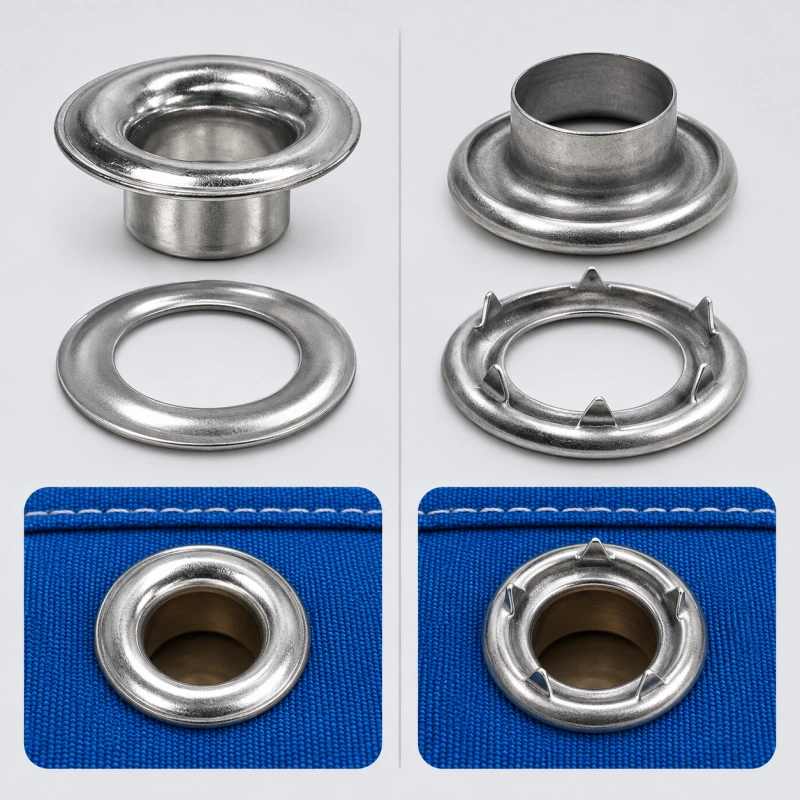
A plain sheet metal grommet and plain washer clamp the material between the front flange and the formed barrel at the back. A rolled rim grommet and matching spur washer add teeth that pass through the material and lodge in the rim. That difference affects grip, die design, and washer feeding. Choose the complete grommet-and-washer pair before specifying an automatic-setting machine.
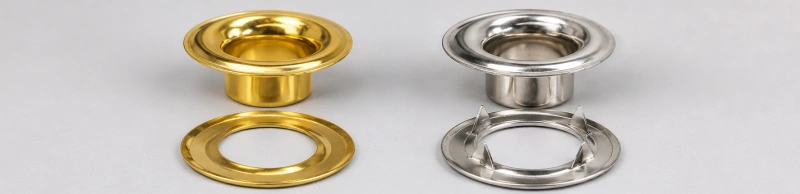
Plain vs Spur Grommets: Key Differences
| Decision point | Plain grommet + plain washer | Rolled rim grommet + spur washer |
| Grommet design | Sheet metal flange and formable barrel | Rolled rim that receives the washer spurs |
| Washer design | Generally smooth backing profile | Projecting spurs with a matched profile |
| Holding mechanism | Barrel capture and clamping of the material | Spurs pass through material and lock into the rim |
| Rotation resistance | Depends on clamp and substrate; assess on the assembly | Spurs can resist turning when correctly engaged; verify in the substrate |
| Material compatibility | Choose barrel length and washer for the finished stack | Check spur engagement and grip on the finished stack |
| Typical applications | Bags, banners, curtains, and other qualified assemblies | Tarp, tent, and awning tie points with suitable reinforcement |
| Setting dies | Dies matched to the grommet and plain washer | Dies matched to the rolled rim and spur washer |
| Automatic feeding | Check whether the feeder accepts the selected washer | Check separation, orientation, clearance, and centering |
Use a plain washer where its grip meets the product’s load requirements. For repeated pulling or movement, trial a rolled rim grommet with a spur washer on the finished material. Compare the sets under the same test conditions.
How Plain and Spur Grommets Work
Plain Grommets with Plain Washers
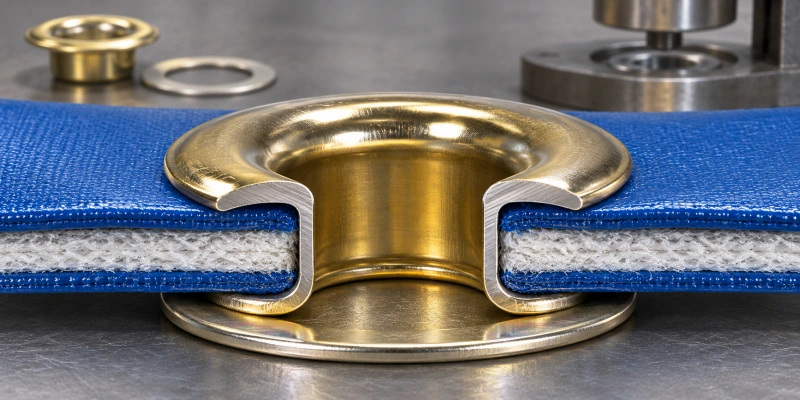
The barrel passes through a prepared hole. The setting die flares the barrel over the washer at the back, clamping the material between the washer and front flange. The back should form evenly: an incomplete flare may leave the washer loose, while excessive pressure can crease the material or crack a coating.
If the hole is too close to an edge or the reinforcement is too small, the material may tear even while the metal stays in place. Compare washer shapes in our eyelet washer selection guide.
Rolled Rim Grommets with Spur Washers
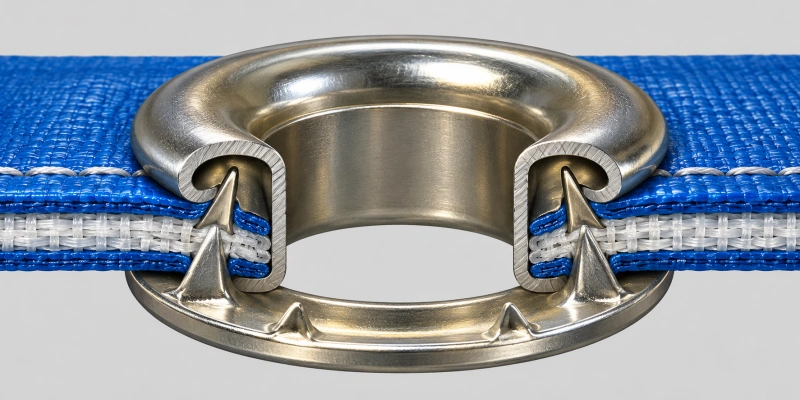
These two parts form a matched assembly. During setting, the washer spurs pass through the material and lodge inside the rolled rim. The teeth grip the material and help prevent the grommet from turning. The setting still needs a suitable hole, enough material around it, and a barrel length matched to the compressed stack.
Spur Washers vs Teeth Washers
A tooth washer (also called a teeth washer) belongs to a different pairing: a sheet metal grommet with a toothed washer. A spur washer pairs with a rolled rim grommet, and its teeth lock into the rim. Both have teeth, but they require the correct matching grommet and setting die. If a drawing says only “grommet with teeth,” request the part numbers or samples.
When to Choose Plain or Spur Grommets
Material and Reinforcement Requirements
Compare hardware on the finished stack. A single layer of coated polyester, a welded PVC hem, a folded canvas edge, and a webbing tab compress differently and carry loads differently. Measure thickness at the setting point, including reinforcement, then choose the barrel length and washer for that stack. A spur washer must pass through the material and lock into its matching rolled rim.
Inspect the set for puncture damage, crushed layers, and coating cracks. If the edge or reinforcement tears in a pull test, revise the construction rather than increasing washer diameter alone.
Load Conditions and Industrial Applications
Where tests show sufficient grip, a plain assembly may be the right choice. For tarp tie points, tent hems, awnings, and marine covers exposed to repeated pulling, trial the rolled rim and spur pair on reinforced samples. Edge distance, seam design, and pull direction can change the result. See our guide to eyelet machines for outdoor covers for panel layout and handling.
Use the same pull direction and inspection criteria when comparing the two candidates. Record whether the fastener loosens, rotates, or pulls through the material.
Installation and Tooling Requirements
Integrated Punching vs Separate Pre-Punching
Both conventional assemblies need a hole for the barrel. You can punch it in a separate step or use a machine configured to punch and then set the grommet. In either case, check the hole against the actual hardware and material. A self-piercing grommet is a separate fastener design that cuts the hole as it is set.
Punch separately if the setting machine has no punch, or if an integrated punch leaves trapped fibers or damages the coating. Trial the thickest seam or hem rather than a single flat layer. See our guide to pre-punching requirements.
Dedicated Setting Dies for Plain and Spur Grommets
The die supports the front flange and forms the barrel over the intended washer. For a rolled rim and spur pair, it must also allow the teeth to enter the rim without crushing the material. Specify the punch, upper and lower dies, and washer support for the actual components.
A shared size number does not establish die compatibility. Check the barrel, flange, hole, and washer dimensions against the compressed stack. Our articles on grommet setting die selection and grommet and die compatibility explain the measurements.
Can the Same Automatic Eyelet Machine Install Both Types?
Machine and Tooling Compatibility
Some automatic machines can run both assemblies after a qualified changeover. The machine must have enough capacity and space for each pair, with suitable punches, dies, and feeding parts. A die swap alone may leave the spur washer catching or arriving off center. Confirm the changeover on your machine with production samples.
Record the grommet and washer dimensions, barrel length, compressed material thickness, and required placement tolerance. Use these to check the punch, tooling interface, and washer path before ordering parts.
Washer Feeding System Changeover
Check washer handling separately during changeover. Spurs can catch on neighboring washers or track covers. Follow one washer from the bowl to the lower die: it must separate, travel in the right orientation, and reach the barrel on center every cycle.
Vibratory Washer Feeder
If the machine uses a vibratory bowl, check whether it separates overlapping washers and rejects inverted ones. Adjust the outlet gate or wiper for the spur shape as needed, then run production washers through the bowl and look for hooks and double stacks.
Washer Feeding Track
The track needs enough clearance for the spur tips without giving the washer room to flip. Inspect bends, covers, and the exit for scraping. If the existing track cannot guide the washer consistently, use a track made for that profile.
Washer Escapement
The escapement should release one washer while holding the next. Check for double delivery, missed release, and spurs catching on the gate during a continuous run. A few hand-fed strokes will not reveal every feed fault.
Lower Die Holder and Positioning
At the setting station, seat the washer with its spurs facing the material and center it under the barrel. Check the track exit, lower die support, and clearance around the teeth. A tilted washer can leave an uneven set or damage the material.
QC16002 Automatic Eyelet Punching Machine
The QC16002 Automatic Eyelet Punching Machine has integrated punching, customized dies, and automatic feeding for eyelets and washers. For rolled rim grommets with spur washers, send the actual fastener pair and material stack so QC Machinery can check the required tooling and feeding setup in a sample trial.
How to Validate Spur Grommet Installation Before Mass Production
Use production hardware and representative material in the trial, including the thickest reinforced section. Agree on acceptance criteria, then inspect individual settings and a continuous feed run.
| Check | Acceptance evidence to record |
| Feeding consistency and single-part delivery | Cycle log for missed, doubled, or jammed washers over an agreed trial quantity |
| Washer orientation and centering | Correct face and centered seat on each inspected sample |
| Forming uniformity and engagement | Even back roll; teeth through the material and lodged in the rim |
| Fabric damage | No unacceptable cut fibers, coating cracks, delamination, or crushed hem |
| Rotation resistance | Result under the product’s approved rotation check, if required |
| Retention in the intended load direction | Test method, load path, observed failure mode, and application-specific limit |
Appearance shows whether the parts formed and seated properly; a pull test shows how the finished joint behaves under load. Where retention matters, use the method in our pull-out strength testing guide and record the load direction and failure mode.
Frequently Asked Questions
Are Rolled Rim Grommets and Spur Grommets the Same?
“Spur grommet” usually means a rolled rim grommet paired with a spur washer. “Rolled rim” names the grommet; “spur” names the matching washer.
Are Spur Grommets Always Stronger Than Plain Grommets?
Spurs can improve grip and limit rotation, but the finished joint may still fail at the fabric or reinforcement. Compare both assemblies in the intended material and pull direction.
Can Teeth Washers Replace Spur Washers?
No. A tooth washer is generally paired with a sheet metal grommet; a spur washer is paired with a rolled rim grommet. Use the washer specified for the chosen system.
Choosing the Right Grommet Installation Solution
Choose the fastener pair on the finished material, then specify its punch, dies, feeder, and inspection method. To discuss an automatic eyelet machine solution, send QC Machinery both hardware samples, the material stack and thickness, required hole and edge positions, and your production target. We can use a sample trial to define the machine configuration.